
What Is the Charging Time Calculator?
This tool estimates how long it will take to charge a rechargeable battery. It uses three inputs: the battery's capacity in milliamp-hours (mAh), the charger's output current in milliamps (mA), and the charging efficiency as a percentage. Because no charger is perfectly efficient, the calculator accounts for energy lost as heat so your estimate is more realistic.
How to Use It
Enter your battery capacity (printed on the battery or in the device spec), the charger's rated output current, and an efficiency value. Most real-world chargers run at roughly 80–90% efficiency, so 85% is a sensible default. Use 100% only for a theoretical best case. The result shows the time in decimal hours plus a friendly hours-and-minutes breakdown.
The Formula Explained
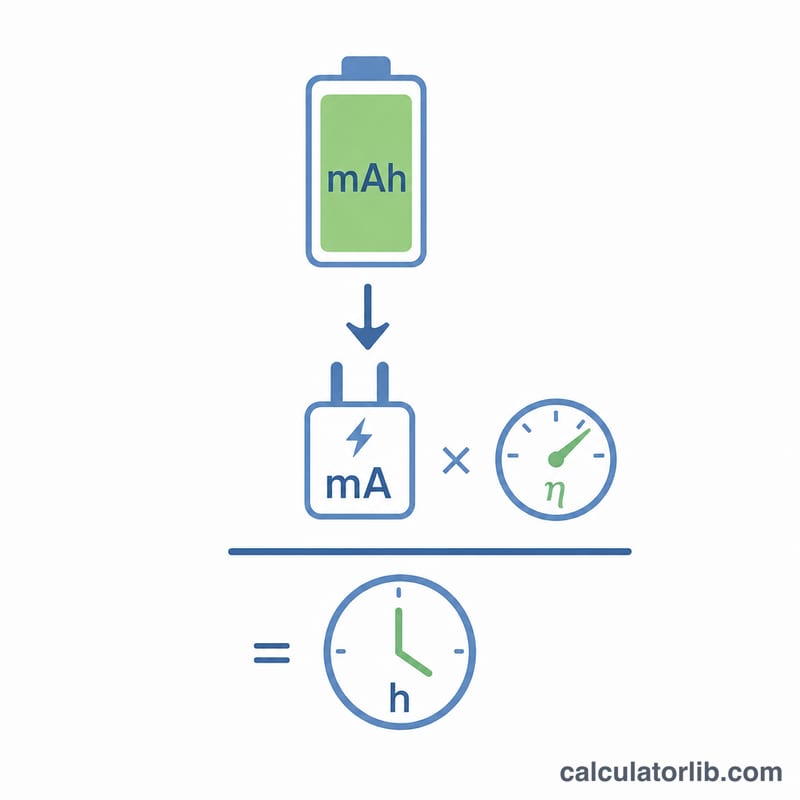
The base relationship is time = capacity ÷ current. To include losses, the charger current is multiplied by efficiency to get the effective current actually delivered to the cell:
$$\text{Hours} = \frac{\text{Capacity (mAh)}}{\text{Charger (mA)} \times \text{Efficiency}}$$
Lower efficiency means less effective current, which lengthens charging time.
Worked Example
Suppose you have a 4000 mAh battery, a 2000 mA charger, and 85% efficiency. Effective current = \(2000 \times 0.85 = 1700\) mA. Charging time = \(4000 \div 1700 \approx 2.35\) hours, or about 2 h 21 min.
FAQ
Why is my real charge time different? Chargers taper current near full charge (constant-voltage phase), temperature varies, and the battery may not start at 0%. This is an estimate of the bulk charge phase.
What efficiency should I use? 80–90% is typical for phone and power-bank charging. If unsure, use 85%.
Can I use it for power banks or EVs? Yes, as long as you keep the units consistent (mAh and mA). For larger packs you can convert Ah to mAh by multiplying by 1000.