
What is the Typing Speed (WPM) Calculator?
This tool measures how fast you type in words per minute (WPM), the universal benchmark used in typing tests, transcription jobs, and data-entry assessments. Because real words vary in length, typing tests define a "word" as exactly five characters (including spaces and punctuation). The calculator gives you both your gross speed and your net (error-adjusted) speed, plus an accuracy percentage.
How to use it
Enter the total number of characters you typed, the time you spent in minutes (decimals are fine, e.g. 1.5 for 90 seconds), and the number of uncorrected errors remaining in your text. Click calculate to see your gross WPM, net WPM, and accuracy. If you have no errors, gross and net WPM will be the same.
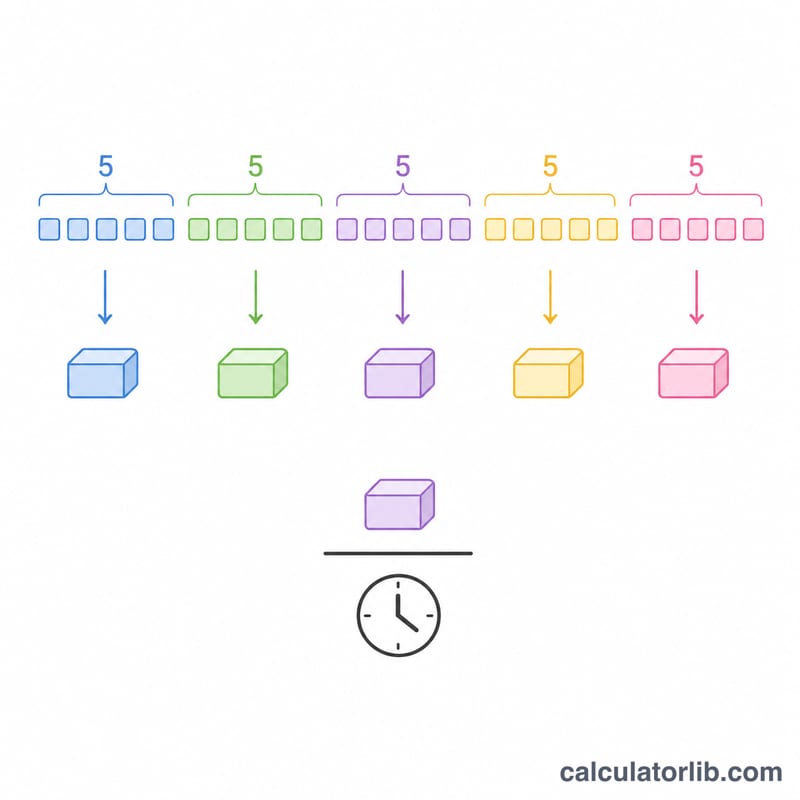
The formula explained
Gross WPM divides your character count by 5 to convert to standardized words, then divides by elapsed minutes. Net WPM penalizes each uncorrected mistake by subtracting your error rate (errors ÷ minutes) — this rewards both speed and accuracy. Accuracy is the share of standardized words typed correctly: (words − errors) ÷ words × 100.
$$\text{Gross WPM} = \frac{\text{Characters}/5}{\text{Minutes}}$$$$\text{Net WPM} = \frac{\text{Characters}/5}{\text{Minutes}} - \frac{\text{Errors}}{\text{Minutes}}$$$$\text{Accuracy} = \frac{\left(\text{Characters}/5\right) - \text{Errors}}{\text{Characters}/5} \times 100$$Worked example
Suppose you type 300 characters in 2 minutes with 4 errors. Words = \(300 \div 5 = 60\). Gross WPM = \(60 \div 2 = \mathbf{30}\). Error rate = \(4 \div 2 = 2\), so Net WPM = \(30 - 2 = \mathbf{28}\). Accuracy = \((60 - 4) \div 60 \times 100 \approx \mathbf{93.33\%}\).
Interpreting Your Gross WPM, Net WPM and Accuracy
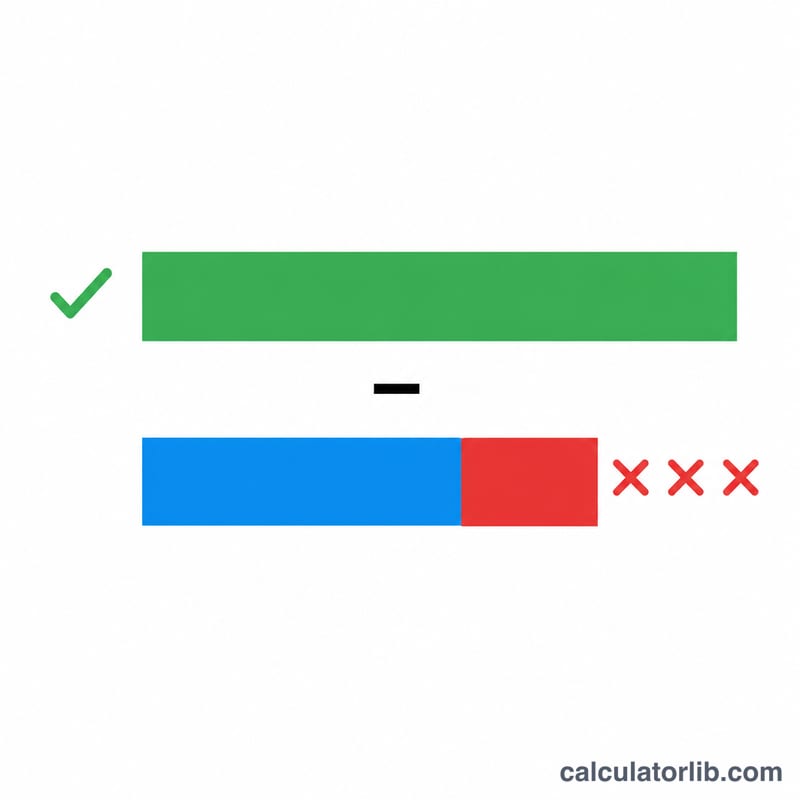
The calculator reports three numbers from the same three inputs. Gross WPM is raw output: characters divided by 5 (the standard convention in which any 5 keystrokes, including spaces and punctuation, count as one "word"), divided by elapsed minutes. Net WPM subtracts an error penalty of one word per uncorrected error, spread over the duration of the test. Accuracy expresses how much of what you produced was correct rather than how fast you produced it.
Net WPM is the figure that employment typing tests, civil-service and clerical screening tests, and transcription-industry benchmarks normally quote. When a job posting asks for "45 WPM," it is almost always a net figure, because an employer is paying for usable text, not keystrokes. Gross WPM on its own describes mechanical finger speed only.
What the gap between gross and net tells you
If gross and net are within a word or two of each other, errors are not materially affecting your measured output. A gap of more than a few WPM means uncorrected errors are consuming a visible share of productivity — the text you produced would need correction before it could be used, and the net figure is the honest estimate of your delivered throughput.
The size of the penalty depends on test length, because the error count is divided by minutes:
$$\text{Penalty per error} = \frac{1}{\text{Minutes}}\ \text{WPM}$$
| Test length | Cost of each uncorrected error | Cost of 5 errors |
|---|---|---|
| 1 minute | 1.0 WPM | 5.0 WPM |
| 2 minutes | 0.5 WPM | 2.5 WPM |
| 3 minutes | 0.33 WPM | 1.7 WPM |
| 5 minutes | 0.2 WPM | 1.0 WPM |
| 10 minutes | 0.1 WPM | 0.5 WPM |
This is why the same number of mistakes looks far more damaging on a one-minute test than on a ten-minute one, and why net scores from tests of different lengths are not directly comparable.
A worked reading of one result
Suppose a 5-minute test produced 1,000 characters with 10 uncorrected errors:
$$\text{Gross WPM} = \frac{1000/5}{5} = \frac{200}{5} = 40$$
$$\text{Net WPM} = 40 - \frac{10}{5} = 40 - 2 = 38$$
The result is a gross speed of 40 WPM and a net speed of 38 WPM, with 10 errors against 200 words typed — an accuracy of 95%. The 2-WPM gap is small because the errors were spread over five minutes; the identical 10 errors inside a one-minute burst would remove 10 WPM.
Reading the accuracy figure
Accuracy is the gating number in most data-entry and clerical screening. As a widely used rule of thumb, accuracy below roughly 95% is treated as a failing result regardless of raw speed: a fast typist producing text that needs line-by-line checking creates more downstream work than a slower one producing clean text. Some transcription and medical/legal data-entry employers set the bar higher still (98–99%). The exact threshold is set by the individual employer or testing provider, not by any international standard, so confirm the number that applies to the test you are facing.
Because the penalty is subtractive, net WPM can reach zero or go negative. If errors per minute exceed words typed per minute — for example 50 words typed and 60 errors in one minute, giving \(50 - 60 = -10\) — the net score is negative. Testing platforms differ in whether they display such a result as a negative number or floor it at zero; either way it means the output was not usable text.
Comparability: what has to match before two scores mean the same thing
A WPM figure is only meaningful alongside the conditions that produced it. Two results are comparable only when they share:
- The same word definition. This calculator uses the standard 5-character word. Tests that count actual space-delimited words, or that exclude spaces from the character count, will produce different numbers from identical typing.
- Similar text difficulty. Common-word prose, unfamiliar vocabulary, mixed case, numbers, code and symbol-heavy text all yield different speeds for the same typist. Numeric and alphanumeric data entry is often measured in keystrokes per hour (KPH) instead of WPM for exactly this reason.
- The same error-counting rule. Counting only errors left in the final text is very different from counting every incorrect keystroke made along the way, including ones you backspaced over. A typist who corrects as they go scores well under the first rule and poorly under the second.
- The same test length and timing method. As shown above, length changes the per-error penalty; whether the clock starts on the first keystroke or on page load also shifts short-test results.
For the same reason, a score from this calculator should be compared against your own earlier scores measured the same way, or against a specific test provider's published thresholds — not against a general "average WPM" quoted without its measurement conditions.
FAQ
What is a good typing speed? The average adult types around 40 WPM. 60–80 WPM is considered fast, and professional typists often exceed 90 WPM.
Why divide by five? Using a fixed 5-character "word" makes results comparable regardless of language or word length — it's the standard across typing tests.
Gross vs net WPM — which matters? Net WPM is more meaningful because it accounts for accuracy. A high gross speed with many errors isn't truly productive.