What Is the Reading Speed Calculator?
This tool measures how fast you read by converting the number of words you read and the time it took into a standard words per minute (WPM) figure. WPM is the universal benchmark for reading speed, used by educators, speed-reading programs, and productivity enthusiasts alike. The calculator also reports your words per hour so you can estimate how long longer texts will take.
How to Use It
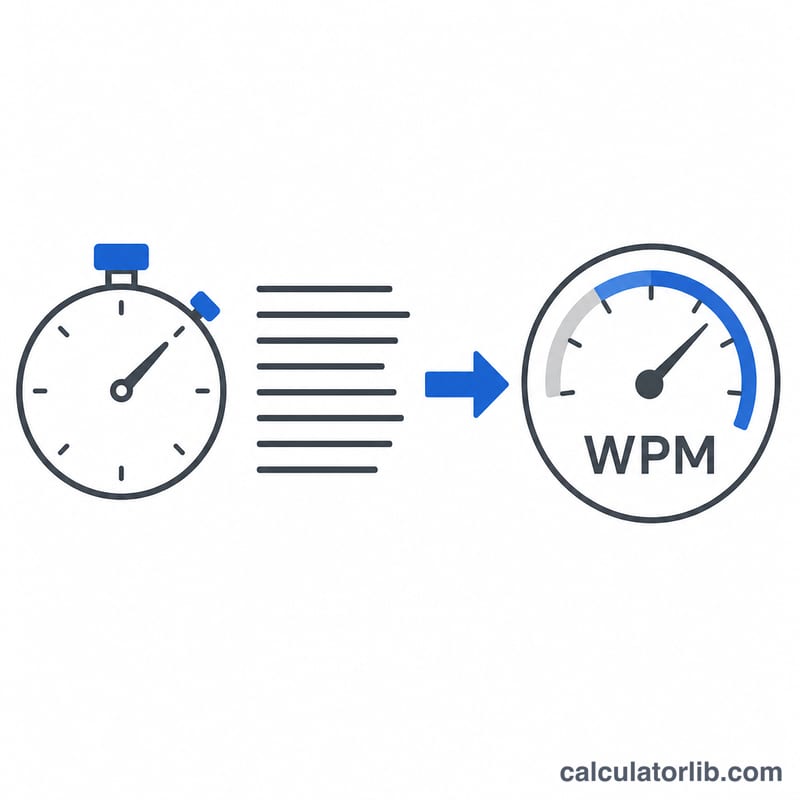
Read a passage and time yourself. Enter the total number of words you read and the number of minutes (decimals allowed, e.g. 2.5) you spent. The calculator divides words by minutes to give your WPM. If you don't know the exact word count, most books average about 250–300 words per page.
The Formula Explained
The math is simple division: $$\text{WPM} = \frac{\text{Words Read}}{\text{Minutes Spent}}$$ For example, if you read 3,000 words in 12 minutes, your speed is \(3000 \div 12 = 250\) WPM. Multiplying by 60 gives 15,000 words per hour. Average adult reading speed is roughly 200–300 WPM, while trained speed readers can exceed 500 WPM with good comprehension.
Worked Example
Suppose you finish a 1,500-word article in 5 minutes. Your reading speed is \(1500 \div 5 = 300\) WPM, or 18,000 words per hour. That means a 90,000-word novel would take about 5 hours of reading at this pace.
Average Reading Speeds by Reader Type and Purpose
Reading speed depends heavily on the reader, the text and the goal. The ranges below are approximate figures for English-language text, drawn from the reading-research literature. They are not fixed standards, and other languages and scripts differ.
| Reader type / purpose | Typical WPM | Comprehension note |
|---|---|---|
| Reading aloud | ~150-160 | Limited by speech rate. Comprehension is usually good, but attention is split between articulating and understanding. |
| Learning / studying | ~100-200 | Slower, deliberate reading aimed at retention (a range often attributed to Ronald Carver's work on reading rates). Aims for high comprehension. |
| Average adult, silent reading | ~200-300 | Brysbaert (2019) meta-analysis: about 238 WPM for non-fiction and about 260 WPM for fiction. Comprehension is typically around 75% on the test materials used. |
| Proficient / college-level readers | ~300-400 | Fluent readers can keep good comprehension on familiar, moderately difficult text. |
| Skimming | ~450-700+ | Used to get the gist or locate information. Detail comprehension is noticeably lower. |
| Speed-reading claims | 500+ (often far higher) | Rayner et al. (2016) reviewed the evidence and found a trade-off between speed and comprehension. Beyond roughly 400-500 WPM, understanding generally drops. |
Sources: Brysbaert, M. (2019), "How many words do we read per minute? A review and meta-analysis of reading rate," Journal of Memory and Language; Rayner, K. et al. (2016), "So much to read, so little time: How do we read, and can speed reading help?" Psychological Science in the Public Interest. Figures are rounded and vary by study.
Time to Finish Common Texts at Different Speeds
Reading time is \(\text{time} = \frac{\text{words}}{\text{WPM}}\). The table assumes a constant speed with no breaks, which real reading rarely has.
| Text (words) | 150 WPM | 250 WPM | 350 WPM | 500 WPM |
|---|---|---|---|---|
| 1,000-word article | 6.7 min | 4 min | 2.9 min | 2 min |
| 5,000-word long read | 33.3 min | 20 min | 14.3 min | 10 min |
| 50,000-word short novel | 5 h 33 min | 3 h 20 min | 2 h 23 min | 1 h 40 min |
| 90,000-word novel | 10 h | 6 h | 4 h 17 min | 3 h |
Example: \(\frac{90{,}000}{250} = 360\) minutes, which is 6 hours. Times are rounded to the nearest minute (or tenth of a minute for short texts).
Interpreting Your WPM Result
To calculate WPM, divide the words read by the minutes spent. For example, 1,200 words read in 5 minutes gives \(\frac{1{,}200}{5} = \) 240 WPM.
What the bands generally indicate
- Below 200 WPM: Typical of careful reading, studying, difficult or technical material, unfamiliar vocabulary, or reading in a second language.
- 200-300 WPM: The range of average adult silent reading for English. The Brysbaert (2019) meta-analysis puts the averages at about 238 (non-fiction) and 260 (fiction).
- 300-450 WPM: Fluent, practiced reading of fairly easy or familiar text. This is common among proficient and college-level readers.
- 450+ WPM: Usually corresponds to skimming or scanning rather than full reading. Detail retention is typically reduced.
What affects the measurement
- Text difficulty: Dense, technical or unfamiliar content slows reading. Light fiction is read faster.
- Purpose: Memorizing, learning, ordinary reading and skimming all produce different rates in the same person.
- Comprehension: A WPM figure says nothing about how much was understood unless it is paired with a comprehension check.
- Format: Screen versus paper, font size, line length and language all shift results.
Speed and comprehension
Research reviews, including Rayner et al. (2016), find a speed-accuracy trade-off. Once reading goes beyond roughly 400-500 WPM, comprehension typically declines. Claims of very high speeds with full understanding are not supported by the evidence.
Note: A single timed sample is only an estimate. Results vary with the passage, your alertness and how words are counted, so an average over several samples is more reliable.
FAQ
What is a good reading speed? Most adults read 200–300 WPM. Above 400 WPM with solid comprehension is considered fast.
Does faster reading hurt comprehension? Pushing too fast can reduce understanding. Aim to balance speed with the ability to recall and use what you read.
How can I count the words I read? Use the document's word count tool, or estimate 250–300 words per typical book page and multiply by pages read.