
What Are Linear Inches?
Linear inches is a single measurement airlines use to describe the overall size of a piece of luggage. Instead of looking at length, width, and height separately, the three dimensions are simply added together. The result tells you whether your bag fits within an airline's allowance — many carriers cap checked bags at 62 linear inches and carry-on bags around 45 linear inches.
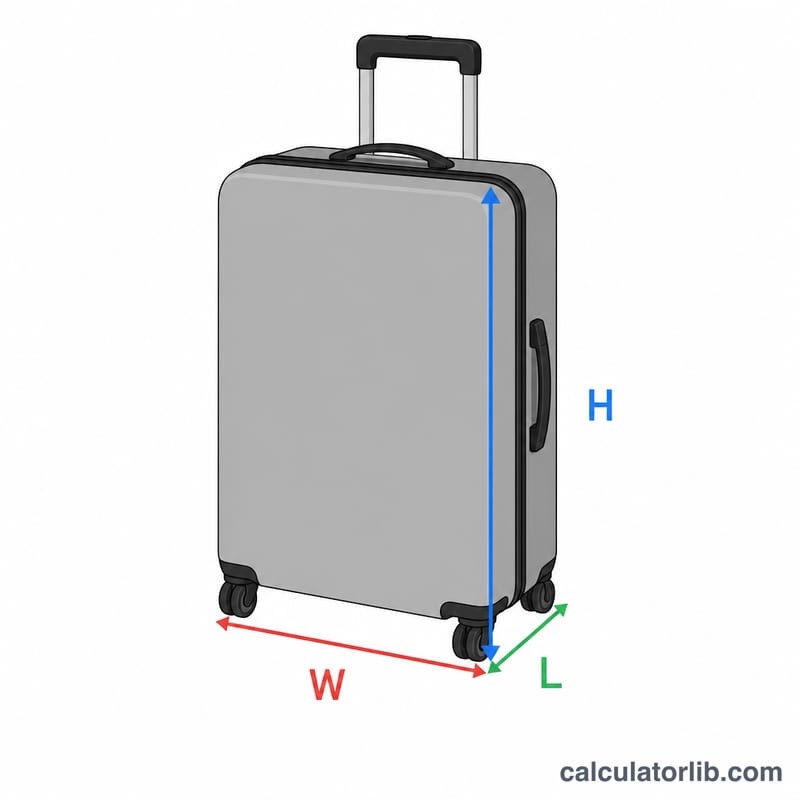
How to Use This Calculator
Measure your bag at its widest points, including wheels, handles, and any external pockets. Enter the length, width, and height in inches and the calculator instantly returns the total linear inches. It also converts the figure to centimeters so you can compare against limits given in metric units.
The Formula Explained
The math is straightforward addition:
$$\text{Linear Inches} = \text{Length} + \text{Width} + \text{Height}$$
Because the dimensions are added (not multiplied), the unit stays in inches — it is not a volume. A bag measuring 28 × 20 × 12 inches has 60 linear inches, comfortably under a 62-inch limit.

Worked Example
Suppose a suitcase measures 22 inches long, 14 inches wide, and 9 inches high. Adding them gives $$22 + 14 + 9 = 45$$ linear inches — a common carry-on limit. In centimeters that is \(45 \times 2.54 = 114.3\) cm.
FAQ
Is linear inches the same as volume? No. Volume multiplies the dimensions; linear inches adds them, so the result is still a linear measurement.
What is a typical checked-bag limit? Many airlines allow up to 62 linear inches for checked baggage, but always confirm with your specific carrier.
Should I include wheels and handles? Yes. Airlines measure the bag at its outermost points, so include protruding wheels, handles, and pockets for an accurate result.