What this calculator does
This tool converts a length given in meters into two useful imperial forms: a straight decimal feet value (for example 3.28084 ft) and a practical feet-and-inches value where the inch part is rounded to a fraction you choose, such as the nearest 1/8 or 1/16 of an inch. It works with decimals and negative values, and reduces fractions to lowest terms (so 4/8 becomes 1/2).
How to use it
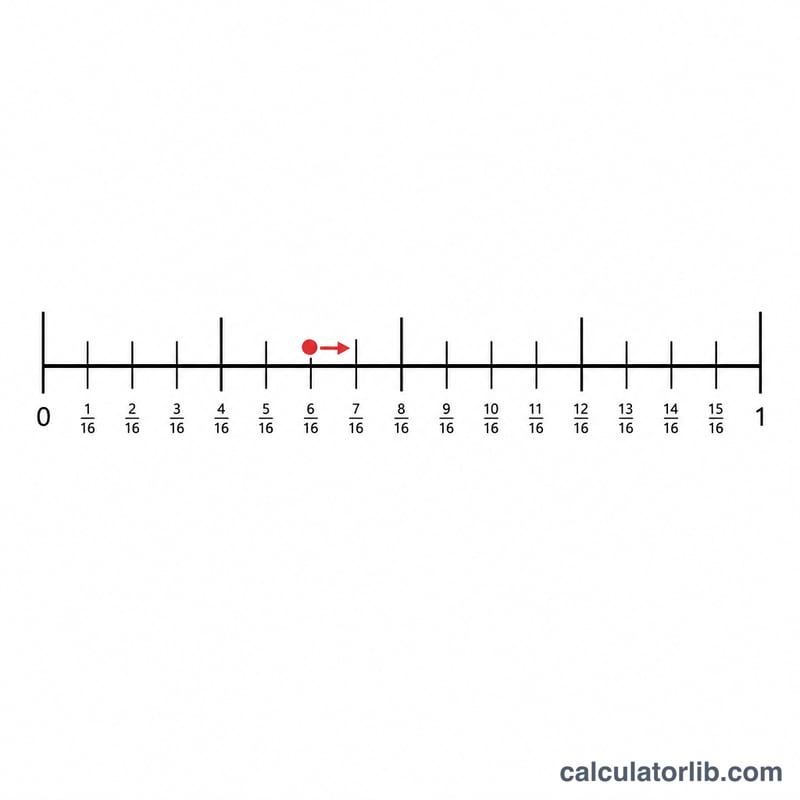
Type the number of meters, optionally toggle the sign with the +/- button, and pick how finely you want the inches rounded under "Fractions of an Inch: 1/". A value of 8 rounds to the nearest eighth; 16 to the nearest sixteenth, and so on up to 64ths. Press calculate to see both the decimal feet and the feet-plus-inches result.
The formula explained
One foot is exactly 0.3048 meters and one inch is exactly 0.0254 meters, so $$\text{feet} = \dfrac{\text{meters}}{0.3048}, \quad \text{total inches} = \dfrac{\text{meters}}{0.0254}$$ The whole feet are \(\lfloor \text{totalInches} / 12 \rfloor\); the remaining inches are split into a whole-inch part and a fractional part. The fraction is rounded to your denominator \(D\) with \(\text{numerator} = \text{round}(\text{frac} \times D)\), carries are handled (so you never see "12 in" or "8/8"), and the fraction is reduced with the greatest common divisor.
Worked example
For 1 meter with denominator 8: $$\text{feet} = \frac{1}{0.3048} = 3.28084 \text{ ft}$$ Total inches = \(\frac{1}{0.0254} = 39.37008\) in, giving 3 whole feet (36 in) and 3.37008 in left over → 3 whole inches and 0.37008 in. Multiplying \(0.37008 \times 8\) rounds to 3, so the fraction is 3/8. Result: 1 m = 3 ft 3 3/8 in.
Common Meters to Feet and Inches Conversions
Values below use the exact definitions 1 ft = 0.3048 m and 1 in = 0.0254 m. Feet-plus-inches are rounded to the nearest 1/16 in and shown in lowest terms; decimal feet are rounded to 6 places.
| Meters | Decimal feet | Feet + inches (nearest 1/16 in) |
|---|---|---|
| 0.1 m | 0.328084 ft | 0 ft 3 15/16 in |
| 0.25 m | 0.820210 ft | 0 ft 9 13/16 in |
| 0.5 m | 1.640420 ft | 1 ft 7 11/16 in |
| 1 m | 3.280840 ft | 3 ft 3 3/8 in |
| 1.5 m | 4.921260 ft | 4 ft 11 1/16 in |
| 1.8 m | 5.905512 ft | 5 ft 10 7/8 in |
| 2 m | 6.561680 ft | 6 ft 6 3/4 in |
| 2.5 m | 8.202100 ft | 8 ft 2 7/16 in |
| 3 m | 9.842520 ft | 9 ft 10 1/8 in |
| 5 m | 16.404199 ft | 16 ft 4 7/8 in |
| 10 m | 32.808399 ft | 32 ft 9 11/16 in |
| 100 m | 328.083990 ft | 328 ft 1 in |
Example of the method for 1.8 m: total inches \(= 1.8 / 0.0254 = 70.866142\) in; feet \(= \lfloor 1.8 / 0.3048 \rfloor = 5\); remaining inches \(= 70.866142 - 12 \times 5 = 10.866142\); the fraction \(0.866142 \times 16 = 13.86 \to 14\), so \(14/16 = 7/8\). Result: 5 ft 10 7/8 in.
Constants and Exact Definitions
- 1 inch = 0.0254 m exactly (0.0254 m = 25.4 mm), fixed by the international yard and pound agreement of 1959.
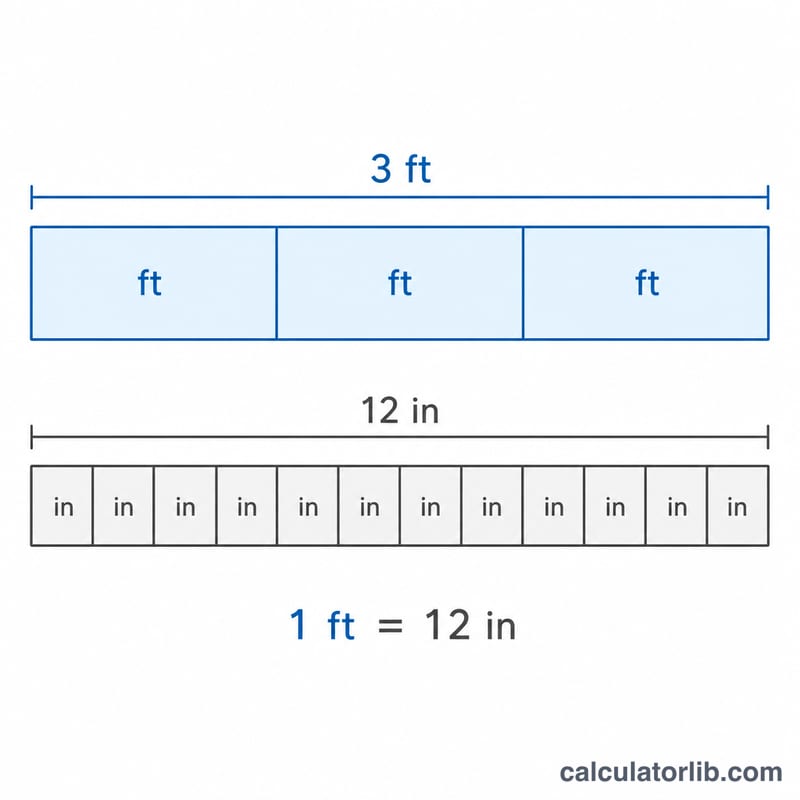
- 1 foot = 0.3048 m = 12 in exactly.
- 1 yard = 0.9144 m = 3 ft = 36 in exactly.
- 1 m ≈ 3.280839895 ft ≈ 39.37007874 in (rounded; these are reciprocals of the exact definitions: \(1/0.3048\) and \(1/0.0254\)).
US survey foot: In the United States, the survey foot is defined as 1200/3937 m ≈ 0.3048006096 m, which is about 2 parts per million longer than the international foot. The difference is negligible for everyday lengths (about 0.2 mm over 100 m) but can matter over very large geodetic or land-survey coordinates. The US National Institute of Standards and Technology has deprecated the survey foot, and this calculator uses the international foot (0.3048 m).
FAQ
Is the conversion exact? The meter-to-foot factor is exact (1/0.3048); the decimal display is rounded to 5 places and the inch part to your chosen fraction.
What does the fraction denominator mean? It is the smallest fraction of an inch shown. 1 = whole inches, 2 = halves, 64 = sixty-fourths.
Can I enter negative meters? Yes — use the +/- button. The magnitude is converted and a minus sign is prefixed to the result.