
What this calculator does
The Metric (SI Prefix) Units Conversion Calculator converts a quantity expressed with one SI metric prefix into the same quantity expressed with another prefix. It works for any base unit - meters, grams, seconds, watts, bytes - because the math depends only on the prefixes, never on what they are attached to. Enter a value, pick a "from" prefix and a "to" prefix, and the tool returns the converted number plus the single multiplier you can reuse for quick mental conversions.
How to use it
Type the value you want to convert (it can be negative or zero). Choose the source prefix in the From dropdown and the target prefix in the To dropdown. Each option lists the prefix, its symbol, and its power of ten. The result appears immediately with the target prefix symbol appended, along with the conversion factor and the exponent shift used.
The formula explained
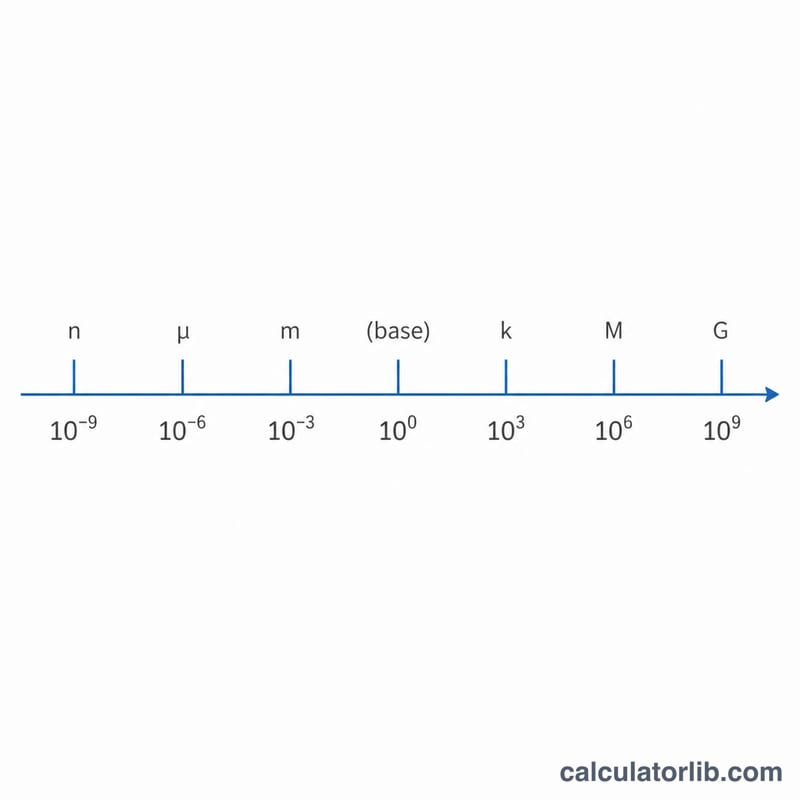
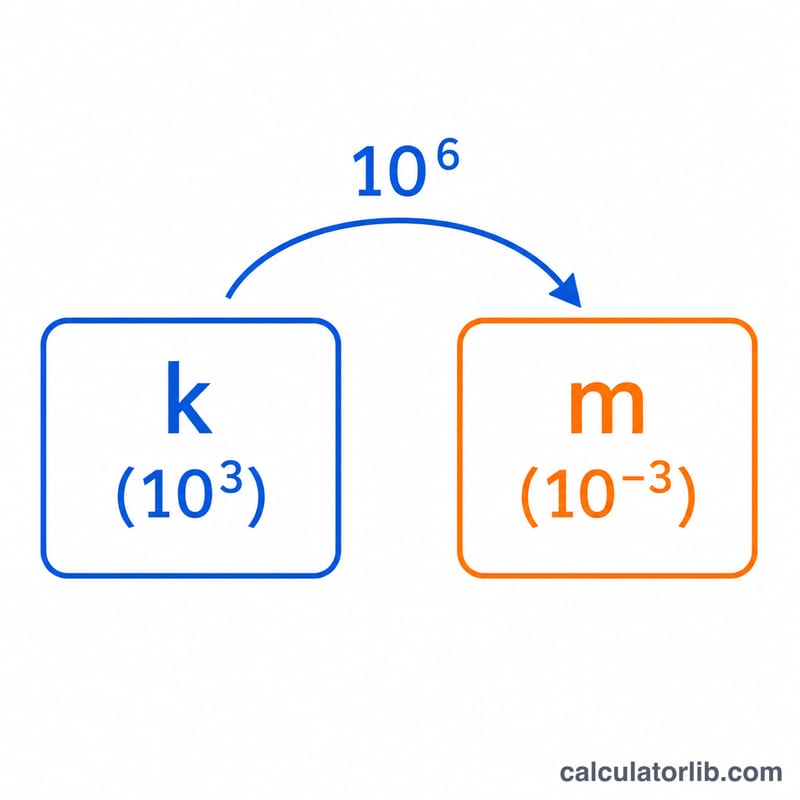
Every SI prefix is a power of ten applied to a base unit. Kilo means \(10^3\), milli means \(10^{-3}\), and the plain base unit is \(10^0\). To convert a value from a source prefix with exponent \(n_{from}\) into a target prefix with exponent \(n_{to}\), multiply by 10 raised to the difference of the exponents:
$$\text{result} = \text{value} \times 10^{(n_{from} - n_{to})}$$The factor \(10^{(n_{from} - n_{to})}\) is the same no matter what value you use, so once you know it you can convert any quantity between those two prefixes by a single multiplication.
Worked example
Convert 1 giga-unit to kilo-units. Giga is \(10^9\) and kilo is \(10^3\), so the exponent difference is \(9 - 3 = 6\). The factor is \(10^6 = 1{,}000{,}000\), and \(1 \times 1{,}000{,}000 = 1{,}000{,}000\). Therefore 1 giga-unit equals 1,000,000 kilo-units. Converting downward, 5 milli (\(10^{-3}\)) to kilo (\(10^3\)) gives \(10^{(-3-3)} = 10^{-6} = 0.000001\), so 5 milli = 0.000005 kilo.
FAQ
Do I need to enter the base unit? No. The base unit cancels out, so the calculator never asks for it. The conversion is identical for meters, grams or any other unit.
What if From and To are the same? The factor becomes \(10^0 = 1\) and the result equals your input value unchanged.
Can I handle extreme spans like quetta to quecto? Yes - the difference can reach 60 orders of magnitude. The result is computed from the exponent difference directly; very large or small answers display in scientific-style notation where needed.