What is the Pallet Stacking Calculator?
The Pallet Stacking Calculator estimates how efficiently rectangular boxes can be arranged on a standard pallet. Enter your box dimensions and weight, the pallet footprint, and the maximum height available for boxes, and it returns the number of boxes per layer, the number of stacked layers, the total box count, the resulting stack height, and the total load weight. It is a fast planning tool for warehouse operators, shippers, and logistics teams who need to optimize space and check weight limits.
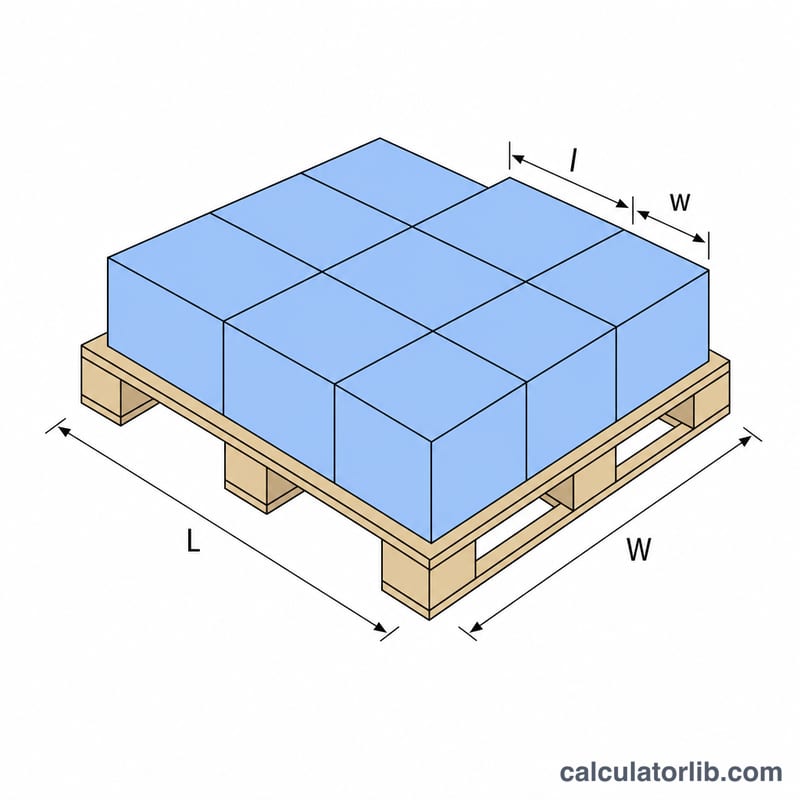
How to use it
Provide the box length \(B_L\), width \(B_W\), height \(B_H\) and weight, then the pallet length \(P_L\) and width \(P_W\), and finally the maximum stack height \(H_{max}\) available for the boxes (excluding the pallet base). All lengths use the same unit (centimeters) and weight is in kilograms. The calculator instantly recalculates a full stacking summary.
The formula explained
Boxes per layer is the larger of two simple grid layouts, aligning the box either lengthwise or rotated 90 degrees on the pallet:
$$N_{layer} = \max\!\left( \left\lfloor \tfrac{P_L}{B_L} \right\rfloor \left\lfloor \tfrac{P_W}{B_W} \right\rfloor,\ \left\lfloor \tfrac{P_L}{B_W} \right\rfloor \left\lfloor \tfrac{P_W}{B_L} \right\rfloor \right)$$The layer count and totals follow directly:
$$L = \left\lfloor \tfrac{H_{max}}{B_H} \right\rfloor, \quad N = N_{layer} \times L, \quad W = N \times w_{box}$$Here \(L\) is the number of layers, \(N\) the total boxes, and \(W\) the total load weight. The floor function \(\lfloor \cdot \rfloor\) keeps only whole boxes.
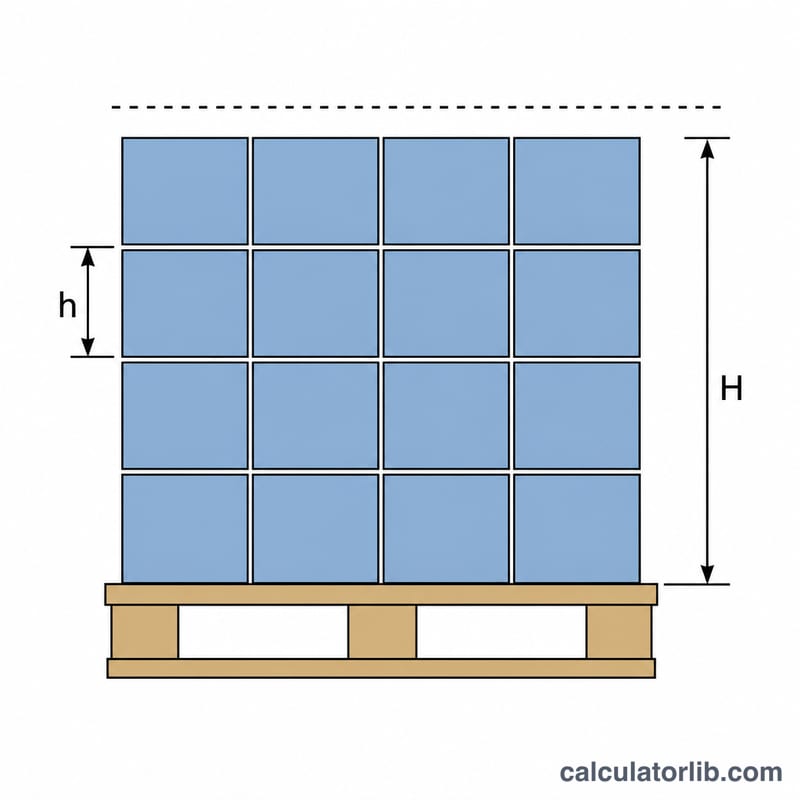
Worked example
A box measures 40 × 30 × 25 cm and weighs 5 kg on a 120 × 100 cm pallet with a 150 cm stack allowance:
$$N_{layer} = \max(3 \times 3,\ 4 \times 2) = \max(9, 8) = 9$$$$L = \left\lfloor \tfrac{150}{25} \right\rfloor = 6, \quad N = 9 \times 6 = 54$$$$W = 54 \times 5 = 270\,\text{kg}$$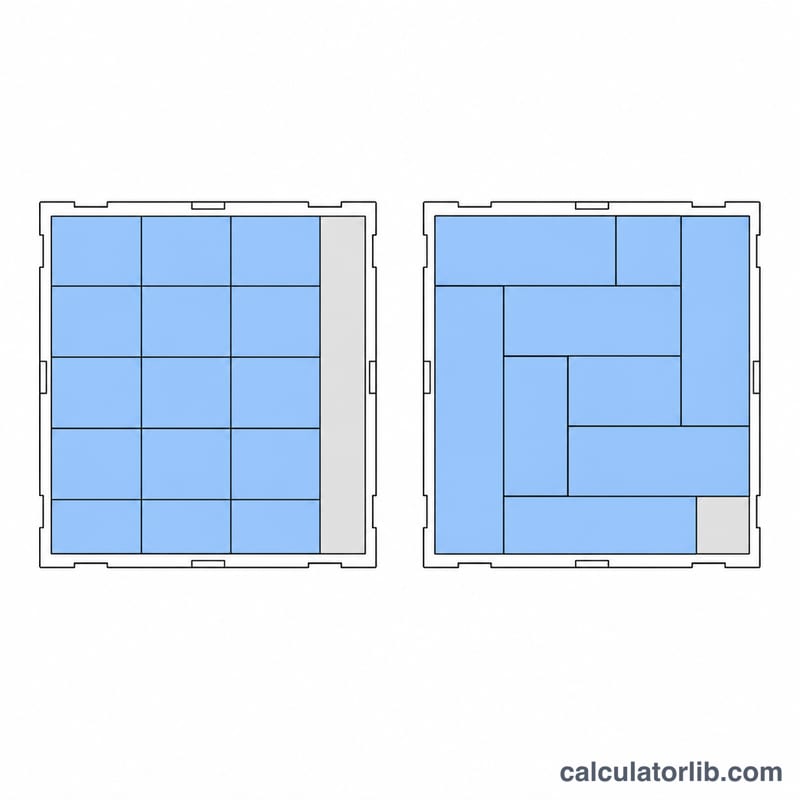
Standard Pallet Sizes Reference
Pallet dimensions differ by region and standard. Use the footprint that matches the pallet you actually ship on as the pallet length and width in the calculator. Dimensions are given as length × width.
| Pallet standard | Dimensions (cm) | Dimensions (mm / in) | Typical base height | Typical payload (approx.) |
|---|---|---|---|---|
| EUR / EPAL 1 (Europe) | 120 × 80 | 1200 × 800 mm | ~12–15 cm (EPAL: 14.4 cm) | ~1,000–1,500 kg dynamic |
| EUR 2 / EPAL 2 (Europe) | 120 × 100 | 1200 × 1000 mm | ~12–15 cm | ~1,000–1,500 kg dynamic |
| North American GMA / US standard | 121.9 × 101.6 | 48 × 40 in | ~12–15 cm (about 5–6 in) | ~1,000–1,500 kg dynamic |
| ISO 1 | 120 × 100 | 1200 × 1000 mm | ~12–15 cm | ~1,000–1,500 kg dynamic |
| Asian pallet | 110 × 110 | 1100 × 1100 mm | ~12–15 cm | ~1,000–1,500 kg dynamic |
| Australian standard pallet | 116.5 × 116.5 | 1165 × 1165 mm | ~12–15 cm | ~1,000–1,500 kg dynamic |
Note: Base height and payload figures are typical ranges only. The exact limits depend on the pallet type, material (wood, plastic, metal), condition and the governing standard. Dynamic load (pallet being moved) is usually lower than static or racked load limits. Always check the pallet marking or the manufacturer's data sheet.
Scenario Comparison: Box Sizes and Orientations
All scenarios use a 120 × 100 cm pallet, a maximum stack height of 150 cm for the boxes (pallet base not included), and a box weight of 8 kg. The calculator tests both box orientations on the pallet footprint and keeps the better one:
$$B_{\text{layer}} = \max\left( \left\lfloor \frac{120}{L_b} \right\rfloor \left\lfloor \frac{100}{W_b} \right\rfloor,\; \left\lfloor \frac{120}{W_b} \right\rfloor \left\lfloor \frac{100}{L_b} \right\rfloor \right), \qquad L = \left\lfloor \frac{150}{H_b} \right\rfloor$$
| Box size (L × W × H, cm) | Orientation A (L along 120) | Orientation B (rotated) | Boxes per layer | Layers | Total boxes | Stack height | Total weight (8 kg/box) |
|---|---|---|---|---|---|---|---|
| 40 × 30 × 25 | 3 × 3 = 9 | 4 × 2 = 8 | 9 | 6 | 54 | 150 cm | 432 kg |
| 30 × 20 × 20 | 4 × 5 = 20 | 6 × 3 = 18 | 20 | 7 | 140 | 140 cm | 1,120 kg |
| 50 × 40 × 30 | 2 × 2 = 4 | 3 × 2 = 6 | 6 (rotated wins) | 5 | 30 | 150 cm | 240 kg |
| 35 × 25 × 20 | 3 × 4 = 12 | 4 × 2 = 8 | 12 | 7 | 84 | 140 cm | 672 kg |
Reading the table:
- For 50 × 40 × 30 cm boxes, the standard orientation fits only \(\lfloor 120/50 \rfloor \times \lfloor 100/40 \rfloor = 2 \times 2 = 4\) boxes per layer. Rotating the boxes gives \(\lfloor 120/40 \rfloor \times \lfloor 100/50 \rfloor = 3 \times 2 = 6\), a 50% gain.
- The 30 × 20 × 20 cm case reaches 1,120 kg at 8 kg per box. That is within a typical 1,000–1,500 kg range, but a heavier box would exceed it. Weight can limit the load before height does.
- Where the stack height is below 150 cm (140 cm here), the leftover 10 cm is too small for another layer.
Practical Tips for Pallet Stacking
- Check total weight first. Compare the calculated load with the pallet's rated load, plus the limits of your carrier, racking and handling equipment. Add the pallet's own weight where the limit is for gross weight.
- Subtract the pallet base height. The max height you enter should be the available height for goods only. For example, a 180 cm carrier or door height minus a ~15 cm pallet base leaves about 165 cm for boxes. Also account for any lower carrier, truck, container-door or racking height limit.
- Keep boxes within the pallet edges. Overhang reduces box compression strength, risks damage and may be refused by carriers. The calculator only counts boxes that fit fully inside the footprint.
- Allow for stretch wrap and strapping. Wrap, corner boards and straps add a little to the width, length and height. If you are close to a limit, keep a small margin of a few centimetres.
- Look at wasted area. If there is a lot of unused space on a layer, consider an interlocked or pinwheel pattern, or a different pallet size. The calculator assumes a single uniform orientation per layer, so mixed patterns may fit more boxes than it shows.
- Verify compression strength. The bottom layers carry the weight of all layers above. Check that the box's stacking strength (for example, its rated compression value) is sufficient, especially under humid conditions or long storage.
- Balance the load. Place heavier items low and spread weight evenly for a stable stack.
This is general information for planning purposes, not professional logistics or safety advice. Always follow your carrier's, pallet manufacturer's and local regulations' requirements.
FAQ
Does it account for box rotation? Yes, it compares two uniform orientations and picks the one that fits more boxes per layer.
Does it consider mixed or interlocked patterns? No. It assumes a single, uniform column-stack pattern, which is the safest and most common configuration.
Should I subtract the pallet height? Yes. Enter only the height available for boxes; the pallet base thickness should already be removed from \(H_{max}\).