What this calculator does
The Pallet Quantity Calculator estimates how many boxes fit on a single pallet and how many pallets you need to ship a given quantity. It uses your carton footprint, the pallet footprint, and the maximum allowed stack height to build a simple, repeatable load plan for warehousing, freight quoting, and container planning.
How to use it
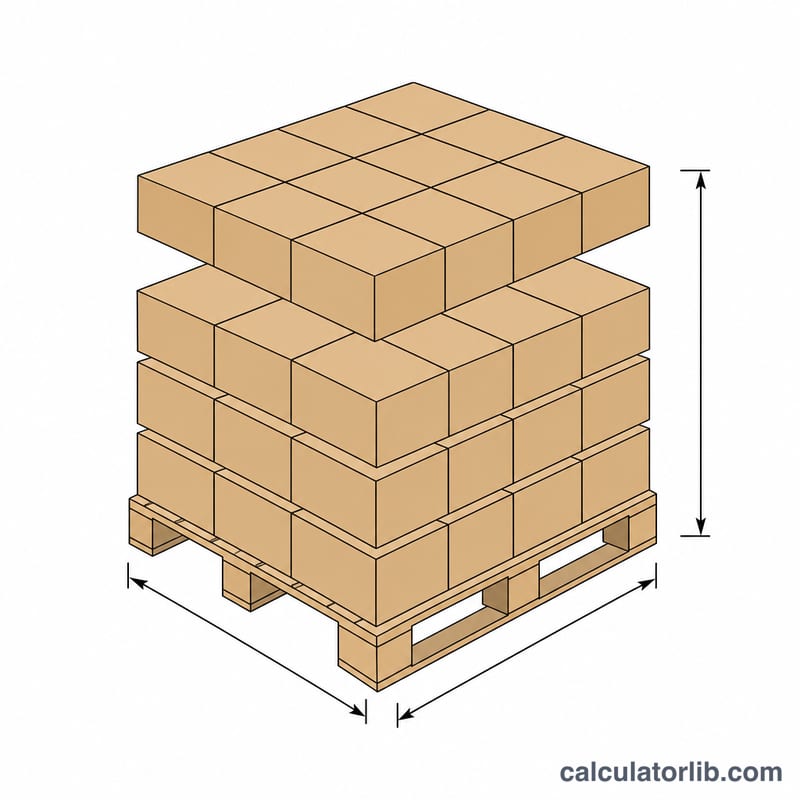
Enter the total number of boxes to ship, the box dimensions (length, width, height in centimetres), the usable pallet footprint, and the maximum stack height. The tool assumes a single box orientation and returns boxes per layer, layers per pallet, boxes per pallet, and total pallets needed.
The formula explained
First find how many boxes tile one layer of the pallet footprint, then how many layers stack within the height limit:
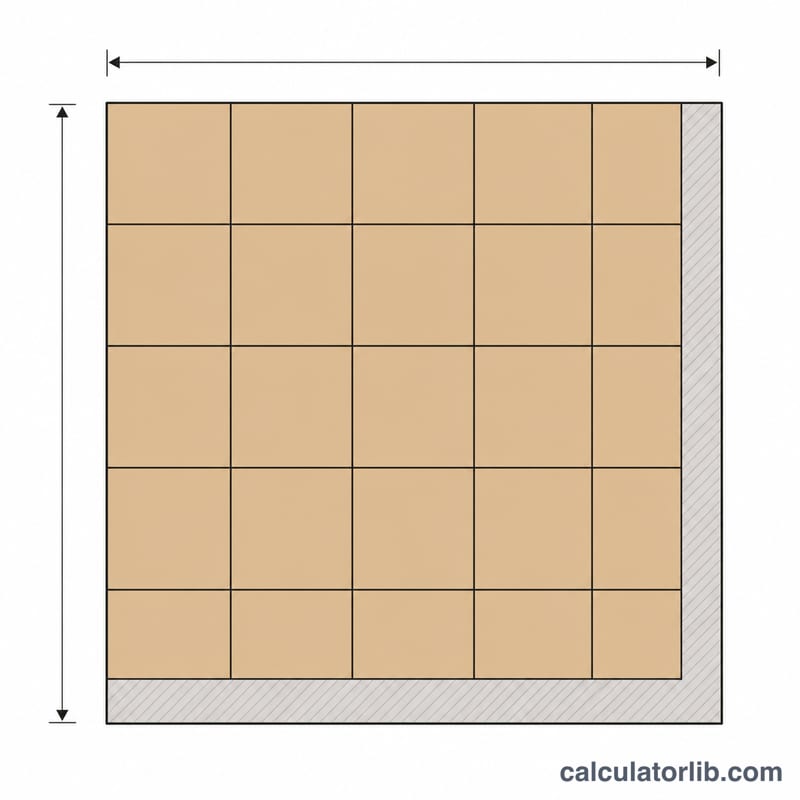
\(L_p = \lfloor P_L / b_L \rfloor \times \lfloor P_W / b_W \rfloor\) boxes per layer, and \(n = \lfloor H / b_H \rfloor\) layers.
Boxes per pallet and pallets needed are then:
$$B_p = L_p \times n, \qquad \text{Pallets} = \left\lceil \frac{N}{B_p} \right\rceil$$Here \(P_L, P_W\) are pallet length and width, \(b_L, b_W, b_H\) are box dimensions, \(H\) is the stack height limit, and \(N\) is the total box count. The floor \(\lfloor \cdot \rfloor\) discards partial fits and the ceiling \(\lceil \cdot \rceil\) rounds pallets up.
Worked example
Ship \(N = 500\) boxes of \(40 \times 30 \times 25\) cm on a \(120 \times 100\) cm pallet, stacked up to \(150\) cm:
$$L_p = \lfloor 120/40 \rfloor \times \lfloor 100/30 \rfloor = 3 \times 3 = 9$$$$n = \lfloor 150/25 \rfloor = 6, \quad B_p = 9 \times 6 = 54$$$$\text{Pallets} = \left\lceil \frac{500}{54} \right\rceil = \lceil 9.26 \rceil = 10$$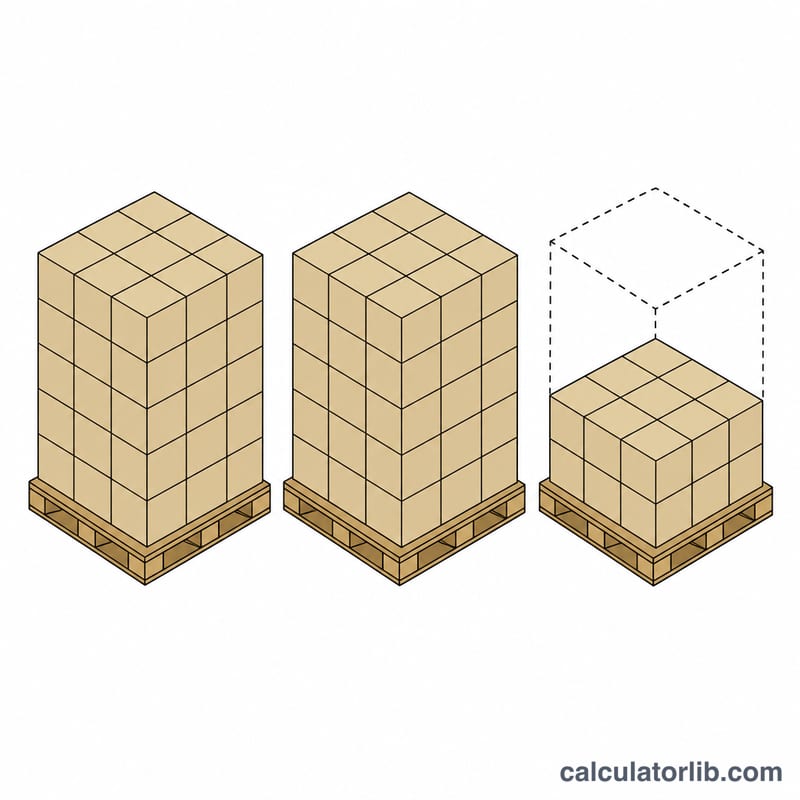
Standard Pallet Sizes
ISO 6780 lists six pallet footprints that are used around the world. Pallet sizes still vary by region, so check which pallet your warehouse, supplier or carrier actually uses before you enter its dimensions. The first value is length, the second is width.
| Footprint (mm) | Footprint (cm) | Footprint (in) | Common name / main region |
|---|---|---|---|
| 1200 × 800 | 120 × 80 | 47.24 × 31.50 | EUR / EPAL pallet, Europe |
| 1200 × 1000 | 120 × 100 | 47.24 × 39.37 | Europe and Asia |
| 1219 × 1016 | 121.9 × 101.6 | 48 × 40 | GMA pallet, North America |
| 1165 × 1165 | 116.5 × 116.5 | 45.87 × 45.87 | Australia |
| 1100 × 1100 | 110 × 110 | 43.31 × 43.31 | Asia |
| 1067 × 1067 | 106.7 × 106.7 | 42 × 42 | North America, Europe and Asia |
What to enter: Enter the usable footprint, meaning the area you will actually let cartons cover. If you plan to leave a margin for stretch wrap or corner boards, subtract it from the length and width first. For Max Stack Height, enter only the height available for boxes. Do not include the pallet deck. A EUR pallet deck is about 14.4 cm tall. For example, if the total loaded height limit is 160 cm, the boxes on a EUR pallet can be stacked to about 160 − 14.4 = 145.6 cm.
Practical Tips for Better Pallet Loads
The calculator finds how many boxes fit with simple straight rows in one orientation. Use these checks to turn that number into a load you can safely ship.
- Try the box rotated 90°. Swap the box length and width and run the calculation again, then keep whichever gives more boxes per layer. Example: a 40 × 30 cm box on a 120 × 100 cm pallet gives \(\lfloor 120/40 \rfloor \times \lfloor 100/30 \rfloor = 3 \times 3 = 9\) boxes per layer. Rotated, it gives \(\lfloor 120/30 \rfloor \times \lfloor 100/40 \rfloor = 4 \times 2 = 8\). The first orientation is better here, but with other box sizes the rotated one often wins.
- Use the leftover strips. Straight rows can leave empty strips along one or two edges. A mixed layout (some rows turned 90°) or a pinwheel layout can sometimes fit extra cartons in those gaps. Alternating the pattern from layer to layer also locks the layers together and makes the stack more stable.
- Don't let cartons hang over the edge. When carton walls extend past the pallet, they lose support and much of their stacking strength. They are also easily damaged during handling. Keep the footprint you enter at or inside the pallet edges.
- Check the weight. Total pallet weight = (boxes per pallet × weight of one box) + pallet tare weight. Example: 54 boxes at 12 kg each on a 25 kg pallet gives \(54 \times 12 + 25 = 673\) kg. Compare this to the pallet's rated load (dynamic and racking ratings are often lower than static) and to your carrier's or vehicle's limits.
- Check the total loaded height. Total height = deck height + (number of layers × box height). Confirm it with your carrier, the trailer or container door height, and any racking beam clearances. These limits differ between companies and countries.
- Check that the bottom cartons can bear the load. The bottom layer carries all the layers above it. Before you use the full number of layers, compare that weight with the carton's compression (crush) strength, and allow a safety margin for humidity, storage time and stacking pallets on top of each other.
- Plan for the last partial pallet. The number of pallets is rounded up, so the last one is often only partly full. Example: 9 boxes per layer × 6 layers (25 cm boxes in 150 cm of stack height) = 54 boxes per pallet. For 500 boxes you need \(\lceil 500/54 \rceil =\) 10 pallets, and the last one holds only 500 − 9 × 54 = 14 boxes. You can move the leftover boxes onto another shipment, or change the order quantity to a whole number of pallets: 486 boxes fills 9 pallets and 540 fills 10.
FAQ
Does it rotate boxes for a better fit? No. It assumes one fixed orientation, so real pallets may hold slightly more with mixed layouts.
Should I include the pallet base in stack height? Enter the usable stacking height above the deck, since the pallet base is not counted.
Why round pallets up? A partial pallet still occupies a full pallet position in transport, so the count rounds up.