What is the GSM Fabric Weight Calculator?
GSM stands for grams per square meter, the standard unit used across the textile industry to describe how heavy a fabric is. This calculator converts the measured weight and area of a small fabric swatch into its equivalent weight per square meter, giving you a fast, repeatable quality-control figure without weighing an entire roll.
How to use it
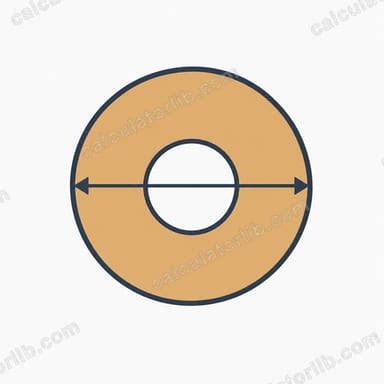
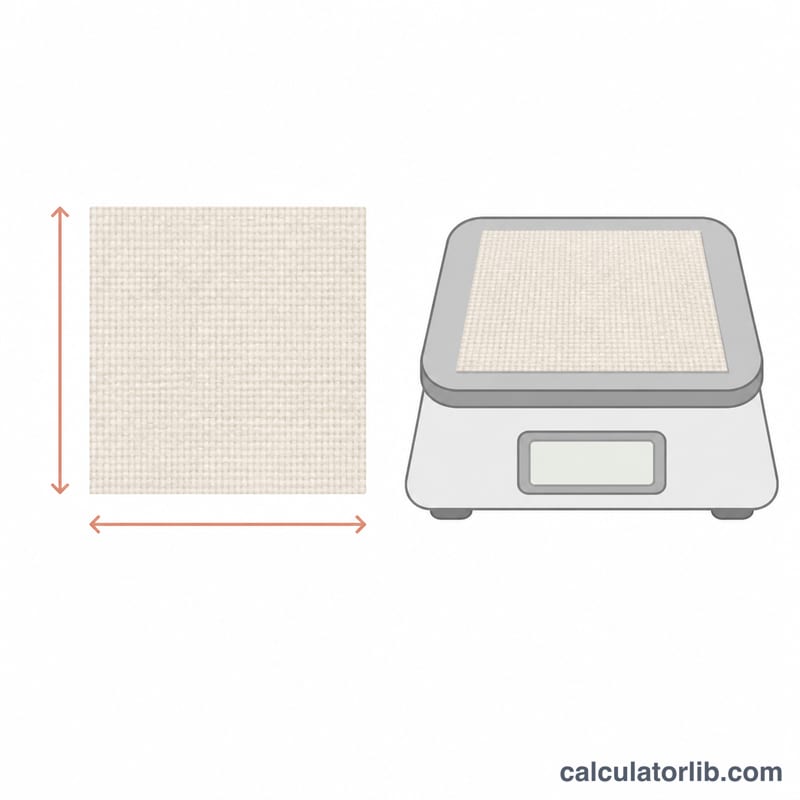
Cut a swatch of known area — a round GSM cutter typically punches exactly \(100\,\text{cm}^2\). Weigh it on a precision scale in grams, enter that weight and the swatch area, and the calculator returns the fabric's GSM. Using a larger, precisely cut sample reduces the impact of scale rounding.
The formula explained
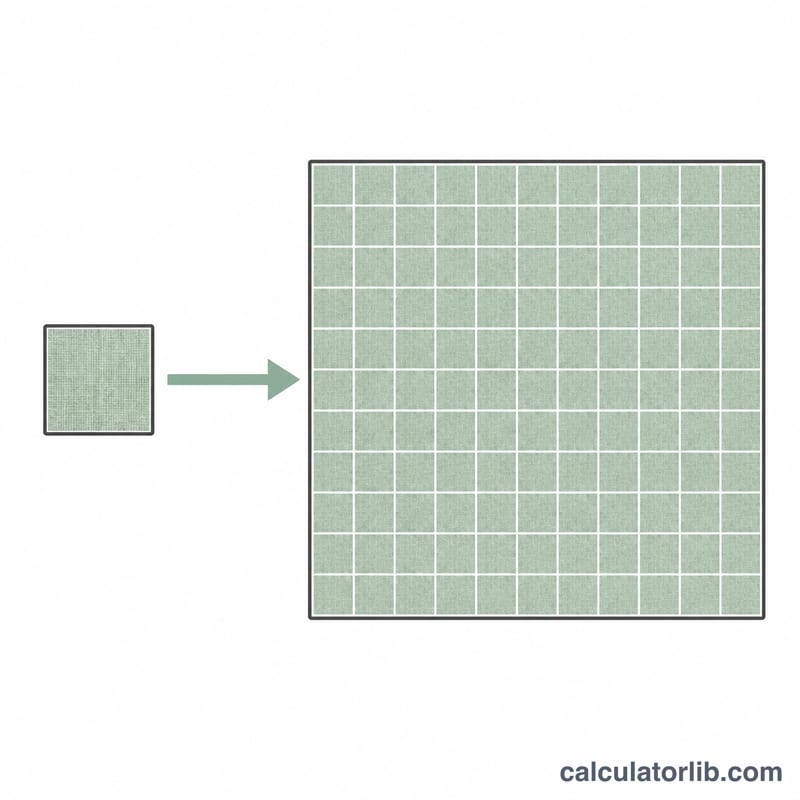
Because there are \(10000\) square centimeters in one square meter, the fabric weight is:
$$\text{GSM} = \frac{W \times 10000}{A}$$
where \(W\) = swatch weight in grams and \(A\) = swatch area in square centimeters. Equivalently, you can first convert the area with \(A_{m^2} = \tfrac{A}{10000}\) and then divide \(W\) by that value.
Worked example
Suppose a swatch measures \(100\,\text{cm}^2\) and weighs \(2\,\text{g}\):
$$\text{GSM} = \frac{2 \times 10000}{100} = 200\ \text{g/m}^2$$
So the fabric weighs 200 GSM — a typical mid-weight jersey knit.
Typical GSM by Fabric Type
The table shows approximate GSM ranges for common fabrics. The ounces per square yard (oz/yd²) column uses the conversion \(\text{oz/yd}^2 \approx \text{GSM} \times 0.0295\), because 1 oz/yd² ≈ 33.9 g/m². Oz/yd² is used mainly in the US. Most other countries quote fabric weight in GSM (g/m²).
| Fabric type | Typical GSM (g/m²) | Approx. oz/yd² | Weight band |
|---|---|---|---|
| Chiffon, organza | 25–60 | 0.7–1.8 | Light |
| Voile, lawn | 60–100 | 1.8–3.0 | Light |
| Poplin, shirting | 100–150 | 3.0–4.4 | Light |
| Single jersey (T-shirt) | 140–200 | 4.1–5.9 | Light to medium |
| Linen | 150–250 | 4.4–7.4 | Medium |
| Fleece, sweatshirt | 250–350 | 7.4–10.3 | Medium |
| Canvas | 300–400+ | 8.9–11.8+ | Medium to heavy |
| Denim | 300–450 | 8.9–13.3 (often sold as about 9–14 oz) | Medium to heavy |
| Terry towels | 300–600 | 8.9–17.7 | Medium to heavy |
General weight bands
| Band | GSM | Approx. oz/yd² | Typical uses |
|---|---|---|---|
| Light | < 150 | < 4.4 | Blouses, linings, summer shirts, scarves |
| Medium | 150–350 | 4.4–10.3 | T-shirts, dresses, trousers, sweatshirts |
| Heavy | > 350 | > 10.3 | Heavy denim, upholstery, coats, towels, bags |
Note: These ranges are only a general guide. Actual GSM depends on the manufacturer, fiber content, yarn count, weave or knit structure, and finishing. The light, medium and heavy bands are a common industry convention, not a formal standard, and suppliers may draw the lines in slightly different places. For specifications and quality control, always use the supplier's stated GSM and tolerance.
More GSM Calculation Examples
Every example uses the same formula. The swatch weight is in grams and the area is in square centimetres. Multiplying by 10,000 converts cm² to m², because 1 m² = 10,000 cm²:
$$\text{GSM} = \frac{W \times 10000}{A}$$Example 1: 10 cm × 10 cm square, 1.25 g
- Area: \(A = 10 \times 10 = 100\ \text{cm}^2\)
- Apply the formula: \(\text{GSM} = \frac{1.25 \times 10000}{100} = \frac{12500}{100} = 125\)
- Result: 125 GSM, which is about \(125 \times 0.0295 \approx 3.7\) oz/yd².
- Classify: 125 is below 150, so this is a light fabric. Poplin and shirting fall in this range.
Example 2: 20 cm × 25 cm rectangle, 17.5 g
- Area: \(A = 20 \times 25 = 500\ \text{cm}^2\)
- Apply the formula: \(\text{GSM} = \frac{17.5 \times 10000}{500} = \frac{175000}{500} = 350\)
- Result: 350 GSM
- Convert to oz/yd²: \(350 \times 0.0295 = 10.325 \approx 10.3\ \text{oz/yd}^2\)
- Classify: 350 GSM sits right at the top of the medium band (150–350), next to the heavy band. Heavy fleece, canvas and lighter denim fall in this range.
Example 3: circular swatch 11.28 cm across, 0.45 g
Circular sample cutters are common because a diameter of about 11.28 cm gives an area of almost exactly 100 cm².
- Radius: \(r = 11.28 \div 2 = 5.64\ \text{cm}\)
- Area: \(A = \pi r^2 = \pi \times 5.64^2 = \pi \times 31.8096 \approx 99.93\ \text{cm}^2\), which is close to 100 cm²
- Apply the formula: \(\text{GSM} = \frac{0.45 \times 10000}{99.93} = \frac{4500}{99.93} \approx 45.0\)
- Result: about 45 GSM, or \(45 \times 0.0295 \approx 1.3\) oz/yd².
- Classify: well below 150, so this is a light fabric. 45 GSM is typical of a sheer chiffon.
Tips for accurate results
- Weigh small swatches on a scale that reads to at least 0.01 g. On a 100 cm² sample, an error of 0.01 g changes the result by 1 GSM.
- Measure the swatch area carefully. A 1 mm error on each side of a 10 cm square changes the area by about 2%.
- Condition the fabric before weighing, because moisture content affects weight. Average several swatches taken from different places across the width of the fabric.
FAQ
What area should my swatch be? Any known area works, but a 100 cm² round cutter is the industry standard and makes the math simple.
Does higher GSM mean better quality? Not necessarily — GSM measures weight, not quality. Lightweight voiles and heavy denims both have their uses; GSM just helps you specify and compare consistently.
Can I use ounces per square yard instead? This tool reports metric GSM. To convert, multiply GSM by about 0.0295 to get oz/yd².