What this calculator does
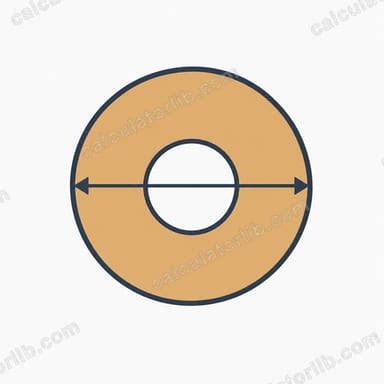
A shaped bagel is essentially a ring of dough, which geometrically is a torus. Given the weight of the dough piece, such as a 3 oz or 85 g portion, this calculator estimates how thick the dough rope is, how wide the bagel is across, and how large the hole is. It models the raw, freshly shaped bagel before proofing, boiling and baking, all of which enlarge it.
How to use it
Enter the dough weight and choose ounces or grams. Leave the density at 1.1 g/cm³ for a typical low-hydration bagel dough, which is denser than bread dough because it is stiff and has little trapped air. The ring ratio is the distance from the center of the hole to the center of the rope, divided by the rope radius. A value near 1.6 gives a bagel with a modest hole; larger values give a bigger hole and a thinner ring.
The formula explained
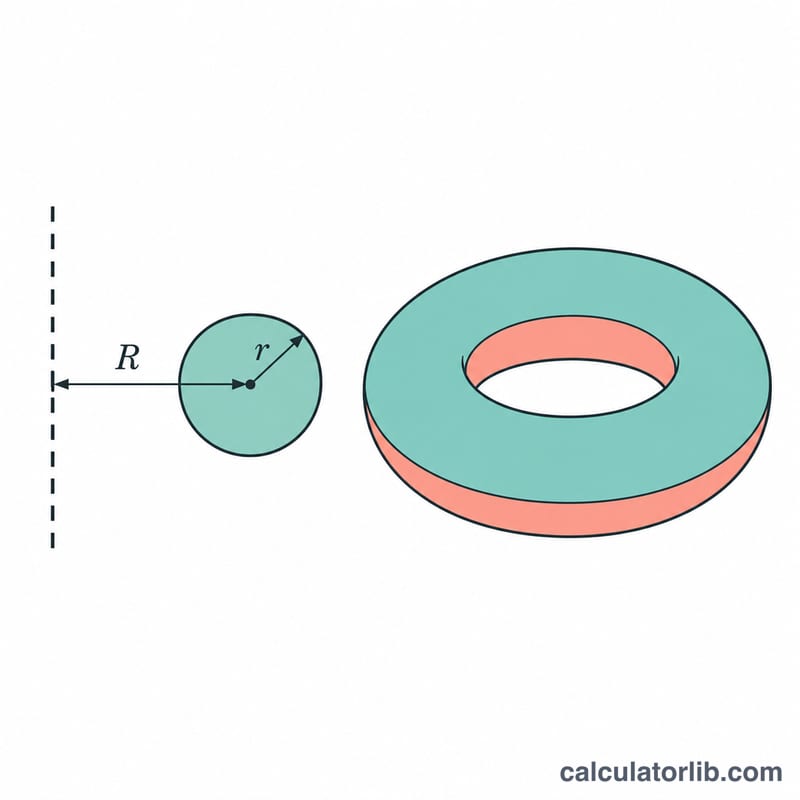
The volume of a torus is
$$V = 2\pi^2 R r^2$$where \(R\) is the center radius and \(r\) is the rope radius. With \(R = k r\) and \(V = \text{weight} / \text{density}\), the rope radius is
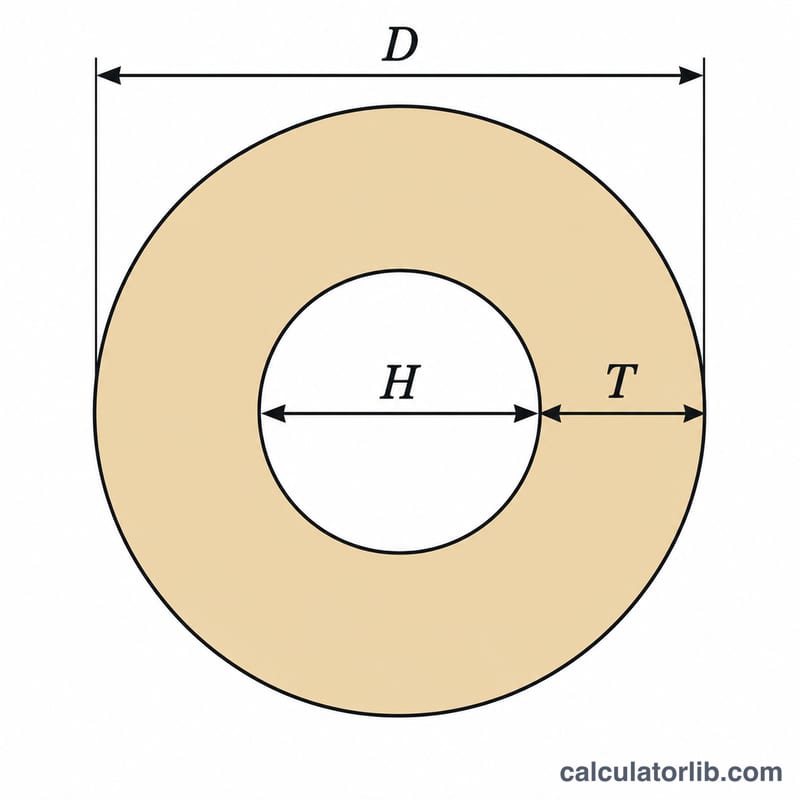
$$r = \sqrt[3]{\frac{V}{2\pi^2 k}}$$Thickness is \(t = 2r\), the outer diameter is \(D = 2r(k+1)\) and the hole diameter is \(d = 2r(k-1)\).
Worked example
Take 100 g of dough, density 1 g/cm³ and \(k = 2\). Then \(V = 100\ \text{cm}^3\).
$$r = \sqrt[3]{\frac{100}{2\pi^2 \times 2}} = \sqrt[3]{2.533} \approx 1.363\,\text{cm}$$$$t = 2r \approx 2.73\,\text{cm},\quad D = 2r \times 3 \approx 8.18\,\text{cm}$$For a 3 oz piece (85.05 g) at 1.1 g/cm³ and \(k = 1.6\), the result is about 2.70 cm thick and 7.01 cm (2.76 in) across.
Bagel Size by Dough Weight and Ring Ratio
The table uses the torus model with a dough density of 1.1 g/cm³. The volume is \(V = m/\rho\), the rope radius is \(r = \sqrt[3]{V/(2\pi^2 k)}\), the thickness is \(t = 2r\), the outer diameter is \(D = 2r(k+1)\), and the hole diameter is \(d = 2r(k-1)\). Weights are converted exactly (1 oz = 28.3495 g), so 2 oz is 56.7 g rather than a rounded 57 g. The ring ratio k = 1.4 gives a small hole, 1.6 a typical hole, and 2.0 a wide, open ring. These are raw dough shapes; baking and boiling change the final size.
| Dough weight | Ring ratio k | Thickness (cm) | Thickness (in) | Outer diameter (cm) | Outer diameter (in) | Hole diameter (cm) | Hole diameter (in) |
|---|---|---|---|---|---|---|---|
| 2 oz (57 g) | 1.4 | 2.46 | 0.97 | 5.91 | 2.33 | 0.98 | 0.39 |
| 2 oz (57 g) | 1.6 | 2.35 | 0.93 | 6.12 | 2.41 | 1.41 | 0.56 |
| 2 oz (57 g) | 2.0 | 2.19 | 0.86 | 6.56 | 2.58 | 2.19 | 0.86 |
| 3 oz (85 g) | 1.4 | 2.82 | 1.11 | 6.76 | 2.66 | 1.13 | 0.44 |
| 3 oz (85 g) | 1.6 | 2.70 | 1.06 | 7.01 | 2.76 | 1.62 | 0.64 |
| 3 oz (85 g) | 2.0 | 2.50 | 0.99 | 7.51 | 2.96 | 2.50 | 0.99 |
| 4 oz (113 g) | 1.4 | 3.10 | 1.22 | 7.44 | 2.93 | 1.24 | 0.49 |
| 4 oz (113 g) | 1.6 | 2.97 | 1.17 | 7.71 | 3.04 | 1.78 | 0.70 |
| 4 oz (113 g) | 2.0 | 2.75 | 1.08 | 8.26 | 3.25 | 2.75 | 1.08 |
| 4.5 oz (128 g) | 1.4 | 3.23 | 1.27 | 7.74 | 3.05 | 1.29 | 0.51 |
| 4.5 oz (128 g) | 1.6 | 3.09 | 1.21 | 8.02 | 3.16 | 1.85 | 0.73 |
| 4.5 oz (128 g) | 2.0 | 2.86 | 1.13 | 8.59 | 3.38 | 2.86 | 1.13 |
| 5 oz (142 g) | 1.4 | 3.34 | 1.32 | 8.02 | 3.16 | 1.34 | 0.53 |
| 5 oz (142 g) | 1.6 | 3.20 | 1.26 | 8.31 | 3.27 | 1.92 | 0.75 |
| 5 oz (142 g) | 2.0 | 2.97 | 1.17 | 8.90 | 3.50 | 2.97 | 1.17 |
Worked check for 3 oz at k = 1.6: \(m = 3 \times 28.3495 = 85.05\) g, so \(V = 85.05/1.1 = 77.32\) cm³. Then \(r = \sqrt[3]{77.32/(19.739 \times 1.6)} = \sqrt[3]{2.448} \approx 1.348\) cm, giving \(t = 2.70\) cm, \(D = 2 \times 1.348 \times 2.6 = 7.01\) cm and \(d = 2 \times 1.348 \times 0.6 = 1.62\) cm.
Because size scales with the cube root of weight, doubling the dough weight increases every dimension by only about 26% (21/3 ≈ 1.26).
Bagel Geometry Terms
- Torus: the donut-shaped solid used to model a bagel. Its volume is \(V = 2\pi^2 R r^2\), in cm³.
- Rope radius r (cm): the radius of the circular cross-section of the dough ring, that is, half the dough rope's thickness.
- Center radius R (cm): the distance from the center of the hole to the center of the dough rope. It is the radius of the ring's centerline.
- Ring ratio k = R/r (unitless): describes how open the ring is. Values near 1 give almost no hole, while larger values give a wider hole and a thinner-looking ring. A ratio of 1 or less would make the hole vanish or overlap itself, so k should be greater than 1.
- Dough thickness t (cm): the height of the bagel, equal to the rope diameter, \(t = 2r\).
- Outer diameter D (cm): the full width of the bagel, \(D = 2(R + r) = 2r(k+1)\).
- Hole diameter d (cm): the width of the center opening, \(d = 2(R - r) = 2r(k-1)\).
- Dough density ρ (g/cm³): mass per unit volume of the raw dough, used in \(V = m/\rho\). Dense, low-hydration dough is higher in density, and dough that has proofed and trapped gas is lower. The 1.1 g/cm³ used here is an adjustable assumption, not a fixed constant.
Ounce and Gram Dough Weight Conversions
Use 1 oz = 28.3495 g (avoirdupois ounce). To convert grams to ounces, divide by 28.3495.
| Ounces (oz) | Grams (g) |
|---|---|
| 2 | 56.70 |
| 3 | 85.05 |
| 3.5 | 99.22 |
| 4 | 113.40 |
| 4.5 | 127.57 |
| 5 | 141.75 |
| 6 | 170.10 |
Common rounded gram weights used in recipes convert back as 57 g ≈ 2.01 oz, 85 g ≈ 3.00 oz, 113 g ≈ 3.99 oz, 128 g ≈ 4.52 oz and 142 g ≈ 5.01 oz.
Length: 1 in = 2.54 cm exactly. To convert centimeters to inches, divide by 2.54. For example, 7.01 cm ÷ 2.54 ≈ 2.76 in. To convert inches to centimeters, multiply by 2.54.
FAQ
Why is my baked bagel bigger?
Proofing, boiling and oven spring add volume and lower the effective density, so baked bagels are typically 20-40% wider than the raw ring. Lower the density input to approximate this.
What ring ratio should I use?
Between 1.4 and 2.0 suits most shaped bagels. Measure a sample bagel and adjust until the result matches.
Is this exact?
No. Hand-shaped bagels are not perfect tori, so treat the output as a planning estimate.