What is a recipe cost calculator?
A recipe cost calculator works out how much a dish really costs to make. It turns the prices of the packages you buy into the cost of the amounts the recipe uses. It then splits the total across servings and suggests a menu price based on a target food cost percentage. Restaurants, bakeries, caterers and home cooks who sell food use this to price items so they make a profit.
How to use it
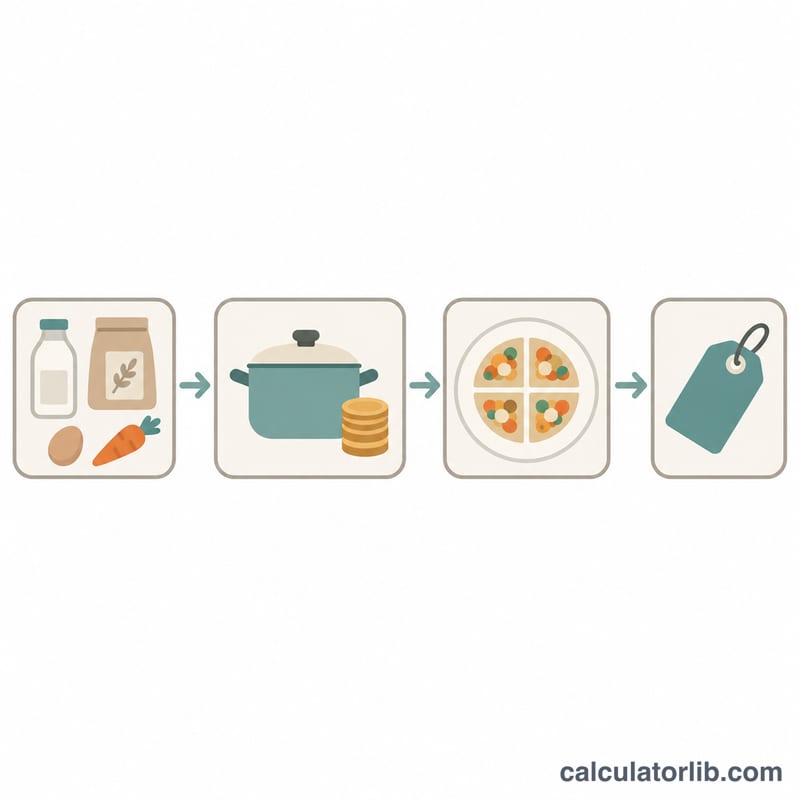
For each ingredient, enter the price of the package you buy, the package size, and how much the recipe uses. Size and amount must be in the same unit, such as grams, millilitres or pieces. Add any small extra costs like oil, spices or packaging, then enter the number of servings and your target food cost percentage. Many restaurants aim for 25 to 35 percent.
The formula
$$C_{\text{serving}} = \frac{\sum_i P_i \times \frac{U_i}{S_i} + E}{N}$$Here \(P_i\) is the package price, \(S_i\) the package size, \(U_i\) the amount used, \(E\) the extra costs and \(N\) the number of servings. The suggested menu price is \(M = C_{\text{serving}} / (f/100)\), where \(f\) is the target food cost percentage. The gross profit per serving is \(G = M - C_{\text{serving}}\).
Worked example
Say a batch of 5 servings uses 2 kg of an ingredient that costs $10 per kg, plus 1 unit from a 3-unit pack priced at $6, with $3 of extras. The target food cost is 25%.
$$C_{\text{total}} = 10 \times \tfrac{2}{1} + 6 \times \tfrac{1}{3} + 3 = 25$$$$C_{\text{serving}} = \tfrac{25}{5} = 5, \quad M = \tfrac{5}{0.25} = 20, \quad G = 20 - 5 = 15$$So each serving costs $5 to make, should sell for about $20, and leaves $15 of gross profit.
Kitchen Unit Conversions for Matching Package Size and Amount Used
The calculator works out each ingredient's cost as \(\text{Price} \times \text{Used} \div \text{Size}\). For this to be correct, the package size and the amount used must be in the same unit. If the package is labeled in pounds and the recipe uses grams, convert one of them first. The kilogram and pound conversions below are exact by definition. The ounce, gallon and cup values are rounded. Gallons, quarts, cups, fluid ounces and spoons are US customary measures. UK imperial and metric cups and spoons are different sizes.
| Unit | Equivalent |
|---|---|
| Mass | |
| 1 kg | 1000 g |
| 1 lb | 16 oz = 453.592 g |
| 1 oz (avoirdupois) | 28.3495 g |
| Volume | |
| 1 L | 1000 mL |
| 1 US gallon | 3.785 L |
| 1 US quart | 946.4 mL |
| 1 US cup | 236.6 mL |
| 1 US fluid ounce | 29.57 mL |
| 1 tablespoon (US) | 14.79 mL |
| 1 teaspoon (US) | 4.93 mL |
| Count | |
| 1 dozen | 12 pieces |
Volume to weight: You can't use one fixed factor to turn volume into weight. The answer depends on the ingredient's density. A cup of flour weighs much less than a cup of water or a cup of sugar. If the package is sold by weight and the recipe measures by volume, weigh the amount you actually use, or use a density figure for that specific ingredient.
Example: A recipe uses 300 g from a 5 lb bag. First convert the bag to grams: \(5 \times 453.592 = 2267.96 \approx 2268\ \text{g}\). The fraction of the bag used is then
$$\frac{300\ \text{g}}{2268\ \text{g}} \approx 0.132$$That is about 13.2% of the bag. In the calculator, enter 2268 as the package size and 300 as the amount used, so both are in grams.
FAQ
What food cost percentage should I use?
Full-service restaurants often target 28 to 35 percent. Cafes and bakeries may go lower for drinks and higher for premium items. Lower percentages mean higher prices and margins.
Should I include waste and trimming?
Yes. Enter the amount you buy before trimming as the amount used, or add a waste allowance to extra costs, so the cost reflects reality.
Does this include labour and rent?
No. It covers ingredient (food) cost only. The gap between menu price and food cost has to pay for labour, overheads and profit.