What It Is
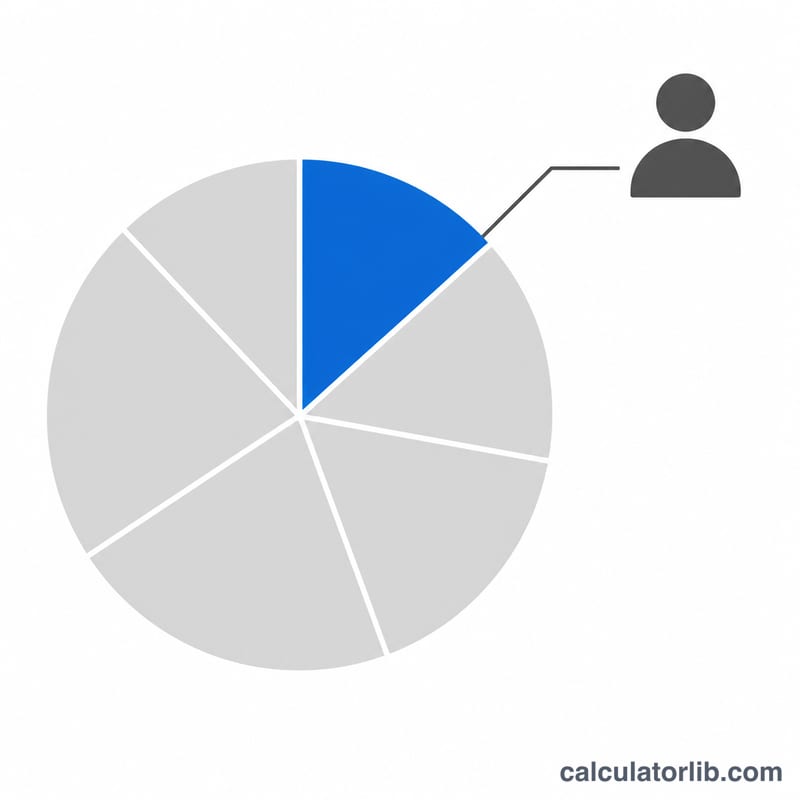
The Equity Ownership Percentage Calculator tells you what fraction of a company you own based on the number of shares you hold relative to the total common shares outstanding. It is a foundational metric for founders, employees with stock, and investors who want to understand their proportional claim on ownership, voting power, and value.
The Formula
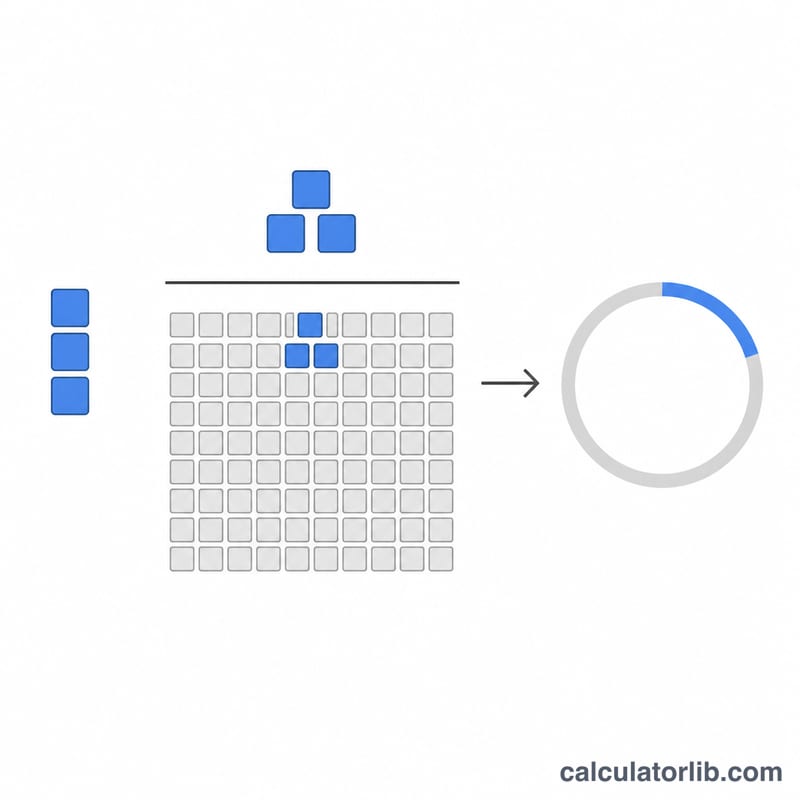
Ownership percentage is a simple ratio scaled to 100. If \(H\) = shares held and \(T\) = total common shares outstanding, then:
$$\text{Ownership \%} = \frac{H}{T} \times 100$$Here \(H\) is the number of shares registered to a single owner and \(T\) is every common share the company has issued and that is held by all shareholders.
How To Use It
Enter the number of shares you hold and the total shares outstanding, then read your stake as a percentage. Make sure both figures use the same share class and the same point in time, since new issuances or buybacks change the total.
Worked Example
Suppose you hold 250 shares and the company has 1,000 shares outstanding:
$$\text{Ownership \%} = \frac{250}{1000} \times 100 = 25\%$$You therefore own a 25% equity stake in the company.
Interpreting Your Ownership Percentage
Your ownership percentage is your shares divided by total shares outstanding. What that number means in practice depends on the company's jurisdiction, its share classes, and its bylaws or articles of association. The thresholds below are common reference points, not universal rules.
- Above 50% (simple majority): Holding more than half of the voting shares generally lets you pass ordinary resolutions on your own. These include electing or removing directors in many jurisdictions. Exactly 50% is a deadlock, not control.
- 25%+ (blocking minority): In jurisdictions where special resolutions need 75% approval (for example, the UK under the Companies Act 2006), holding more than 25% of the votes can block them. Such resolutions typically cover changes to the articles of association.
- 33.3%+ (blocking minority): Where a two-thirds supermajority is required, holding more than one third of the votes can block the resolution. Some corporate statutes and bylaws set two-thirds thresholds for matters such as mergers or charter amendments.
- 66.7%+ and 75%+ (supermajority): Holding about two thirds or three quarters of the votes may let you pass supermajority or special resolutions alone. The exact threshold depends on the law and the company's governing documents.
- Under 5% (typically passive): A stake this small usually gives limited influence on its own. In the United States, beneficial ownership of more than 5% of a registered class of voting equity securities triggers SEC filings (Schedule 13D or 13G). Other countries have their own disclosure thresholds. For example, UK-listed companies have a 3% initial notification threshold.
These thresholds can change with share class voting rights (for example, super-voting or non-voting shares), shareholder agreements, and quorum rules. Your economic ownership (share of profits and sale proceeds) can also differ from your voting power. This is general information, not legal or financial advice. Consult a qualified professional about your specific situation.
Ownership Percentage Across Different Scenarios
The same number of shares can represent very different stakes as the share count changes. Each row applies Ownership % = Shares Held ÷ Total Shares × 100.
| Scenario | Shares held | Total shares outstanding | Ownership % |
|---|---|---|---|
| Baseline | 250 | 1,000 | 25% |
| After a new issuance of 250 shares | 250 | 1,250 | 20% |
| After a buyback of 200 shares | 250 | 800 | 31.25% |
| Fully diluted, including 200 options/warrants | 250 | 1,200 | 20.83% (rounded) |
| Very small stake | 1 | 1,000,000 | 0.0001% |
Worked check for the buyback row: \(\frac{250}{1000 - 200} \times 100 = \frac{250}{800} \times 100 = 31.25\%\). Issuing new shares dilutes your stake, while a buyback raises it even though you hold the same number of shares.
Key Terms and Definitions
- Shares outstanding
- Shares currently held by investors, including insiders and institutions. They exclude treasury shares. This is the usual denominator for ownership percentage.
- Shares issued
- All shares the company has ever issued. This includes shares later repurchased and held in treasury.
- Authorized shares
- The maximum number of shares the company may issue under its charter. Increasing it usually requires shareholder approval.
- Treasury shares
- Issued shares the company has bought back and holds itself. They generally carry no votes and receive no dividends.
- Common vs. preferred stock
- Common stock typically carries voting rights and a residual claim on profits and assets. Preferred stock usually has priority on dividends or liquidation and often limited or no voting rights. Terms vary by company.
- Basic vs. fully diluted shares
- Basic shares are the shares outstanding today. Fully diluted shares add everything that could become shares, such as options, warrants, and convertible securities.
- Options, warrants, and convertibles
- Options and warrants are rights to buy shares at a set price. Convertibles (convertible notes or preferred stock) can be exchanged for common shares under set terms.
- Dilution
- The reduction in your ownership percentage when the total share count rises, for example through new issuance or the exercise of options.
- Voting vs. economic ownership
- Voting ownership is your share of the votes. Economic ownership is your share of profits and sale proceeds. They can differ when share classes carry different voting rights or when preferred terms apply.
FAQ
Does this account for dilution? No. It reflects your stake at the current total. If new shares are issued, the total rises and your percentage falls unless you buy more.
Fully diluted vs. basic? For a fully diluted figure, use the total that includes options, warrants, and convertible securities as \(T\).
Can I use it for any share class? Yes, as long as \(H\) and \(T\) refer to the same class of shares.