What this calculator does
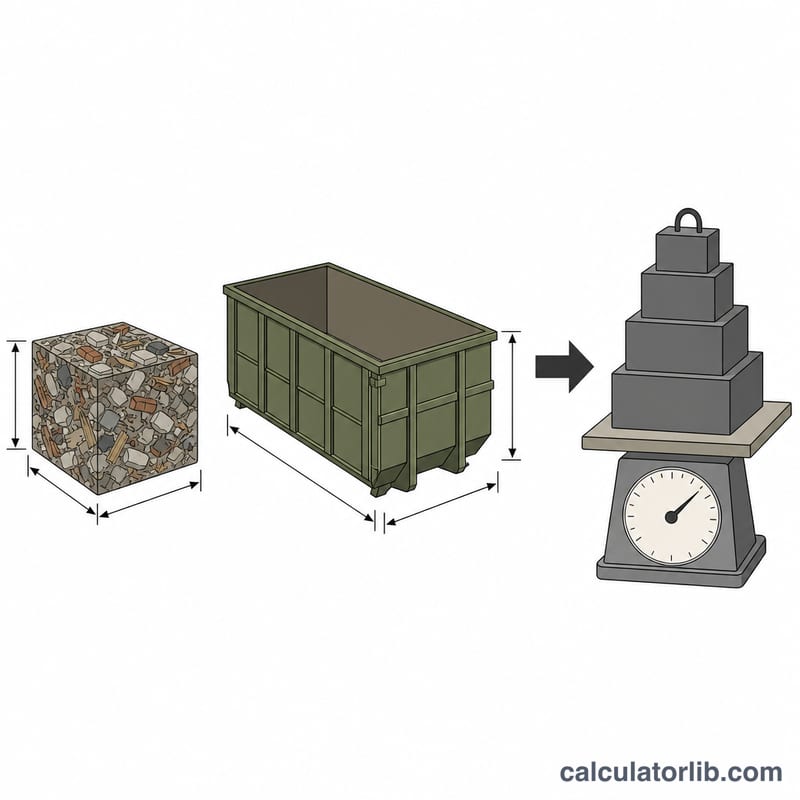
The Waste Volume to Tonnage Calculator converts a measured volume of demolition debris or bulk material into its equivalent weight. Dumpster fees, hauling contracts, and landfill tipping charges are often billed by weight (tonnage), while jobsite estimates are usually made by volume. Bridging the two requires the material's bulk density.
The formula explained
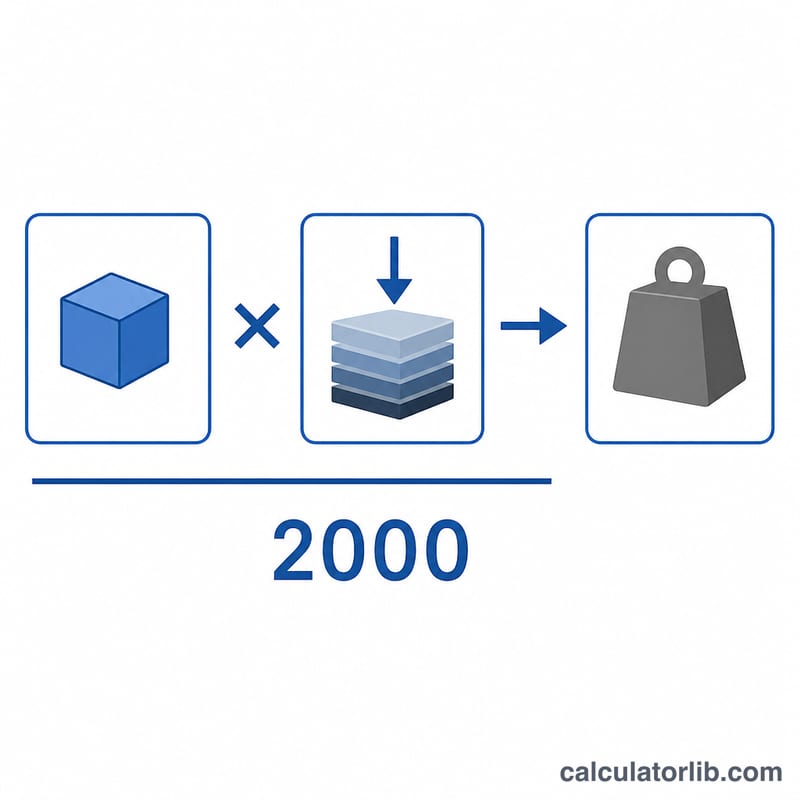
Weight equals volume multiplied by bulk density. The primary equation, using cubic yards and pounds per cubic yard, is:
$$\text{Tons} = \frac{V \times \rho}{2000}$$where \(V\) = waste volume in cubic yards, \(\rho\) = bulk density in pounds per cubic yard, and 2,000 is the number of pounds in one US short ton. To get kilograms, multiply the total pounds by \(0.45359237\); divide that by 1,000 for metric tonnes.
How to use it
Enter the total volume of waste in cubic yards and the bulk density of the material. Use a loose (uncompacted) density if the debris is piled, or a compacted density if it is packed into a container. The calculator returns the weight in tons, pounds, kilograms, and metric tonnes.
Worked example
Suppose you have \(10\) cubic yards of mixed debris at a bulk density of \(2{,}000\) lb/cy:
$$\text{Tons} = \frac{10 \times 2000}{2000} = 10\ \text{tons}$$That equals \(20{,}000\) lb, or \(20000 \times 0.45359237 \approx 9071.85\) kg (about \(9.07\) metric tonnes).
Bulk Density Reference for Common C&D Materials
These are typical bulk (in-container) densities for construction and demolition (C&D) waste, drawn from waste-hauler container guides and U.S. state DOT material weight tables. They are approximate: real density swings widely with moisture, particle size, contamination, and how tightly a load is packed, so treat each figure as a range and confirm against a scale ticket when weight matters. The values are given in pounds per cubic yard (lb/yd³), the unit this calculator expects; the metric column uses the conversion \(1\ \text{lb/yd}^3 \approx 0.593\ \text{kg/m}^3\). Because the tool divides by 2,000, its output is U.S. short tons (1 short ton = 2,000 lb), the convention used by U.S. haulers and landfills — not the 2,240 lb long ton or the 1,000 kg metric tonne.
| Material | Loose (lb/yd³) | Compacted (lb/yd³) | Approx. kg/m³ |
|---|---|---|---|
| Mixed C&D debris | 350–800 | 1,000–1,500 | ~210–890 |
| Soil / dirt (dry to damp) | 1,800–2,200 | 2,400–3,200 | ~1,070–1,900 |
| Broken concrete (rubble) | 2,000–2,500 | 2,500–3,700 | ~1,190–2,190 |
| Asphalt (broken / millings) | 1,900–2,400 | 2,400–2,900 | ~1,130–1,720 |
| Brick / masonry | 2,000–2,700 | 3,000–3,200 | ~1,190–1,900 |
| Wood / lumber scrap | 250–500 | 500–800 | ~150–475 |
| Drywall / gypsum board | 400–500 | 800–1,000 | ~240–590 |
| Roofing shingles (asphalt) | 400–700 | 1,000–1,400 | ~240–830 |
| Metal scrap (mixed, uncrushed) | 500–1,000 | 1,000–2,000 | ~300–1,190 |
| Yard / green waste | 250–500 | 500–1,000 | ~150–590 |
Note: Dense rubble (concrete, brick, soil) fills a container by weight long before it fills it by volume, while light debris (wood, drywall, green waste) does the opposite. Metal scrap is the most variable line here because it depends heavily on the mix and whether it has been crushed or baled.
Practical Next Steps for Your Estimate
The tonnage this calculator returns is only useful once you compare it to the limits and fees of the container or facility you are actually using. Use these steps to turn the number into a booking decision (fees, weight limits, and unit conventions below follow common U.S. roll-off and landfill practice and vary by region and vendor):
- Check your tons against the container's weight allowance. Roll-off dumpsters are rented with an included weight cap (for example, a 20 yd³ box is often capped at 2–4 tons). If your estimate exceeds that cap, you will pay a per-ton overage — confirm both the included tonnage and the overage rate before you book.
- Round up when you reserve. Density estimates and eyeballed volumes both run optimistic. Book the container size and weight tier one step above your calculated figure rather than exactly at it, so a heavier-than-expected load does not trigger an overage or a second haul.
- Match the density to the situation. Use a compacted density from the table when the material is loaded and settled in a container or truck, and a loose density when you are sizing an open pile on the ground. Using the wrong one can shift your tonnage by a factor of two or more.
- Add a margin for moisture. Wet soil, rain-soaked wood, and saturated drywall or shingles can weigh 15–30% more than the dry values in the table. If the debris is exposed to weather or the job runs through rain, estimate toward the high end of each range.
- Reconcile against the scale ticket. The facility's certified scale weight is what you are billed on — your estimate is only a planning tool. Keep the scale ticket and compare it to your estimate so you can refine the density you use on the next job.
Worked example: a 10 yd³ load of broken concrete at 2,200 lb/yd³ weighs \( \frac{10 \times 2200}{2000} \) = 11 U.S. short tons — already over a typical 2–4 ton dumpster allowance, so this load would need a larger box, a split into multiple hauls, or budgeting for overage fees.
This is general planning guidance, not a quote. Actual container limits, overage rates, and accepted materials differ by hauler and disposal site, so confirm the specifics with your provider before scheduling.
FAQ
Where do I find bulk density? Waste haulers and DOT material tables publish typical values: loose mixed construction and demolition debris is roughly 500–1,000 lb/cy, soil 2,000–2,700 lb/cy, and broken concrete 3,500–4,000 lb/cy.
Is a ton the same as a tonne? No. This calculator's main output is the US short ton (2,000 lb). A metric tonne is 1,000 kg (about 2,204.6 lb), shown separately in the results table.
Why does my estimate differ from the scale ticket? Real density varies with moisture, compaction, and material mix, so treat the result as a planning estimate rather than an exact billed weight.