What is the Lorentz transformation?
The Lorentz transformation relates the space and time coordinates of a single event as measured in two inertial reference frames moving at a constant relative velocity. It is the mathematical foundation of Einstein special theory of relativity and replaces the classical Galilean transformation at speeds approaching the speed of light \(c \approx 2.998 \times 10^{8}\ \text{m/s}\).
The formula explained
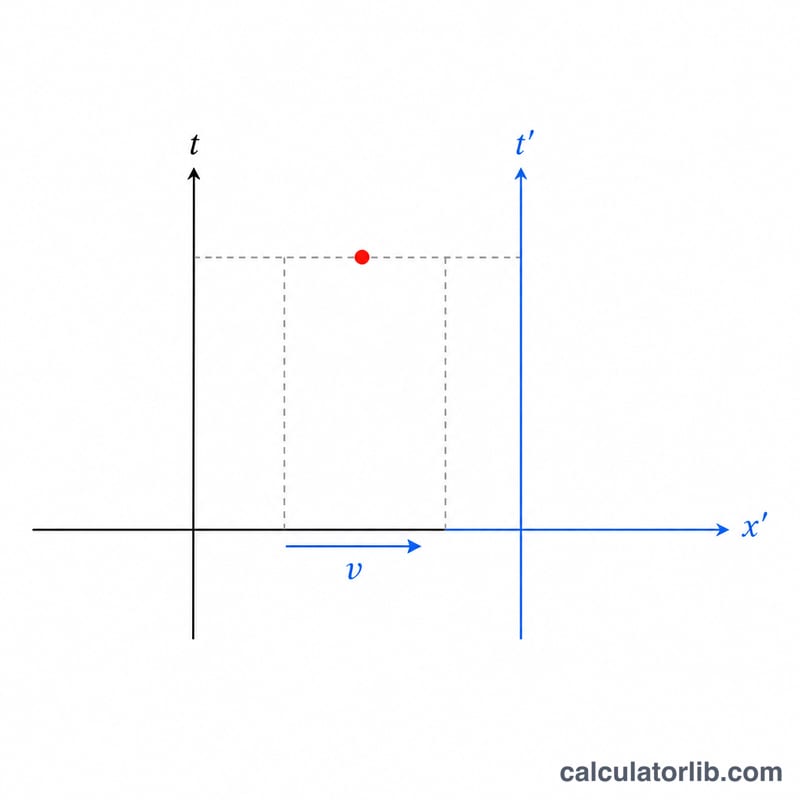
For a frame moving with velocity \(v\) along the x-axis, the transformed coordinates are given by the display equation below, where \(\gamma\) is the Lorentz factor:
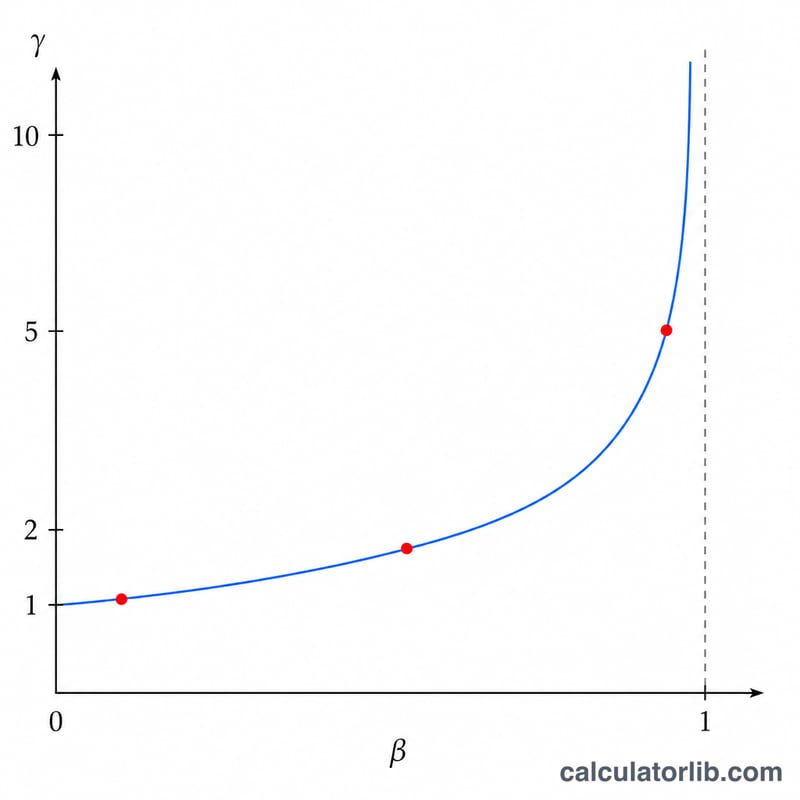
$$x^{\prime} = \gamma (x - v t), \qquad t^{\prime} = \gamma \left( t - \frac{v x}{c^2} \right)$$Here \(\gamma = \frac{1}{\sqrt{1 - v^2/c^2}}\), \(x\) is the position in meters, \(t\) is the time in seconds, and \(v = \beta c\) where \(\beta\) is the velocity expressed as a fraction of the speed of light. As \(v \to c\), the factor \(\gamma \to \infty\), stretching time and contracting length.
How to use this calculator
Enter the relative velocity as a fraction of light speed \(\beta\) (for example 0.6 means 60% of \(c\)), the event position \(x\) in meters, and the event time \(t\) in seconds. The calculator returns the Lorentz factor \(\gamma\), the transformed position \(x^{\prime}\), and the transformed time \(t^{\prime}\).
Worked example
Take \(\beta = 0.6\), \(x = 10\ \text{m}\), and \(t = 0\ \text{s}\). First compute the Lorentz factor:
$$\gamma = \frac{1}{\sqrt{1 - 0.6^2}} = \frac{1}{\sqrt{0.64}} = 1.25$$Then the transformed position and time:
$$x^{\prime} = 1.25 \times (10 - 0) = 12.5\ \text{m}$$$$t^{\prime} = 1.25 \left( 0 - \frac{0.6 \times 10}{c} \right) \approx -2.50 \times 10^{-8}\ \text{s}$$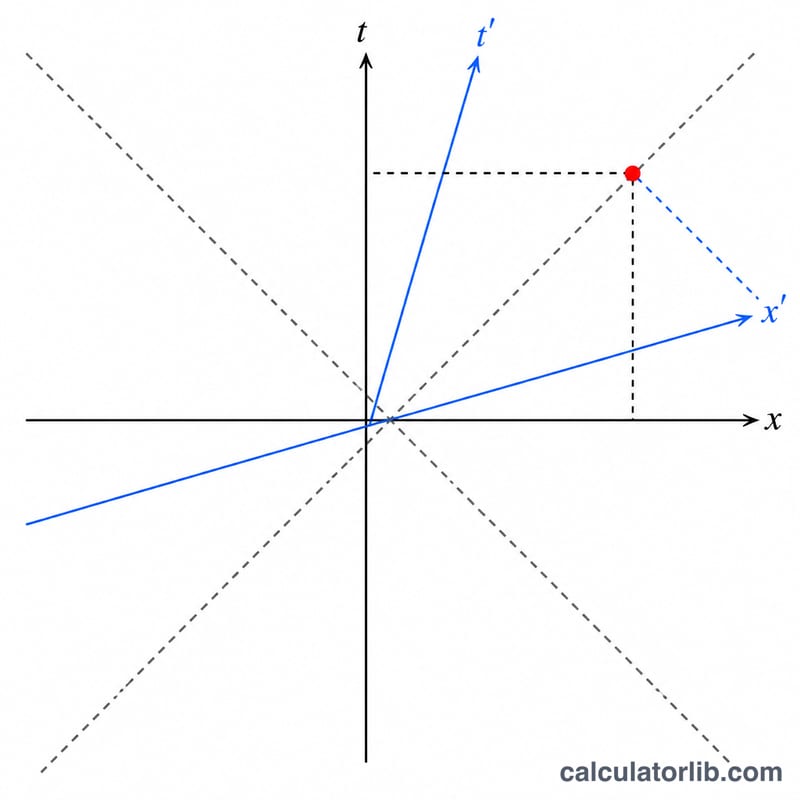
FAQ
Why must the velocity be less than c? The factor \(\gamma\) becomes imaginary if \(v \ge c\), so no massive object can reach or exceed light speed.
What happens at low speeds? When \(v \ll c\), \(\gamma \approx 1\) and the equations reduce to the familiar Galilean transformation \(x^{\prime} = x - v t\).
Is the transformation symmetric? Yes. The inverse transformation has the same form with \(v\) replaced by \(-v\).