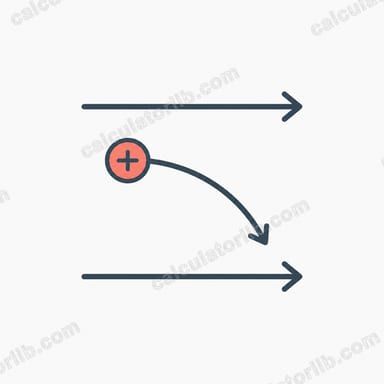

What Is the Lorentz Force?
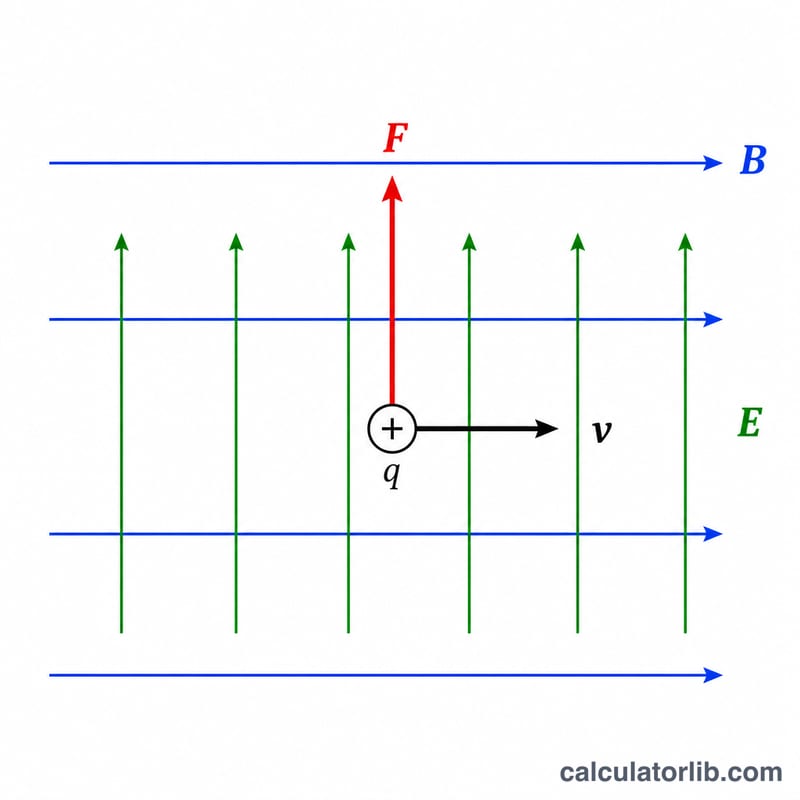
The Lorentz force is the total electromagnetic force experienced by a charged particle. It combines the electric force, which acts whenever a charge sits in an electric field, and the magnetic force, which acts only on a moving charge crossing a magnetic field. This calculator evaluates the scalar magnitude using \( F = q(E + vB\cdot\sin\theta) \), a convenient simplified form for the common case where the electric force and magnetic force point along the same line.
How to Use This Calculator
Enter the charge q in coulombs (use a negative value for an electron or anion), the electric field strength E in volts per metre, the particle's speed v in metres per second, the magnetic flux density B in teslas, and the angle θ between the velocity and the magnetic field in degrees. The calculator returns the total force in newtons along with the separate electric \( (qE) \) and magnetic \( (qvB\cdot\sin\theta) \) contributions.
The Formula Explained
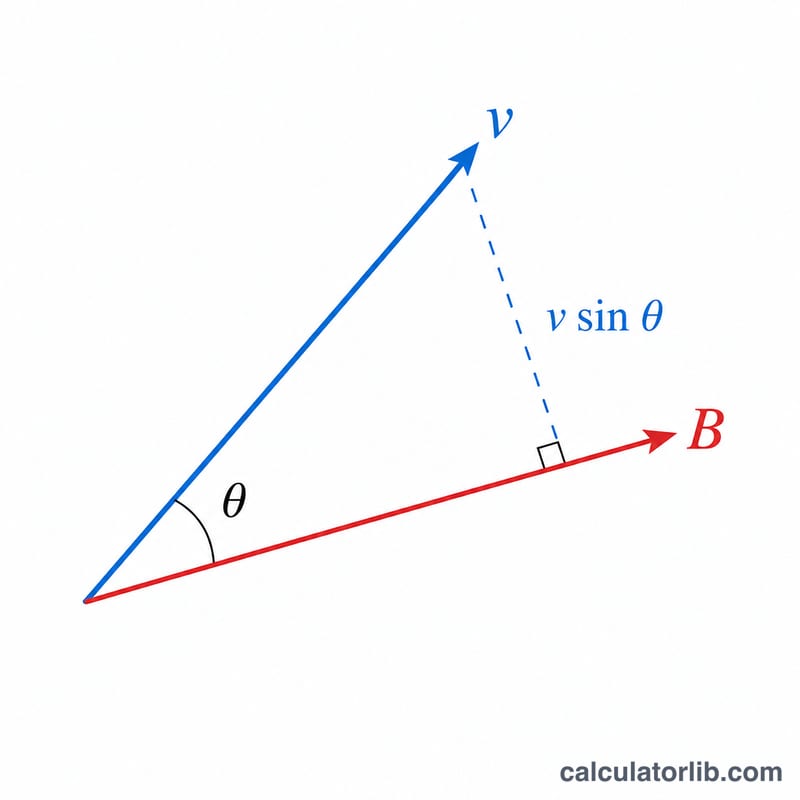
The full vector law is $$F = q(E + v \times B)$$. The magnitude of the magnetic cross product is \( vB\cdot\sin\theta \), where θ is the angle between v and B — it is maximised at \( \theta = 90^\circ \) and zero when the particle moves parallel to the field \( (\theta = 0^\circ) \). Adding the electric contribution \( qE \) gives the combined magnitude $$F = q(E + vB\cdot\sin\theta)$$
Worked Example
A charge of \( q = 2\ \text{C} \) moves at \( v = 100\ \text{m/s} \) through a magnetic field of \( B = 0.5\ \text{T} \) at \( \theta = 90^\circ \), with no electric field \( (E = 0) \). Then $$vB\cdot\sin\theta = 100 \times 0.5 \times \sin 90^\circ = 50,$$ so $$F = 2 \times (0 + 50) = \mathbf{100\ \text{N}}.$$
FAQ
Why does the angle matter? Only the velocity component perpendicular to B produces magnetic force; the \( \sin\theta \) factor captures this, vanishing when motion is parallel to the field.
What if my charge is negative? Enter the negative value — the resulting force sign tells you the direction relative to the assumed positive convention.
Can I ignore the electric field? Yes, set \( E = 0 \) to study a purely magnetic force on a moving charge.