What is a Unit of Electricity?
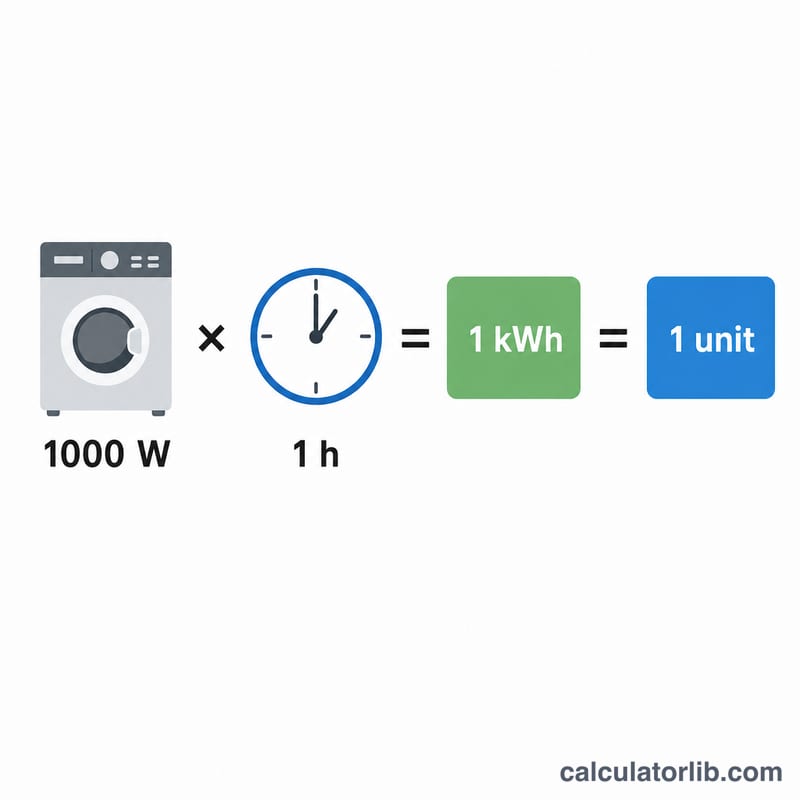
On your electricity bill, a "unit" is simply one kilowatt-hour (kWh) of energy. This is a universal convention used by utility providers worldwide: 1 unit = 1 kWh. One kWh is the energy used by a 1,000-watt appliance running for one hour. This calculator turns the units shown on your meter into kWh and estimates the cost based on the tariff your supplier charges per unit.
How to Use This Calculator
Enter the number of electricity units consumed (read this from your meter or bill) and the cost charged per unit. The calculator returns the energy in kWh — which equals the units — and multiplies the units by your rate to estimate the total cost. Because the conversion is one-to-one, the main use of this tool is quickly pricing your consumption.
The Formula Explained
The conversion is direct: \(\text{kWh} = \text{Units}\). To find the bill amount, use \(\text{Cost} = \text{Units} \times \text{Rate}\), where rate is the price per unit (per kWh) in your local currency.
$$\text{kWh} = \text{Units}$$$$\text{Cost} = \text{Units} \times \text{Rate per Unit}$$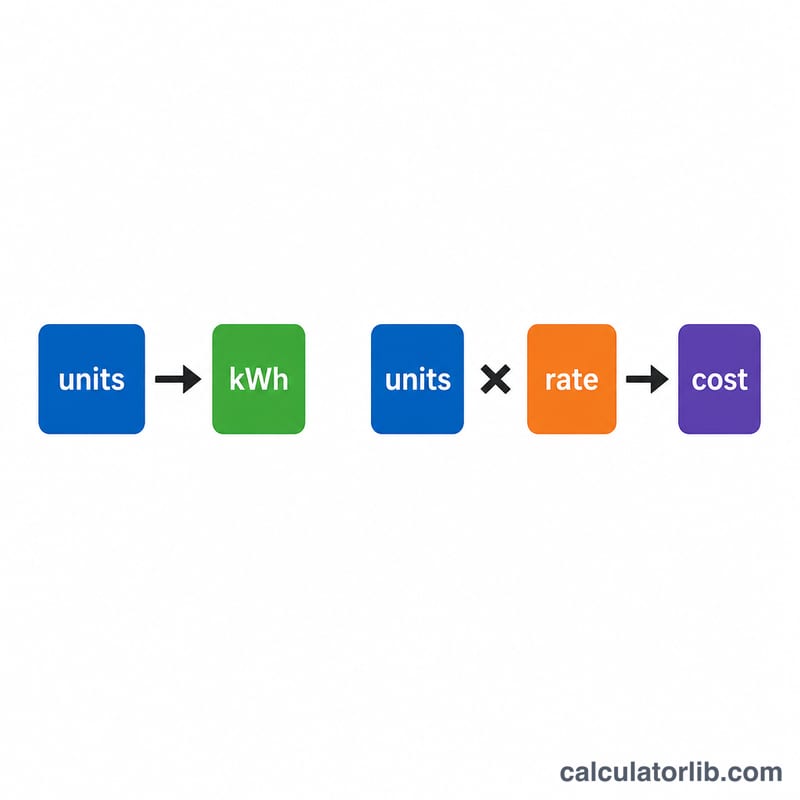
Worked Example
Suppose you used 250 units last month and your supplier charges 0.20 per unit. The energy is 250 kWh, and the cost is $$250 \times 0.20 = 50.00.$$ So your estimated bill for energy consumed is 50.00.
Electricity Unit Conversion Table
On an electricity bill, one "unit" of electricity means exactly one kilowatt-hour (kWh). This naming is common in India, Pakistan, Bangladesh, Nigeria, the UK and many other countries — the underlying quantity is identical everywhere: \(1\ \text{unit} = 1\ \text{kWh}\). Because the conversion factor is 1, converting units to kWh needs no arithmetic; the useful work is converting that kWh into other energy units.
| 1 unit (1 kWh) equals | Value | Unit |
|---|---|---|
| Units of electricity | 1 | unit |
| Watt-hours | 1,000 | Wh |
| Joules | 3,600,000 | J |
| Megajoules | 3.6 | MJ |
| British thermal units | 3,412.14 | BTU |
| Kilocalories | 859.845 | kcal |
The same factors read in reverse:
| From | To kWh (units) |
|---|---|
| 1 Wh | 0.001 kWh |
| 1 MJ | 0.2778 kWh |
| 1 BTU | 0.000293071 kWh |
| 1 kcal | 0.001163 kWh |
The exact joule relationship is the definition behind every row: one watt is one joule per second, and an hour is 3,600 seconds, so
$$1\ \text{kWh} = 1{,}000\ \text{W} \times 3{,}600\ \text{s} = 3{,}600{,}000\ \text{J} = 3.6\ \text{MJ}$$Note on kW versus kWh. A kilowatt (kW) is power — the rate at which energy is used at an instant. A kilowatt-hour (kWh) is energy — power multiplied by time. A 1 kW appliance running for 1 hour consumes 1 kWh, which is 1 unit on your bill. The same 1 kW appliance running for 30 minutes consumes 0.5 unit, and a 2 kW appliance running for 30 minutes also consumes 1 unit. Meters record energy (kWh), which is why the tariff is quoted per unit.
The BTU and kcal figures follow the international-table definitions (the IT calorie of 4.1868 J and the IT British thermal unit); other BTU definitions differ slightly in the last decimals, so small discrepancies between published tables are normal and immaterial for billing.
Cost Comparison Across Typical Consumption Scenarios
Because 1 unit = 1 kWh, the energy portion of a bill is a single multiplication:
$$\text{Cost} = \text{Units} \times \text{Rate per Unit}$$The table below shows that cost for five realistic monthly consumption levels and four illustrative per-unit rates. The rates 0.10 to 0.40 per kWh are shown in generic currency terms so they can be read as dollars, euros, pounds or any other currency — they are examples, not the tariff of any particular country or utility. Enter the rate printed on your own bill for an exact figure.
| Monthly units (= kWh) | @ 0.10 / unit | @ 0.20 / unit | @ 0.30 / unit | @ 0.40 / unit |
|---|---|---|---|---|
| 50 units = 50 kWh | 5.00 | 10.00 | 15.00 | 20.00 |
| 100 units = 100 kWh | 10.00 | 20.00 | 30.00 | 40.00 |
| 250 units = 250 kWh | 25.00 | 50.00 | 75.00 | 100.00 |
| 500 units = 500 kWh | 50.00 | 100.00 | 150.00 | 200.00 |
| 1000 units = 1000 kWh | 100.00 | 200.00 | 300.00 | 400.00 |
Worked example. A meter reading moves from 4,820 to 5,070 over a billing month, and the tariff is 0.30 per unit:
$$\text{Units} = 5{,}070 - 4{,}820 = 250\ \text{units} = 250\ \text{kWh}$$$$\text{Cost} = 250 \times 0.30 = 75.00$$So 250 units of consumption produces an energy charge of 75.00 at that rate.
What these figures exclude. Every cell above is the energy charge only. A real bill usually adds a fixed or standing charge (a daily or monthly amount that does not depend on consumption), taxes or levies such as VAT or GST, and in many places metering, transmission or fuel-adjustment surcharges. Many utilities also bill in slabs or blocks, where the first tranche of units is cheaper than later ones, or on time-of-use tariffs where the same kWh costs more at peak hours than off-peak. Where those structures apply, a single average rate gives an approximation rather than the exact billed amount — for a slab tariff, calculate each block at its own rate and add the results.
FAQ
Is 1 unit always 1 kWh? Yes. The billing "unit" is defined as one kilowatt-hour, regardless of country.
Does this include fixed charges or taxes? No. This estimates only the energy cost (units × rate). Standing charges, taxes, and levies are added separately by your supplier.
What rate should I enter? Use the per-unit (per-kWh) price from your latest bill or tariff sheet for the most accurate estimate.