What this calculator does
The Daily Electricity Usage Calculator turns an appliance's power rating into the energy it actually consumes. Enter the device wattage, how many hours it runs each day, and your electricity price per kWh, and you instantly see the energy used and cost per day, month, and year. It works for any appliance worldwide — just use your local cost per kilowatt-hour.
How to use it
Find the wattage on the appliance label or in its manual (e.g. a 100 W bulb, a 1500 W heater). Enter the number of hours you typically use it each day. Then enter the price you pay per kWh — check a recent electricity bill. The calculator shows kWh per day along with monthly (30-day) and yearly (365-day) totals and costs.
The formula explained
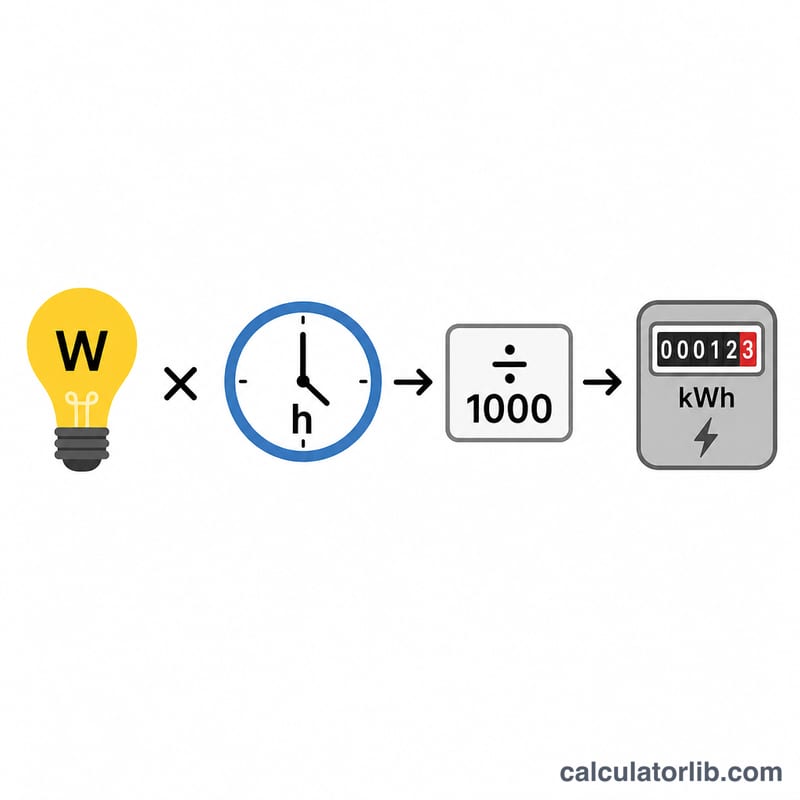
Energy in kilowatt-hours equals power in watts multiplied by hours of use, divided by 1000 (since 1 kW = 1000 W):
$$\text{kWh/day} = \frac{\text{Watts} \times \text{hours/day}}{1000}$$
Cost simply multiplies that energy by your rate: $$\text{Cost/day} = \text{kWh/day} \times \text{rate}$$ Monthly and yearly figures scale the daily value by 30 and 365.
Worked example
A 100 W light bulb running 5 hours a day at $0.15 per kWh: $$\text{kWh/day} = \frac{100 \times 5}{1000} = 0.5\ \text{kWh}$$ $$\text{Cost/day} = 0.5 \times \$0.15 = \$0.075$$ Over a year that is \(182.5\) kWh and about \(\$27.38\).
Typical Appliance Wattage and Daily Usage
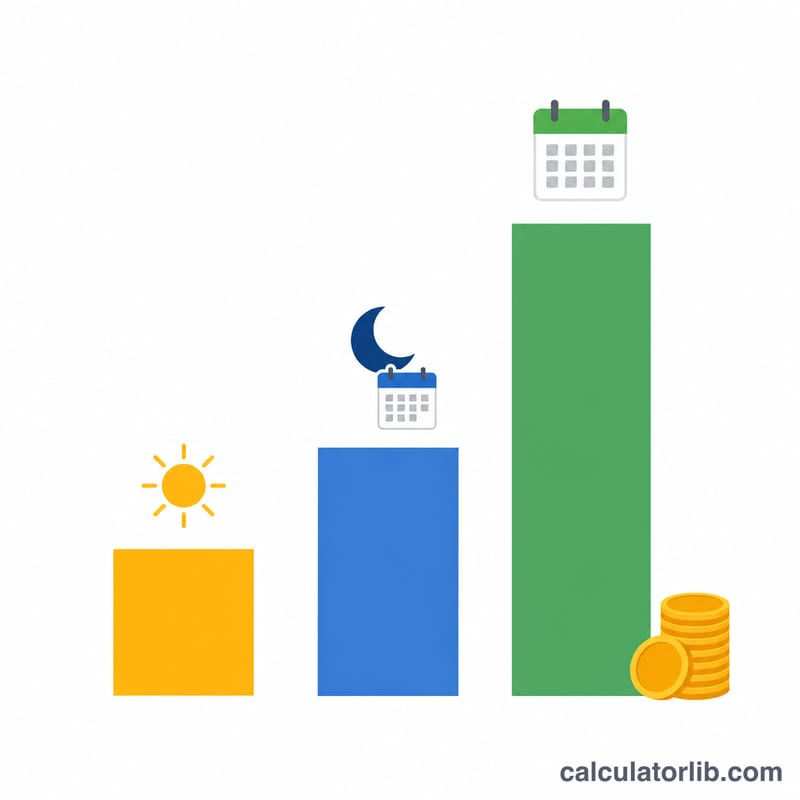
The table lists approximate power ratings for common household appliances, with an assumed typical daily run time and the resulting energy use from \(\text{kWh/day} = \frac{ \text{W} \times \text{h}}{1000}\). All figures are rough. Models differ, so the rating on your appliance's label (or its manual) takes precedence over these ranges.
| Appliance | Typical power (W) | Assumed hours/day | Approx. kWh/day |
|---|---|---|---|
| LED bulb | 8-12 | 5 | 0.04-0.06 |
| Incandescent bulb | 60-100 | 5 | 0.30-0.50 |
| Laptop | 50-100 | 6 | 0.30-0.60 |
| Desktop PC | 200-500 | 4 | 0.8-2.0 |
| LED TV | 50-150 | 4 | 0.2-0.6 |
| Refrigerator (while running) | 100-250 | about 8 (compressor on-time) | 0.8-2.0 |
| Microwave | 600-1200 | 0.25 | 0.15-0.30 |
| Space heater | 1500 | 4 | 6.0 |
| Window AC | 500-1500 | 8 | 4.0-12.0 |
| Washing machine | 500-2000 | 1 | 0.5-2.0 |
| Electric kettle | 1500-3000 | 0.25 | 0.38-0.75 |
Hours per day are illustrative assumptions, not measured averages. Replace them with your own usage for a better estimate.
Interpreting Your Result
A kilowatt-hour (kWh) is the unit most utilities bill by. 1 kWh is the energy used by a 1 kW (1000 W) load running for one hour, so a 100 W bulb running for 10 hours also uses 1 kWh.
The result is an estimate. It assumes the appliance draws its rated power constantly for the hours you enter. Real consumption often differs:
- Duty cycle: a refrigerator compressor, a thermostat-controlled heater or an air conditioner cycles on and off, so average draw is lower than the running wattage. Use only the hours the device is actually drawing power, or an estimate of its on-time.
- Variable load: computers, TVs and washing machines draw different amounts depending on what they are doing.
- Standby power: the small draw of devices that are off but plugged in is not included unless you add it as its own entry.
To compare with your meter or bill, calculate each appliance separately and add the kWh/day values together. Multiply by the number of days in the billing period (or use the monthly figure) and compare the total with the kWh shown on your bill. A gap often points to appliances you left out, standby loads, or inaccurate run-time guesses.
Average household use varies widely by country, climate, home size and heating or cooling type. In the United States, the U.S. Energy Information Administration (EIA) reports average residential use of roughly 29-30 kWh per day (about 10,500-11,000 kWh per year). Figures in other countries are often considerably lower or higher.
FAQ
Where do I find the wattage? It's usually printed on a label on the appliance or in the manual. Some devices list amps and volts instead — multiply them (\(\text{W} = \text{A} \times \text{V}\)).
What rate should I enter? Use your effective cost per kWh from your latest electricity bill, including any per-unit charges.
Why use 30 and 365 days? These are standard averages for monthly and yearly estimates; actual months vary slightly.