
What Is Customer Lifetime Value?
Customer Lifetime Value (CLV or LTV) is the total revenue a business can reasonably expect from a single customer over the entire span of their relationship. It is one of the most important metrics in marketing and unit economics because it tells you how much you can afford to spend acquiring a customer while staying profitable. This calculator uses the simple, widely-taught CLV model based on three inputs you can pull from any sales report.
How to Use This Calculator
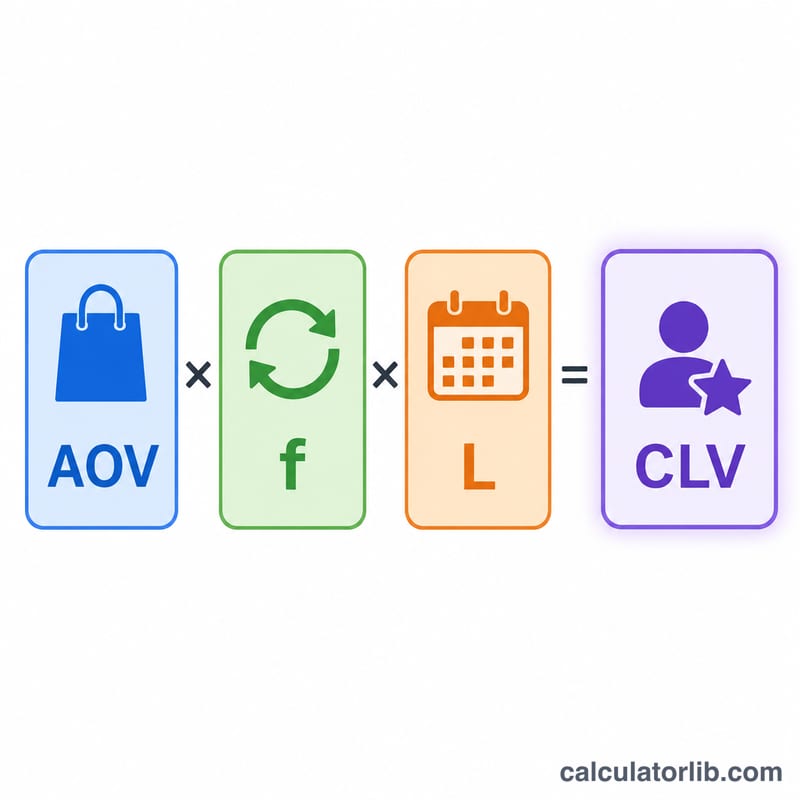
Enter three numbers: your Average Order Value (AOV) — the typical dollar amount spent per purchase; your Purchase Frequency — how many times the average customer buys per year; and your Customer Lifespan — how many years the average customer keeps buying from you. Click calculate to see the estimated lifetime revenue, plus annual revenue per customer and total number of purchases.
The Formula Explained
The model multiplies the three drivers of revenue together:
$$\text{CLV} = \text{Average Order Value} \times \text{Purchase Frequency} \times \text{Customer Lifespan}$$
If you increase any single factor — get customers to spend more, buy more often, or stay loyal longer — the lifetime value grows proportionally. Note this simple version is revenue-based; to get profit-based CLV, multiply the result by your gross margin percentage.
Worked Example
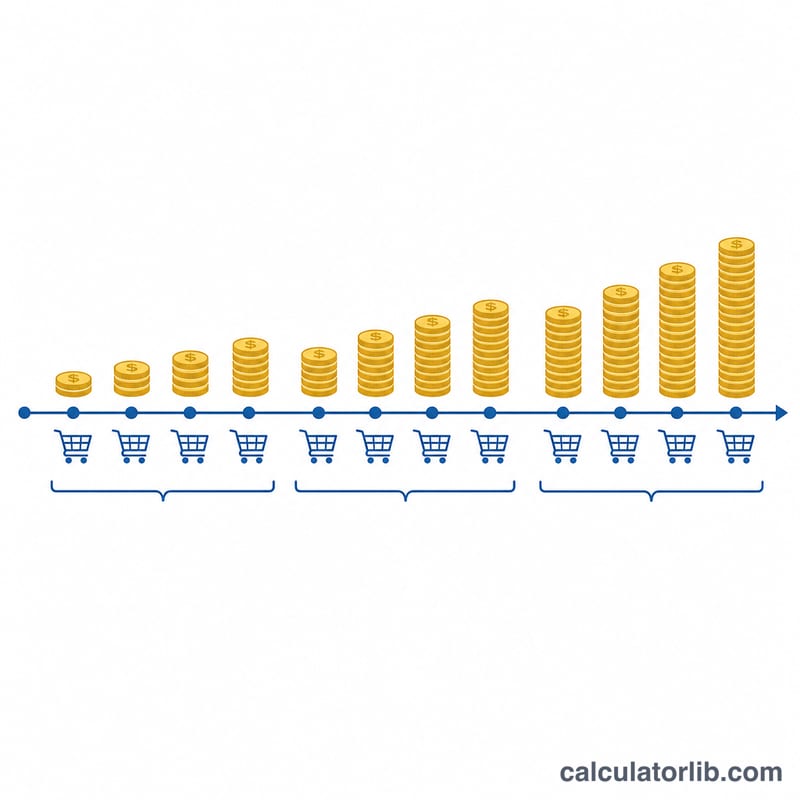
Suppose your store has an average order value of $50, customers buy 4 times per year, and they stay with you for 3 years. The math is: $$\$50 \times 4 \times 3 = \mathbf{\$600}$$ That customer is worth about $600 in revenue over their lifetime, with $200 of annual revenue and 12 total purchases. If your gross margin is 40%, the profit-based CLV would be \(\$600 \times 0.40 = \$240\).
FAQ
Is this revenue or profit? This simple model returns revenue. Multiply by your gross margin to estimate profit.
How do I find purchase frequency? Divide total orders in a period by the number of unique customers, then annualize it.
Why does CLV matter? It sets the ceiling for your customer acquisition cost (CAC). A healthy business typically keeps CLV at least 3× higher than CAC.