What This Calculator Does
The Percentage to Letter Grade Calculator converts a numeric percentage score into a letter grade using the standard 10-point grading scale common in the United States. Enter any score from 0 to 100 and instantly see the matching letter (A, B, C, D, or F) along with the equivalent grade point on a 4.0 GPA scale. Grading scales vary by school and country, so this tool reflects the widely used US 10-point convention.
How to Use It
Type your percentage score into the box — for example, 87 for an 87% test result — and the calculator returns the letter grade. Decimals such as 89.5 are accepted. The result panel also shows the equivalent GPA value, helpful when estimating your cumulative grade point average.
The Formula Explained
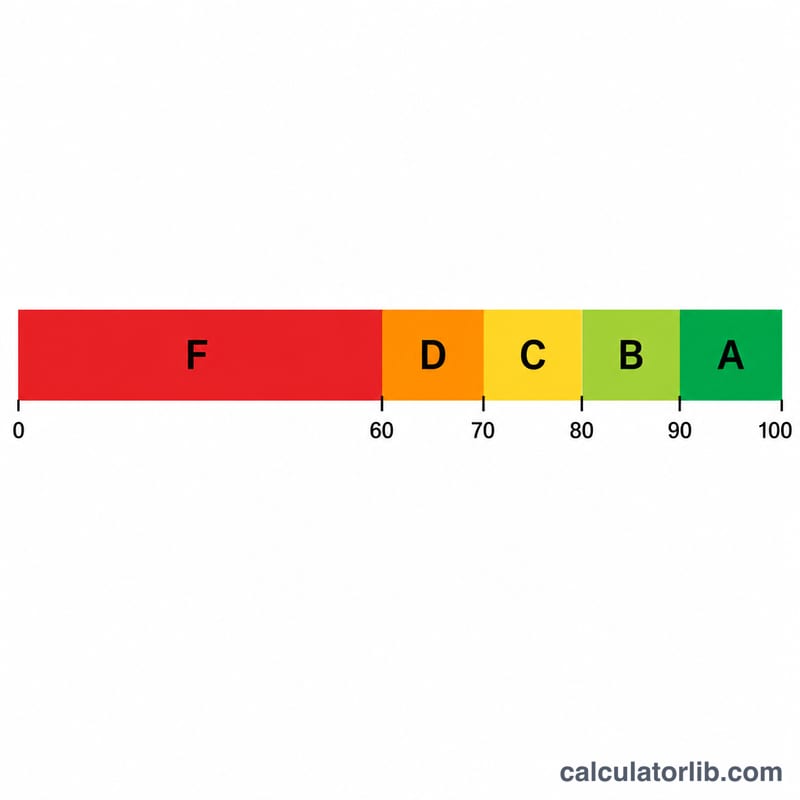
The conversion is a simple piecewise function. Any score of 90 or above earns an A, 80 to 89.99 earns a B, 70 to 79.99 a C, 60 to 69.99 a D, and anything below 60 is an F. Each letter then corresponds to grade points: A = 4.0, B = 3.0, C = 2.0, D = 1.0, F = 0.0.
$$\text{Letter} = \begin{cases} A & \text{Percentage} \geq 90 \\ B & 80 \leq \text{Percentage} < 90 \\ C & 70 \leq \text{Percentage} < 80 \\ D & 60 \leq \text{Percentage} < 70 \\ F & \text{Percentage} < 60 \end{cases}$$
Worked Example
Suppose you scored 85% on an exam. Because 85 falls in the 80–89 band, the letter grade is B, which equals a 3.0 on the 4.0 GPA scale. A score of exactly 90 would round up to an A (4.0), while 59.9 would fall to an F (0.0).
Percentage to Letter Grade and GPA Chart
This chart uses the standard 10-point grading scale common in the United States. Individual schools and instructors may set different cutoffs, so check your own syllabus or school policy.
| Percentage | Letter Grade | 4.0 GPA Value | Typical Descriptor |
|---|---|---|---|
| 90–100% | A | 4.0 | Excellent |
| 80–89% | B | 3.0 | Good |
| 70–79% | C | 2.0 | Satisfactory |
| 60–69% | D | 1.0 | Passing / Poor |
| Below 60% | F | 0.0 | Failing |
Plus/Minus Scale vs. Basic 10-Point Scale
Many US schools add plus and minus modifiers. The plus/minus scale used below is a common example: A+ 97–100 = 4.0, A 93–96 = 4.0, A- 90–92 = 3.7, B+ 87–89 = 3.3, B 83–86 = 3.0, B- 80–82 = 2.7, C+ 77–79 = 2.3, C 73–76 = 2.0, C- 70–72 = 1.7, D+ 67–69 = 1.3, D 63–66 = 1.0, D- 60–62 = 0.7, F below 60 = 0.0. Cutoffs and GPA values vary by institution (some schools give A+ a 4.3, and some do not use minus grades at all), so treat this as an illustration rather than a universal rule.
| Score | Basic Scale Grade | Basic GPA | Plus/Minus Grade | Plus/Minus GPA |
|---|---|---|---|---|
| 97% | A | 4.0 | A+ | 4.0 |
| 93% | A | 4.0 | A | 4.0 |
| 91% | A | 4.0 | A- | 3.7 |
| 88% | B | 3.0 | B+ | 3.3 |
| 85% | B | 3.0 | B | 3.0 |
| 81% | B | 3.0 | B- | 2.7 |
| 78% | C | 2.0 | C+ | 2.3 |
| 75% | C | 2.0 | C | 2.0 |
| 71% | C | 2.0 | C- | 1.7 |
| 68% | D | 1.0 | D+ | 1.3 |
| 65% | D | 1.0 | D | 1.0 |
| 61% | D | 1.0 | D- | 0.7 |
| 55% | F | 0.0 | F | 0.0 |
Notice that under the plus/minus scale, scores near the bottom of a band (such as 91% or 81%) earn a lower GPA value than the basic scale, while scores near the top (such as 88% or 78%) earn a higher one.
Interpreting Your Letter Grade
Letter grades are a shorthand for the level of performance in a course. Conventionally in the US:
- A – excellent; work that consistently exceeds expectations.
- B – good or above average; solid mastery with some gaps.
- C – average or satisfactory; meets the basic requirements.
- D – minimally passing; earns credit at most schools but shows significant gaps.
- F – failing; no course credit is earned.
A D may earn credit but may not satisfy requirements everywhere. Some schools and programs require a minimum grade of C (or C-) for courses in a major or for prerequisites, so a D might need to be retaken in those cases. Policies differ by institution and program.
How grade points feed into a weighted GPA
Each course's grade point value is multiplied by its credit hours, the products are summed, and the total is divided by the total credit hours attempted:
$$\text{GPA} = \frac{ \sum (\text{grade points} \times \text{credit hours})}{\sum \text{credit hours}}$$
Example: an A (4.0) in a 3-credit course, a B (3.0) in a 4-credit course, and a C (2.0) in a 3-credit course:
$$\text{GPA} = \frac{4.0 \times 3 + 3.0 \times 4 + 2.0 \times 3}{3 + 4 + 3} = \frac{12 + 12 + 6}{10} = \frac{30}{10} = 3.00$$
Because of this weighting, a grade in a 4-credit course influences the GPA more than the same grade in a 1-credit course. Some schools also use weighted scales (for example, extra points for honors or AP courses), which this chart does not include.
FAQ
Does this include plus/minus grades? No. This tool uses the basic five-letter scale. Schools that use A−, B+, etc. apply narrower bands that vary by institution.
Is the scale the same everywhere? No. The 10-point scale shown here is standard in the US, but other countries and individual instructors set their own cutoffs.
What letter is exactly 70%? A score of 70 lands in the C band (70–79), so it is a C.