
What This Calculator Does
This tool computes the average flow velocity of a fluid moving through a round pipe when you know the volumetric flow rate in U.S. gallons per minute (GPM) and the inside diameter of the pipe in inches. Velocity is essential for sizing pipes, avoiding erosion or water hammer, and checking that a system stays within recommended speed limits (typically 5–8 ft/s for water).
How to Use It
Enter the flow rate in GPM and the inside pipe diameter in inches, then read the velocity in feet per second (with a metric m/s equivalent). Use the inside diameter, not the nominal pipe size, for accurate results.
The Formula Explained
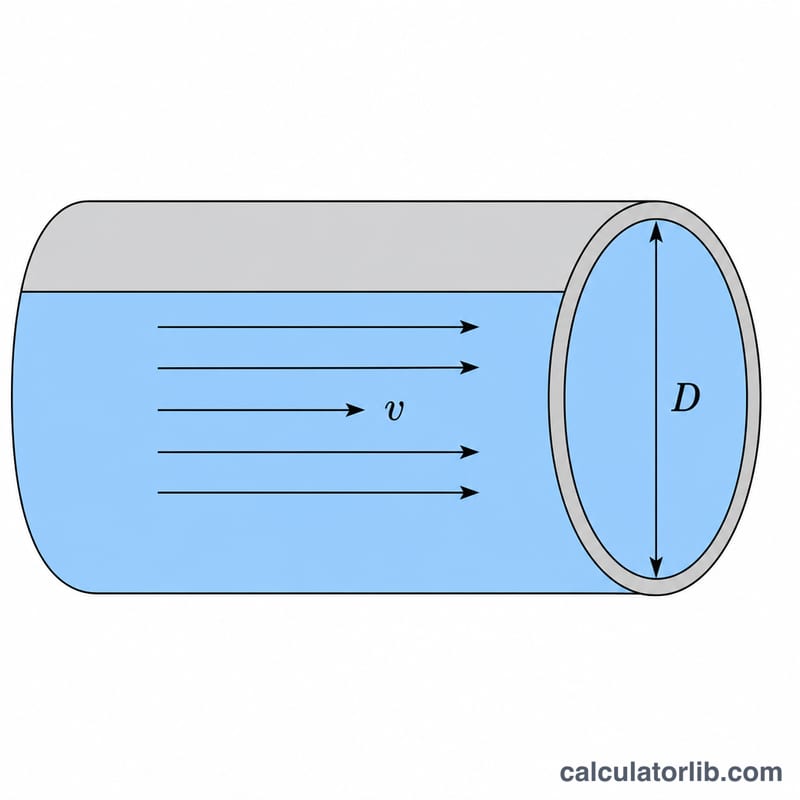
Velocity is flow rate divided by cross-sectional area: $$v = \frac{Q}{\frac{\pi}{4} \cdot D^{2}}$$ To keep units consistent, GPM is converted to cubic feet per second (1 gallon = 0.13368 ft³, divided by 60 seconds), and the diameter is converted from inches to feet (÷12). The area of a circle is \(\frac{\pi}{4} \cdot D^{2}\). Dividing flow by area gives velocity in ft/s.
Worked Example
For 50 GPM in a 2-inch pipe: $$Q = 50 \times \frac{0.13368}{60} = 0.11140 \text{ ft}^3/\text{s}$$ Diameter = \(2/12 = 0.16667\) ft, so area $$A = \frac{\pi}{4} \times 0.16667^{2} = 0.021817 \text{ ft}^2$$ Velocity $$v = \frac{0.11140}{0.021817} \approx \mathbf{5.11 \text{ ft/s}}$$ (about 1.56 m/s).
FAQ
Should I use nominal or actual diameter? Always use the actual inside diameter, which is smaller than the nominal size for most pipe schedules.
What velocity is too high? For water, keep velocity under roughly 5–8 ft/s on supply lines to limit noise, erosion, and pressure loss.
Does this work for any liquid? Yes — velocity depends only on flow rate and area, so the same formula applies to any liquid, though pressure-loss behavior differs by viscosity.