
What is the BAC Calculator?
This tool estimates your Blood Alcohol Content (BAC) — the percentage of alcohol in your bloodstream — using the classic Widmark formula. It is intended for education and curiosity only and is not a substitute for a breathalyzer or any legal/medical judgement. The size of a "standard drink" varies by country (the US uses ~14 g of pure alcohol; the UK and Australia use ~8 g and ~10 g respectively), so you can set the grams per drink to match where you are.
How to use it
Select your gender, enter your body weight in kilograms, the number of standard drinks consumed, the grams of pure alcohol in each drink, and how many hours have passed since your first drink. The calculator returns an estimated BAC percentage along with the total grams of alcohol and the Widmark factor used.
The formula explained
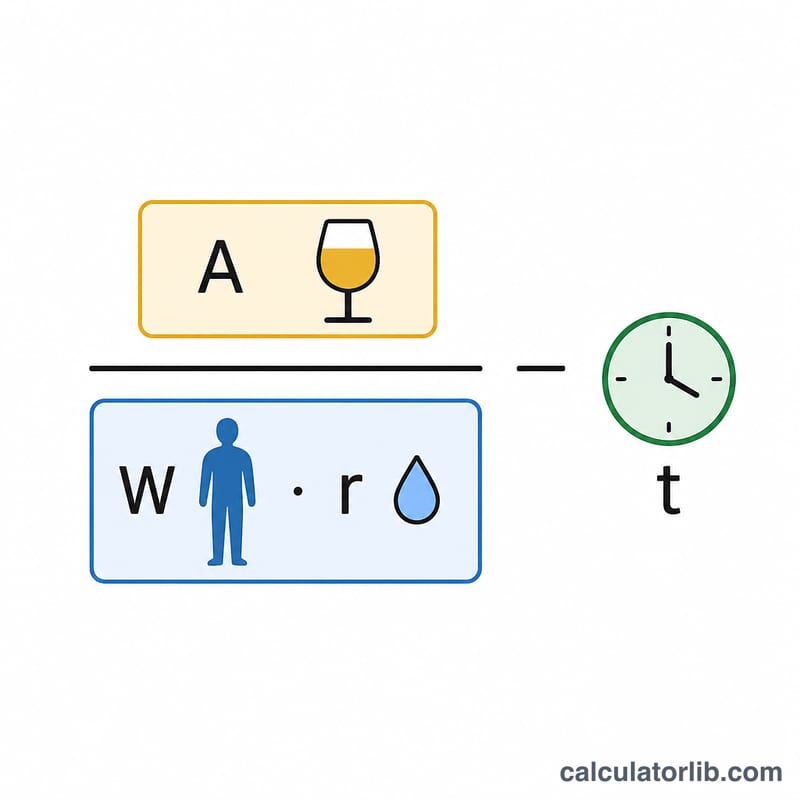
The Widmark equation is $$\text{BAC\%} = \frac{A}{W \times r} \times 100 - 0.015 \times t$$ where A is grams of pure alcohol, W is body weight in grams, r is the distribution factor (about \(0.68\) for men and \(0.55\) for women, since alcohol distributes mainly in body water), and t is hours elapsed. The body metabolizes alcohol at roughly \(0.015\%\) BAC per hour, which is the subtraction term.
Worked example
An 80 kg man has 3 standard drinks of 14 g each over 1 hour. Alcohol = \(3 \times 14 = 42\) g. Weight in grams = 80,000. $$\text{BAC} = \frac{42}{80{,}000 \times 0.68} \times 100 - 0.015 \times 1 = \frac{42}{54{,}400} \times 100 - 0.015 = 0.07721 - 0.015 \approx \mathbf{0.062\%}$$
Interpreting Your BAC Result
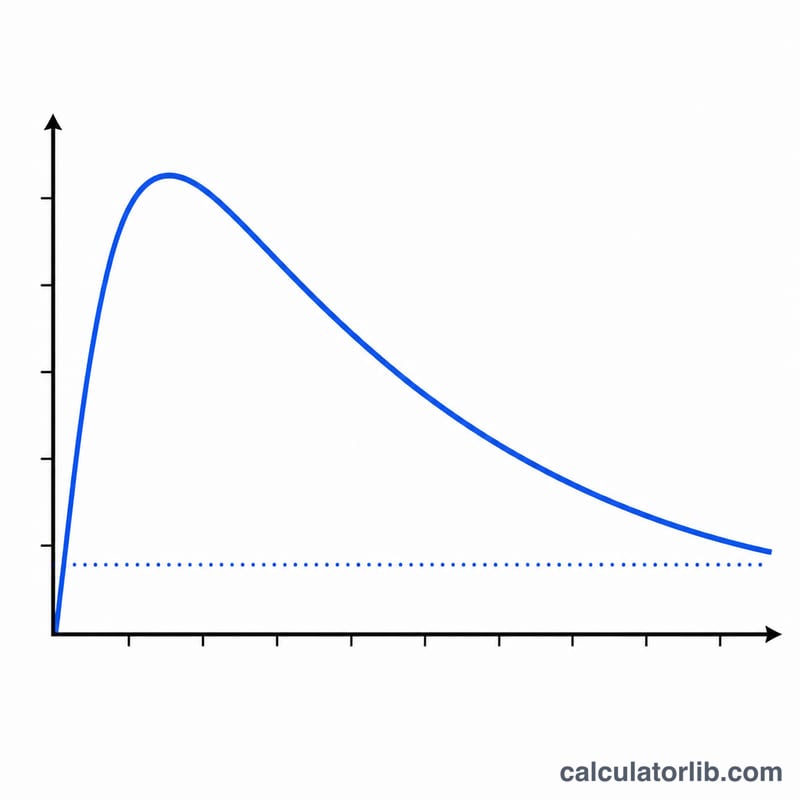
Blood Alcohol Content (BAC) is expressed as a percentage representing grams of alcohol per 100 millilitres of blood. The Widmark estimate this tool produces is an educational approximation only; real BAC depends on food intake, hydration, medications, liver function, drinking speed and many other factors that no formula fully captures. The ranges below are widely cited general references, not a clearance to drive or operate machinery.
- 0.02–0.05% — Mild impairment: some loss of judgment, relaxation, slight decline in visual tracking and the ability to divide attention between tasks.
- 0.05% — The legal driving limit for most drivers in much of Europe, Australia, and many other countries.
- 0.08% — The legal limit for driving ("per se" DUI threshold) in the United States and many other jurisdictions. Utah uses a stricter 0.05% limit.
- 0.15–0.30% — Major impairment of motor control, balance, speech, vision and reaction time; risk of blackout and vomiting.
- 0.30% and above — Potentially life-threatening: stupor, loss of consciousness, suppressed breathing and risk of alcohol poisoning requiring emergency care.
Limits vary by country, by vehicle class, and are typically zero or near-zero for novice and commercial drivers. This is general information, not medical, legal, or professional advice. Never drive after drinking — any amount of alcohol can impair the skills needed to drive safely, even below a legal limit.
BAC Levels and Typical Effects
The following table summarises commonly documented effects associated with rising BAC. Individual responses vary widely; these are general references and not a measure of fitness to drive or perform any task.
| BAC range (%) | Commonly documented effects |
|---|---|
| 0.00–0.03 | Minimal to no obvious effect; subtle changes in mood; most measurable functions near normal. |
| 0.03–0.06 | Relaxation, mild euphoria, lowered inhibition; slight impairment of reasoning, memory and fine coordination. |
| 0.06–0.10 | Reduced coordination and reaction time; impaired depth perception, peripheral vision and judgment. |
| 0.10–0.20 | Significant impairment of motor control and balance; slurred speech, slowed reactions, nausea possible. |
| 0.20–0.30 | Confusion, disorientation, dizziness; may need help to stand or walk; vomiting and blackout likely. |
| 0.30 and above | Stupor, possible loss of consciousness, depressed breathing and heart rate — a medical emergency with risk of death. |
Standard Drink Sizes by Country
A "standard drink" contains a defined mass of pure ethanol, but the amount differs between countries. Enter the matching grams-per-drink value for accurate results. The mass of ethanol in a beverage equals \( \text{volume (mL)} \times \text{ABV} \times 0.789 \), where 0.789 g/mL is the density of ethanol.
| Country | Pure alcohol per standard drink |
|---|---|
| United States | ~14 g |
| United Kingdom (1 unit) | ~8 g |
| Australia | ~10 g |
| Canada | ~13.6 g |
| European Union (varies) | ~10–12 g |
Example beverage volumes and their approximate ethanol content:
| Beverage | Volume | ABV | Pure alcohol |
|---|---|---|---|
| Regular beer | 12 oz / 355 mL | 5% | ≈ 14 g |
| Table wine | 5 oz / 148 mL | 12% | ≈ 14 g |
| Distilled spirits | 1.5 oz / 44 mL | 40% | ≈ 14 g |
Each of these examples is one U.S. standard drink (~14 g of pure alcohol). The same beverages have a calorie content too; for instance, a 355 mL beer at 5% contributes calories from its alcohol that you can estimate with a drink calorie tool.
FAQ
Is this legally accurate? No. It is a rough estimate. Real BAC depends on food, hydration, medications, liver health and other factors.
What's a standard drink? It varies: ~14 g alcohol in the US, ~10 g in Australia, ~8 g in the UK. Adjust the grams-per-drink field accordingly.
Why is BAC sometimes zero? If enough time has passed, the metabolism term can offset all consumed alcohol; the result is floored at 0%.