
What Is the Allowable Blood Loss Calculator?
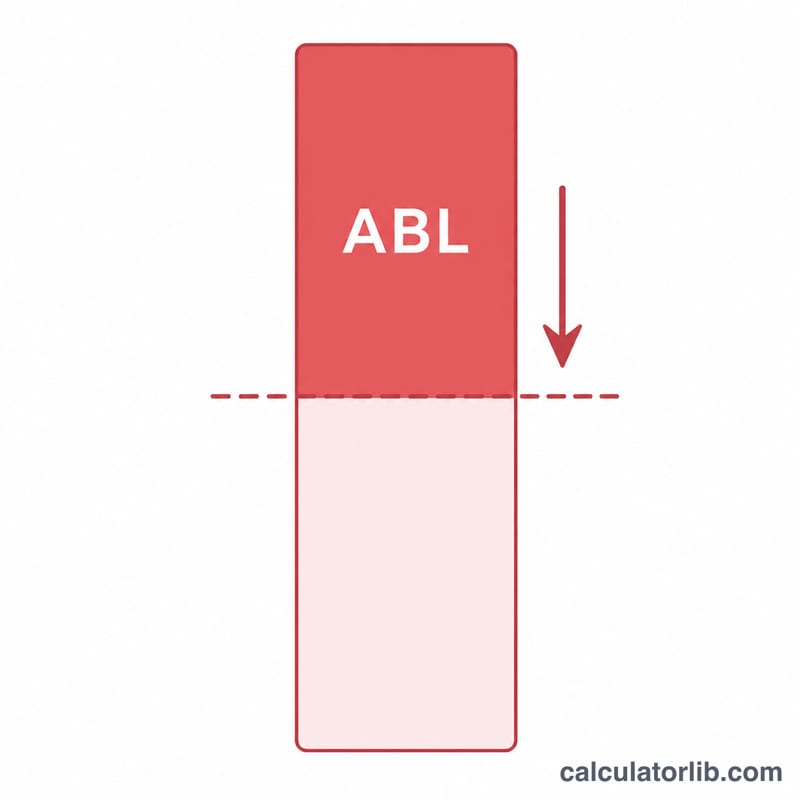
The Allowable Blood Loss (ABL) calculator estimates the maximum volume of blood a patient can lose during surgery before their hematocrit drops below a predefined safe threshold. It is widely used by anesthesiologists and surgeons for perioperative planning of fluid management and transfusion triggers. This tool is intended for clinical education and is not a substitute for professional judgment.
How to Use It
Select the patient category, which sets the average blood volume per kilogram (mL/kg). Enter the patient's weight in kilograms, the initial (preoperative) hematocrit (\(H_i\)), and the lowest acceptable hematocrit (\(H_f\)) you are willing to tolerate. The calculator returns the estimated blood volume (EBV) and the maximum allowable blood loss in milliliters.
The Formula Explained
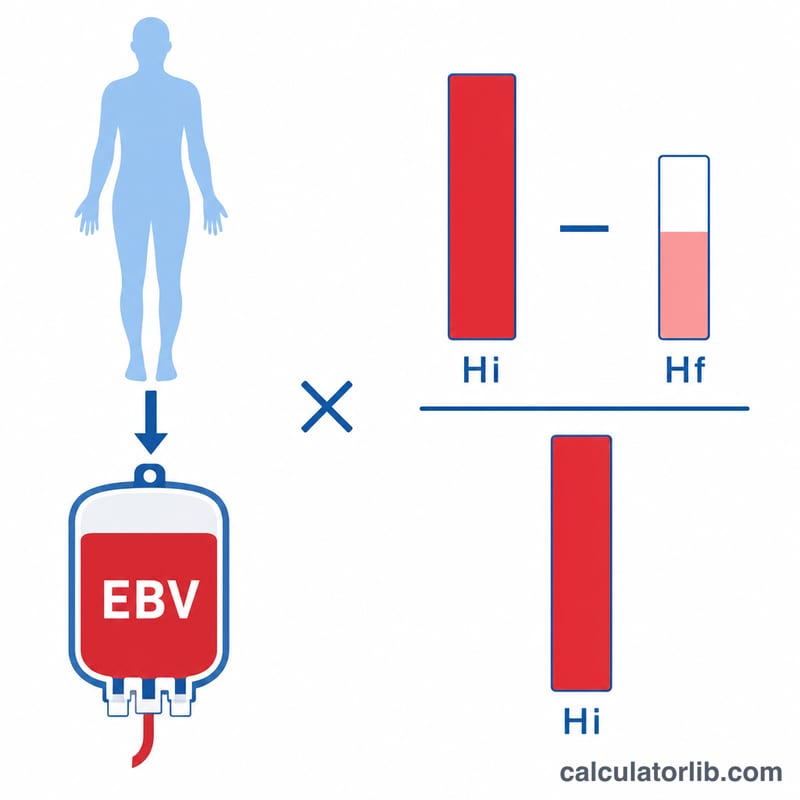
First the estimated blood volume is calculated: $$\text{EBV} = \text{weight}_{kg} \times \text{mL/kg}$$ Typical values are 75 mL/kg for adult males, 65 mL/kg for adult females, 80 mL/kg for infants, and 85–95 mL/kg for neonates. The allowable blood loss is then $$\text{ABL} = \text{EBV} \times \dfrac{H_i - H_f}{H_i}$$ which scales the blood volume by the fractional drop in hematocrit you can permit.
Worked Example
A 70 kg adult male has an EBV of \(70 \times 75 = 5{,}250\) mL. If the initial hematocrit is 45% and the lowest acceptable hematocrit is 30%, then $$\text{ABL} = 5{,}250 \times \frac{45 - 30}{45} = 5{,}250 \times 0.3333 = 1{,}750 \text{ mL}$$ The patient can lose roughly 1,750 mL before reaching the transfusion threshold.
Typical Hematocrit Reference Values
Hematocrit (Hct) is the percentage of blood volume occupied by red blood cells. The calculator uses an initial hematocrit (Hi) and a chosen lowest acceptable hematocrit (Hf). The values below are reference ranges, not treatment thresholds for any specific patient.
| Group | Approximate normal hematocrit (%) |
|---|---|
| Adult male | ~40–54 |
| Adult female | ~36–48 |
| Children (1–12 yr) | ~35–45 |
| Newborn (term) | ~45–61 |
The lowest acceptable hematocrit (the “floor” or transfusion trigger) is chosen by the clinician based on the patient and clinical setting:
| Situation (commonly cited) | Lowest acceptable Hct (%) |
|---|---|
| Young, otherwise healthy patient | ~21–25 |
| General surgical patient | ~25–28 |
| Significant cardiac/pulmonary disease | ~28–30 |
These are references only and not prescriptions. Actual transfusion thresholds must be individualized by the treating team. Hematocrit is roughly three times the hemoglobin value in g/dL; you can compare the two using a hematocrit-to-hemoglobin ratio tool.
Definitions & Glossary
- Allowable Blood Loss (ABL)
- The estimated maximum volume of blood a patient can lose before their hematocrit falls from the initial value to the chosen lowest acceptable value. Calculated as \( \text{ABL} = \dfrac{\text{EBV} \times (\text{H}_i - \text{H}_f)}{\text{H}_i} \).
- Estimated Blood Volume (EBV)
- The patient's total circulating blood volume, estimated as body weight (kg) multiplied by an average blood volume per kilogram appropriate to the patient category.
- Hematocrit (Hi, Hf)
- The proportion of blood volume made up of red blood cells, expressed as a percentage. Hi is the initial (starting) hematocrit; Hf is the final, lowest acceptable hematocrit chosen as the floor.
- Hemoglobin (Hb)
- The oxygen-carrying protein in red blood cells, measured in g/dL. Hematocrit (%) is approximately three times the hemoglobin value, so a hemoglobin of 14 g/dL corresponds to roughly 42% hematocrit.
- Transfusion trigger
- The hemoglobin or hematocrit threshold at or below which red blood cell transfusion is considered. It is patient-specific and set clinically.
- Perioperative
- The period surrounding surgery — before (preoperative), during (intraoperative) and after (postoperative) — during which blood loss is anticipated and monitored.
FAQ
Can I use hemoglobin instead of hematocrit? Yes — the formula works identically if you substitute the initial and lowest acceptable hemoglobin values, since the ratio is unitless.
Is this a transfusion guarantee? No. ABL is an estimate that guides planning; actual losses, ongoing bleeding, and individual physiology require continuous clinical monitoring.
Why does the category matter? Blood volume per kilogram varies by age and sex, so choosing the correct category gives a more accurate EBV and ABL.