
What this calculator does
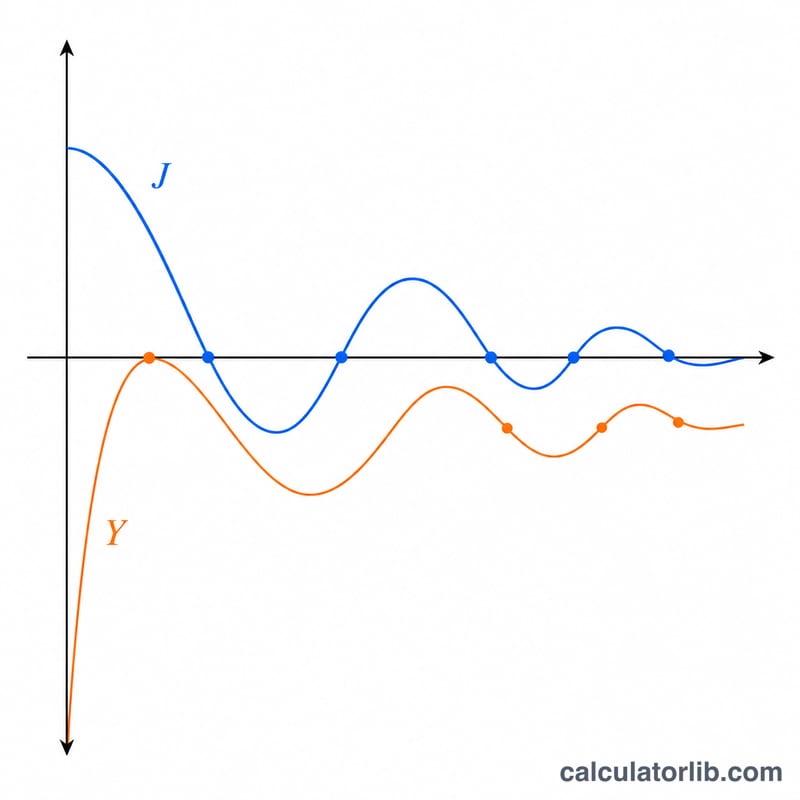
This tool finds the s-th positive zero of the Bessel functions of the first kind \(J_v(x)\) and second kind \(Y_v(x)\) (the Neumann or Weber function) for a real order \(v\). These zeros, written \(j_{v,s}\) and \(y_{v,s}\), appear throughout physics and engineering: vibrating circular membranes (drumheads), heat conduction in cylinders, electromagnetic waveguides, and Fourier-Bessel series. It is a pure-mathematics special-function tool and is universal, with no regional or unit dependence.
How to use it
Enter the Order \(v\) (a real number, typically 0 to 200) and the Zero index \(s\) (a positive integer 1, 2, 3, …). The calculator returns \(j_{v,s}\), the s-th positive root of \(J_v(x)\), and \(y_{v,s}\), the s-th positive root of \(Y_v(x)\). For example, \(v = 0\), \(s = 1\) gives the fundamental drumhead mode.
The formula and method
Both functions solve Bessel's equation \(x^2 y'' + x y' + (x^2 - v^2)y = 0\). \(J_v\) is evaluated from its convergent power series; \(Y_v\) uses $$Y_v = \frac{J_v\cos(v\pi) - J_{-v}}{\sin(v\pi)},$$ with the integer-order case handled as a numerical limit. To locate the s-th zero we seed with the McMahon asymptotic estimate, bracket the root, then refine by bisection until convergence. Because \(Y_v(x) \to -\infty\) at \(x = 0\), the search begins at a small positive \(x\) to avoid the logarithmic singularity.
Worked example
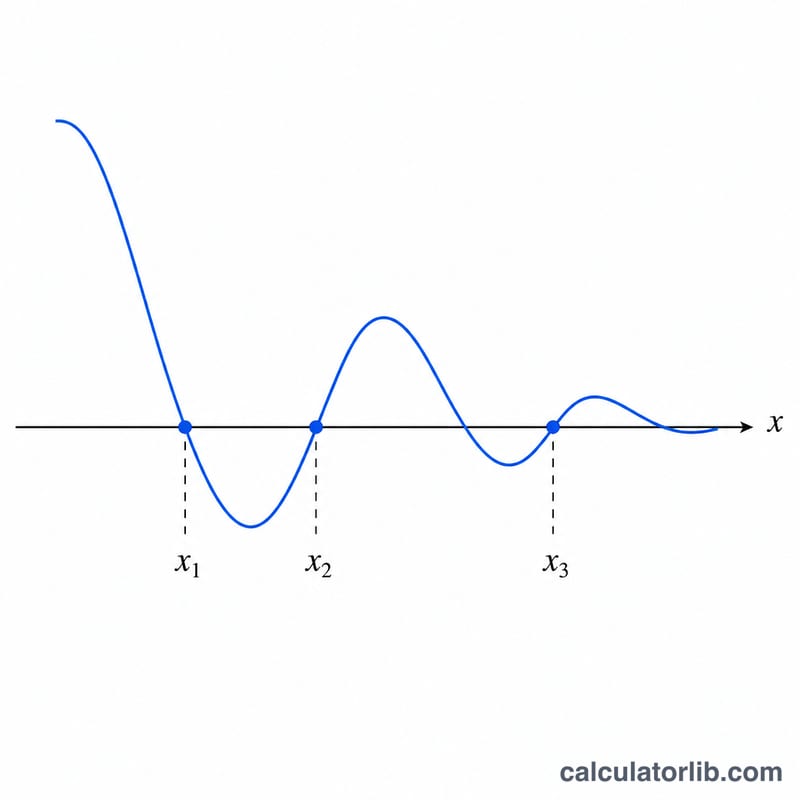
For \(v = 0\), \(s = 1\): the first positive zero of \(J_0(x)\) is \(2.4048255577\), and the first positive zero of \(Y_0(x)\) is \(0.8935769663\). For \(v = 1\), \(s = 1\): \(j_{1,1} = 3.8317059702\) and \(y_{1,1} = 2.1971413260\).
What the Zeros Mean in Applications
Bessel-function zeros are not an abstract curiosity — they are the discrete eigenvalues that emerge whenever a wave, heat, or potential problem is posed on a circular or cylindrical domain. The boundary condition forces the radial part of the solution to vanish (or its derivative to vanish) at the boundary, and that condition is satisfied only at the zeros \(j_{v,s}\).
Vibrating circular membrane (drumhead)
For an ideal circular drum of radius \(a\) with a clamped edge, the displacement separates into modes labelled by \((v,s)\), where \(v\) counts angular nodal diameters and \(s\) counts radial nodal circles. The allowed eigenfrequencies are \(f_{v,s}=\frac{c}{2\pi a}\,j_{v,s}\), where \(c\) is the wave speed. The fundamental tone uses \(j_{0,1}=2.4048256\); higher \(s\) and higher \(v\) both raise the pitch, and because the \(j_{v,s}\) are not integer multiples of one another a drum's overtones are inharmonic.
Cylindrical heat conduction
When solving the heat equation in a long cylinder with a fixed-temperature surface, the radial eigenfunctions are \(J_0(\lambda_s r/a)\) with \(\lambda_s=j_{0,s}\). Each mode decays in time as \(\exp\!\left(-\alpha (j_{0,s}/a)^2 t\right)\), so the smallest zero \(j_{0,1}\) governs the slowest-decaying, longest-lived temperature profile. Larger \(s\) gives larger eigenvalues and therefore faster decay.
Waveguide cutoff frequencies
In a hollow circular metallic waveguide of radius \(a\), transverse-magnetic (TM) modes cut off at frequencies set by \(j_{v,s}\) and transverse-electric (TE) modes by the zeros of the derivative \(J_v'\). For TM modes the cutoff is \(f_{c}=\frac{c\,j_{v,s}}{2\pi a}\); only above this frequency does the mode propagate. The lowest TM mode (TM\(_{01}\)) again uses \(j_{0,1}\).
Fourier–Bessel series
Any reasonable function on a disk can be expanded as \(f(r)=\sum_{s=1}^{\infty} c_s\,J_v\!\left(j_{v,s}\,r/a\right)\). The scaled zeros \(j_{v,s}/a\) act exactly like the wavenumbers \(n\pi/L\) of an ordinary Fourier sine series, and the orthogonality of the \(J_v(j_{v,s}r/a)\) over the disk (with weight \(r\)) lets the coefficients be computed by integration, \(c_s=\frac{2}{a^2 J_{v+1}^2(j_{v,s})}\int_0^a f(r)\,J_v\!\left(j_{v,s}r/a\right) r\,dr\).
How the zeros shift
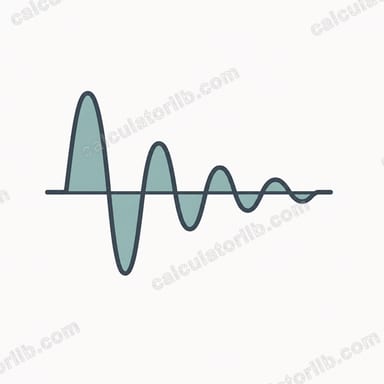
For a fixed order, increasing the index \(s\) increases \(j_{v,s}\) in steps that approach \(\pi\) (the oscillation becomes nearly periodic far from the origin). For a fixed index, increasing the order \(v\) pushes the first zero outward roughly like \(j_{v,1}\approx v + 1.8557\,v^{1/3}+\cdots\) for large \(v\), reflecting how the centrifugal \(v^2/x^2\) term in Bessel's equation delays the onset of oscillation. The practical takeaway: higher angular complexity (\(v\)) and more radial nodes (\(s\)) both correspond to larger eigenvalues and therefore higher frequencies or faster decay.
For a concrete drum example with \(c=100\ \text{m/s}\) and \(a=0.30\ \text{m}\), the fundamental frequency is \(f_{0,1}=\frac{100}{2\pi(0.30)}\,(2.4048256)\approx 127.6\ \text{Hz}\). The first overtone uses \(j_{1,1}=3.8317060\), giving \(\approx 203\ \text{Hz}\), so the overtone-to-fundamental ratio is \(j_{1,1}/j_{0,1}\approx 1.593\) — audibly not an octave or a fifth, which is why drums sound non-pitched compared with strings.
FAQ
Why does \(Y_v\) have its first zero below 1? \(Y_0\) diverges to \(-\infty\) at the origin and crosses zero near \(x \approx 0.894\) before reaching its first maximum, so its first zero is much smaller than that of \(J_0\).
Can v be non-integer? Yes. The defining formula for \(Y_v\) is valid for any non-integer \(v\) directly, and integer orders are treated as a smooth limit.
How accurate are the results? Computations use double-precision arithmetic, giving roughly 10 significant figures for moderate \(v\) and \(s\).