Plasma Volume Calculator

Plasma Volume Calculator

Emerging AI Skill PRO

Enter Calculation

Formula

Plasma Volume=Blood Volume (mL)×(1−Hematocrit (%)100)\text{Plasma Volume} = \text{Blood Volume (mL)} \times \left(1 - \frac{\text{Hematocrit (\%)}}{100}\right)

Example

Plasma Volume=5000×(1−45100)=2,750\text{Plasma Volume} = 5000 \times \left(1 - \frac{45}{100}\right) = 2{,}750
Usage stats

Advertisement

Results

Plasma Volume
2,750
mL
Total Blood Volume 5,000 mL
Cellular Volume (red cells) 2,250 mL

For reference only — not a substitute for a clinician's assessment.

Report an error on this page

What Is Plasma Volume?

Plasma is the fluid component of blood that carries cells, proteins, electrolytes, and nutrients throughout the body. Whole blood is made up of plasma plus the cellular fraction (mostly red blood cells). The hematocrit is the percentage of blood volume occupied by red blood cells, so the remaining fraction represents plasma. This calculator estimates plasma volume directly from your total blood volume and hematocrit.

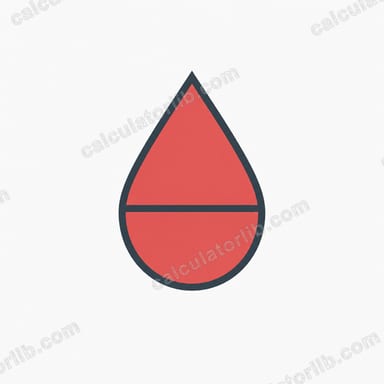
Pie chart of blood composition split into plasma and cellular components
Blood separates into plasma (fluid) and the cellular fraction measured by hematocrit.

How to Use the Calculator

Enter your total blood volume in milliliters (mL) — an average adult has roughly 4,500–5,500 mL — and your hematocrit as a percentage (a typical adult range is 37–52%). The calculator returns the plasma volume, along with the cellular (red cell) volume so the two add up to your total blood volume.

The Formula Explained

The relationship is straightforward: $$\text{Plasma Volume} = \text{Blood Volume} \times (1 - \text{Hct})$$ where Hct is the hematocrit expressed as a decimal fraction. For example, a hematocrit of 45% becomes \(0.45\), so plasma makes up the remaining \(0.55\) (55%) of blood volume.

Advertisement
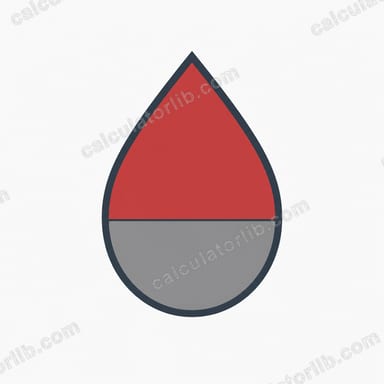
Horizontal bar showing total blood volume divided into plasma and cell portions
Plasma volume is the blood volume multiplied by the fraction not occupied by cells (1 − Hct).

Worked Example

Suppose total blood volume is 5,000 mL and hematocrit is 45%. The hematocrit fraction is \(0.45\), so plasma volume $$= 5{,}000 \times (1 - 0.45) = 5{,}000 \times 0.55 = 2{,}750 \text{ mL}$$ The cellular volume is \(5{,}000 \times 0.45 = 2{,}250\) mL, and \(2{,}750 + 2{,}250 = 5{,}000\) mL, confirming the total.

FAQ

How do I find my total blood volume? Blood volume can be estimated from body weight (roughly 70 mL/kg in adult men, 65 mL/kg in women) or measured clinically.

What is a normal hematocrit? Roughly 42–52% for adult men and 37–47% for adult women, though reference ranges vary by laboratory.

Is this a medical diagnostic tool? No. This is an educational estimator. Always consult a healthcare professional for clinical decisions.


Sources & References

  • 18.1 An Overview of Blood - Anatomy and Physiology 2e — OpenStax, Rice University (Betts JG et al.), Anatomy and Physiology 2e, 2022. Plasma fraction = 100% minus hematocrit; hematocrit women 37-47 (mean 41), men 42-52 (mean 47). · Verified 2026-11-07
  • 18.1 An Overview of Blood - Anatomy and Physiology 2e — OpenStax, Rice University (Betts JG et al.), Anatomy and Physiology 2e, 2022. Reference hematocrit: males 42 to 52 (mean 47); females 37 to 47 (mean 41). · Verified 2026-11-07
  • Estimating blood volume in obese and morbidly obese patients — Lemmens HJ, Bernstein DP, Brodsky JB, Obes Surg 2006;16(6):773-6, doi:10.1381/096089206777346673, PMID 16756741. Mean indexed blood volume in normal-weight adults is 70 mL/kg; the per-kg value falls with obesity, so 70 mL/kg overestimates in obese patients. · Verified 2026-11-07
  • The maintenance and monitoring of perioperative blood volume — Iijima T, Brandstrup B, Rodhe P et al., Perioper Med (Lond) 2013;2:9, doi:10.1186/2047-0525-2-9, PMID 24472160. Blood volume about 75 mL/kg in adult men and 65 mL/kg in adult women (7-8% of body weight), slightly higher per kg in younger subjects. · Verified 2026-11-07

Checked against these sources on . Not reviewed by a clinician. For general information only, not medical advice or a diagnosis. Talk to a doctor about any health concern.

Last updated:

Most popular in Health and Fitness

View all Health and Fitness calculators