What is the Iron Deficiency Calculator?
This calculator estimates the total amount of elemental iron (in milligrams) a person needs to correct iron deficiency anemia. It uses the well-known Ganzoni formula, widely applied in clinical practice to dose intravenous iron replacement. It is an educational estimate only — actual dosing decisions must be made by a qualified clinician.
How to use it
Enter the patient's body weight in kilograms, the current (actual) hemoglobin, the desired target hemoglobin, and the iron stores value. For adults the iron stores depot is conventionally taken as 500 mg (for body weight under 35 kg, 15 mg/kg is often used instead). The calculator returns the total iron deficit to be replaced.
The formula explained
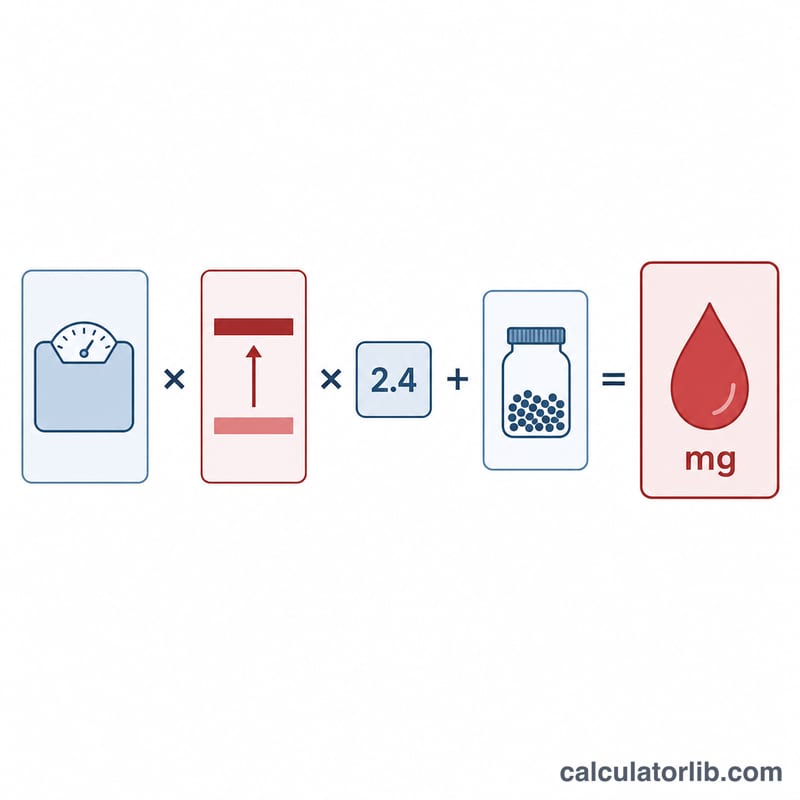
The Ganzoni equation is:
$$\text{Iron deficit (mg)} = \text{body weight (kg)} \times \left( \text{target Hb} - \text{actual Hb} \right) \times 2.4 + \text{iron stores (mg)}$$
The constant 2.4 combines two factors: blood volume is roughly 7% of body weight (0.07 L/kg), and 1 g of hemoglobin contains about 3.4 mg of iron, giving \(0.07 \times 3.4 \times 10 = 2.4\) when Hb is in g/dL. The iron stores term replenishes the body's depot iron once circulating hemoglobin is restored.
Worked example
For a 70 kg adult with actual Hb of 9 g/dL, a target of 15 g/dL, and 500 mg iron stores: $$70 \times (15 - 9) \times 2.4 + 500 = 70 \times 6 \times 2.4 + 500 = 1008 + 500 = \mathbf{1508}\ \textbf{mg}$$ of iron to replace.
Reference Hemoglobin Values and Iron Store Depots
The Ganzoni formula needs three reference points: where the patient's hemoglobin (Hb) sits now, what Hb is being aimed for, and how much iron to add for depot (storage) replenishment. The thresholds below are the World Health Organization (WHO) population thresholds for defining anemia, together with commonly quoted normal adult ranges. They are published reference values used for screening and classification — they are not individual treatment targets, and laboratories differ slightly in the reference intervals they report.
| Group | WHO anemia threshold (Hb) | Typical normal range (g/dL) | Typical normal range (g/L) |
|---|---|---|---|
| Adult men (≥15 y) | < 13.0 g/dL (< 130 g/L) | 13.0 – 17.0 | 130 – 170 |
| Adult women, non-pregnant (≥15 y) | < 12.0 g/dL (< 120 g/L) | 12.0 – 15.5 | 120 – 155 |
| Pregnant women | < 11.0 g/dL (< 110 g/L) | — | — |
| Children 6–59 months | < 11.0 g/dL (< 110 g/L) | — | — |
| Children 5–11 years | < 11.5 g/dL (< 115 g/L) | — | — |
| Children 12–14 years | < 12.0 g/dL (< 120 g/L) | — | — |
If your laboratory reports Hb in g/L or mmol/L, convert before entering it: \(1\ \text{g/dL} = 10\ \text{g/L}\), and \(1\ \text{g/dL} \approx 0.621\ \text{mmol/L}\). The calculator expects g/dL.
Target hemoglobin
A target Hb of 15 g/dL is the value used in Ganzoni's original worked examples and is still the most commonly quoted default for adults in iron-dose calculations. It is a convention, not a universal goal: a lower target (often 12–14 g/dL) is frequently used for women, for older adults, in pregnancy and in chronic kidney or heart disease, and pediatric targets are age-specific. The target Hb you enter should reflect the clinical situation, because this single input has a large effect on the computed deficit.
Iron store (depot) allowance
The second term of the formula adds iron for refilling body stores rather than for building circulating hemoglobin. The convention Ganzoni described, and the one reproduced in most iron-dosing tables, is weight-banded:
| Body weight | Depot convention | Depot iron to enter (mg) |
|---|---|---|
| ≥ 35 kg | Fixed 500 mg | 500 |
| < 35 kg | 15 mg per kg body weight | e.g. 20 kg → 300; 25 kg → 375; 30 kg → 450 |
Some protocols use a smaller depot (for example 0 mg when only correcting Hb, or ~200–300 mg in small adults), so check which convention applies before comparing results between sources. This section is educational reference information, not a prescription.
Interpreting Your Iron Deficit Result
The output is a single number: the total elemental iron, in milligrams, estimated to do two jobs at once — raise circulating hemoglobin from the actual value to the target value, and refill the body's storage (depot) iron. The two jobs correspond directly to the two parts of the formula:
$$\text{Iron deficit (mg)} = \underbrace{\text{Weight (kg)} \times (\text{Target Hb} - \text{Actual Hb}) \times 2.4}_{\text{hemoglobin gap}} + \underbrace{\text{Depot iron (mg)}}_{\text{stores}}$$
Typical adult results computed this way fall roughly in the 500–2000 mg range. The Hb-gap term drives almost all of the variation: with a 500 mg depot allowance, every 1 g/dL of hemoglobin gap adds about 2.4 mg of iron per kilogram of body weight — roughly 168 mg for a 70 kg adult. A small Hb gap therefore produces a result dominated by the depot term, while a deep anemia can easily triple it.
It is a replacement target, not an infusion
The number is the total to be replaced over a course of treatment. It is not a single dose. In practice the total is divided according to the licensed maximum single dose and dosing interval of the specific intravenous iron product being used — these maxima differ substantially between products and between national regulatory approvals, so the same deficit may be given as one, two or several administrations depending on the product and the country's prescribing information. The calculator does not know which product is intended and makes no scheduling recommendation.
Where the constant 2.4 comes from — and where it breaks down
The factor 2.4 is not arbitrary. It bundles three assumptions: blood volume is about 7% of body weight, hemoglobin contains about 3.4 mg of iron per gram (0.34%), and a unit conversion from g/dL to g/L:
$$0.07 \times 3.4 \times 10 = 2.38 \approx 2.4$$
Because blood volume is assumed to be a fixed fraction of body weight, the estimate is least reliable at the extremes of body size. In obesity, blood volume per kilogram is lower than 7%, so using total body weight tends to overestimate the deficit; clinicians therefore sometimes substitute ideal or adjusted body weight. The same caution applies to oedema, ascites or fluid overload, where measured weight includes water that contains no red cells. In very small children and in underweight patients the estimate is correspondingly less precise.
What the formula does not include
- Ongoing blood loss — heavy menstrual bleeding, gastrointestinal bleeding, dialysis losses or surgery will consume iron after the calculation was made, so the real requirement is larger.
- Malabsorption — coeliac disease, atrophic gastritis, bariatric surgery or H. pylori infection affect how much oral iron is usable, which changes the route of treatment rather than the arithmetic.
- Inflammation and anemia of chronic disease — raised hepcidin blocks iron release from stores, so hemoglobin may not respond as the Hb gap predicts even when the full calculated dose is given. Ferritin and transferrin saturation are interpreted alongside C-reactive protein for this reason.
- Iron already given — concurrent oral iron, recent infusions and transfused red cells all contribute iron that the formula does not subtract.
- Other causes of a low Hb — B12 or folate deficiency, thalassemia trait, hemolysis and renal disease are not iron deficiency, and no dose of iron corrects them.
This is general educational information, not medical advice. Whether iron replacement is indicated, which route and product to use, what target hemoglobin is appropriate, and how to monitor the response are clinical decisions that require examination, laboratory results such as ferritin and transferrin saturation, and a diagnosis of the underlying cause. Do not use a calculated figure to start, stop or change treatment — discuss it with a qualified healthcare professional.
Iron Deficit Across Common Scenarios
The table below shows how the calculated deficit changes with body weight and the size of the hemoglobin gap. Every row is computed as \(\text{weight} \times (\text{target Hb} - \text{actual Hb}) \times 2.4 + \text{stores}\), with the depot term set to 500 mg for the adults (≥35 kg) and to 15 mg/kg for the child. These are illustrative input combinations, not treatment recommendations.
| Body weight (kg) | Actual Hb (g/dL) | Target Hb (g/dL) | Iron stores (mg) | Hb-gap term (mg) | Computed deficit (mg) |
|---|---|---|---|---|---|
| 50 | 10 | 14 | 500 | 480 | 980 |
| 60 | 8 | 14 | 500 | 864 | 1364 |
| 70 | 11 | 15 | 500 | 672 | 1172 |
| 80 | 9 | 15 | 500 | 1152 | 1652 |
| 90 | 7 | 15 | 500 | 1728 | 2228 |
| 25 (child) | 9 | 12 | 375 (15 mg/kg) | 180 | 555 |
Worked example: the 90 kg row, step by step
$$\text{Deficit} = 90 \times (15 - 7) \times 2.4 + 500$$
$$= 90 \times 8 \times 2.4 + 500 = 1728 + 500 = 2228\ \text{mg}$$
Reading across the table, two patterns stand out. First, the depot allowance is a fixed floor: the 50 kg row needs 480 mg to close a 4 g/dL gap, so more than half of its 980 mg total is store replenishment. Second, weight and Hb gap multiply, which is why the 90 kg patient with a severe 8 g/dL gap reaches 2228 mg — more than double the 50 kg result — even though both use the same 500 mg depot. Note also that the 80 kg and 60 kg rows share the same 6 g/dL gap, and their totals differ purely by weight.
Because the weight term assumes blood volume is 7% of body weight, a result driven by a high total body weight (as in the 90 kg row) should be treated with more caution if that weight reflects obesity or fluid retention rather than lean mass. A clinician may recalculate using adjusted or ideal body weight in that situation. These figures are educational illustrations only and are not medical advice; dosing decisions belong to a qualified healthcare professional working from the full clinical picture.
FAQ
Why use 500 mg for iron stores? 500 mg represents typical depleted-but-not-zero depot iron reserves to be replenished in adults over 35 kg. Lighter patients use 15 mg/kg.
What target hemoglobin should I use? A target of 15 g/dL is common for adults, but the clinically appropriate target varies by sex, age, and condition.
Is this the dose to give in one infusion? No. The total deficit is often divided across multiple doses depending on the iron product's maximum single dose and the patient's tolerance.