What is the Fresh Frozen Plasma Dose Calculator?
Fresh frozen plasma (FFP) is a blood product used to replace clotting factors in patients with bleeding or coagulopathy, including reversal of warfarin, disseminated intravascular coagulation, and massive transfusion. The standard dosing strategy is weight-based: most guidelines recommend 10-15 mL/kg of body weight. This calculator converts a patient's weight and a chosen dose-per-kilogram into a total plasma volume and an approximate number of units to request.
How to use it
Enter the patient's weight in kilograms and the desired dose in mL/kg (commonly 10, 12, or 15). The tool returns the total FFP volume in millilitres, the typical 10-15 mL/kg range for that patient, and an approximate unit count assuming an average FFP unit volume of about 250 mL. Unit volumes vary by collection method and country, so always confirm the actual volume printed on each bag.
The formula explained
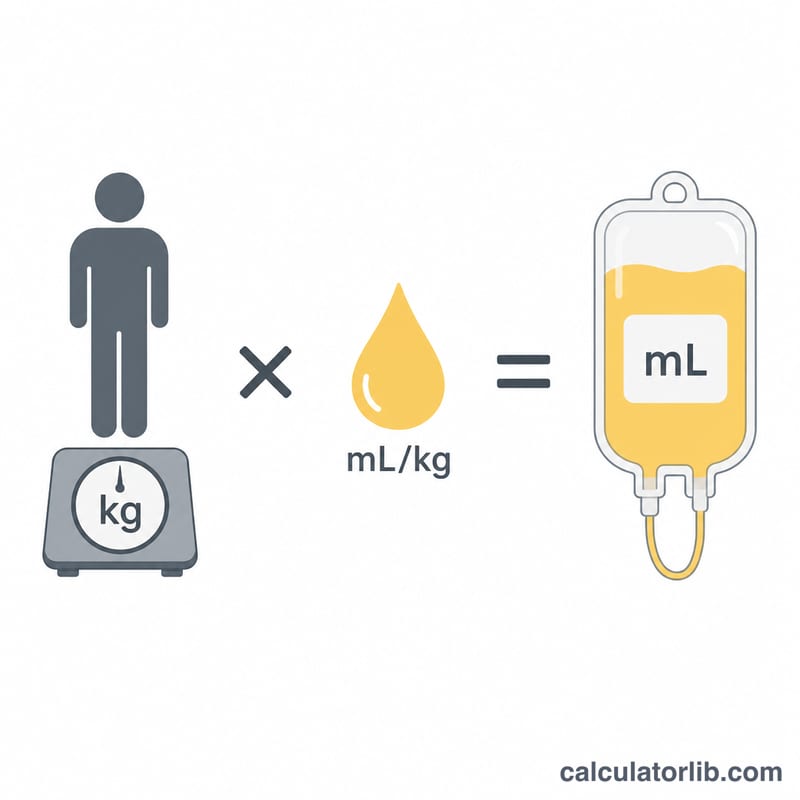
The core equation is simply $$\text{Volume} = \text{Weight} \times \text{Dose-per-kg}$$ For example, a 70 kg patient dosed at 12 mL/kg needs \(70 \times 12 = 840\) mL. Dividing by the average unit volume of 250 mL gives roughly 3.4 units, so you would order 3-4 units. The low and high range values (weight \(\times\) 10 and weight \(\times\) 15) help you bracket a reasonable target.
Worked example
A patient weighs 80 kg and the clinician chooses 15 mL/kg. The dose is $$80 \times 15 = 1{,}200 \text{ mL}$$ The 10 mL/kg lower bound is 800 mL and the 15 mL/kg upper bound is also 1,200 mL. At 250 mL per unit, that is about 4.8 units, so order 5 units.
FFP Volume Across Weights and Doses
The calculator multiplies body weight by the chosen dose: \(\text{Volume (mL)} = \text{Weight (kg)} \times \text{Dose (mL/kg)}\). Approximate units assume a nominal 250 mL per FFP unit, rounded to one decimal place. In practice, whole bags are issued.
| Weight (kg) | 10 mL/kg: mL | 10 mL/kg: units | 12 mL/kg: mL | 12 mL/kg: units | 15 mL/kg: mL | 15 mL/kg: units |
|---|---|---|---|---|---|---|
| 50 | 500 | 2.0 | 600 | 2.4 | 750 | 3.0 |
| 60 | 600 | 2.4 | 720 | 2.9 | 900 | 3.6 |
| 70 | 700 | 2.8 | 840 | 3.4 | 1050 | 4.2 |
| 80 | 800 | 3.2 | 960 | 3.8 | 1200 | 4.8 |
| 100 | 1000 | 4.0 | 1200 | 4.8 | 1500 | 6.0 |
Example: a 70 kg patient at 12 mL/kg gives \(70 \times 12 = 840\) mL, or \(840 \div 250 = 3.36 \approx 3.4\) units.
Interpreting the Calculated FFP Volume
A dose of 10–15 mL/kg is the range commonly cited in transfusion references for adults and children. It is typically associated with a modest rise in clotting factor levels, roughly 15–25% in commonly cited references. The actual rise varies with the patient's starting factor levels, ongoing bleeding or consumption, and the plasma product used.
Why units are rounded to whole bags: FFP is issued as discrete bags, so a calculated 3.4 units is usually rounded to a whole number of bags (3 or 4) by the clinical team. The choice depends on the clinical situation and local practice.
How bag volume shifts the estimate: Real bags usually contain about 200–300 mL, depending on the collection method and blood service. The estimate is \(\text{Units} = \frac{ \text{Volume (mL)}}{\text{Bag volume (mL)}}\). For 840 mL: at 200 mL/bag that is 4.2 units, at 250 mL/bag 3.4 units, and at 300 mL/bag 2.8 units.
Why this is only an estimate: The appropriate dose depends on the indication (for example bleeding versus a procedure), laboratory results such as INR/PT, the patient's clinical status including fluid tolerance, and local protocols or guidelines. Many guidelines advise against transfusing FFP for minor INR elevations without bleeding.
This calculator is educational and does not provide individualized medical advice. Transfusion decisions must be made by qualified clinicians following local protocols.
Key Terms and Glossary
- FFP (fresh frozen plasma)
- The liquid part of donated blood, frozen soon after collection to preserve clotting factors. It is thawed before transfusion.
- Coagulopathy
- A condition in which the blood's ability to clot is impaired. It can be caused by disease, medication, or massive blood loss.
- Clotting factors
- Plasma proteins that act in sequence to form a stable blood clot, including fibrinogen and factors II, V, VII, VIII, IX, X and XI.
- INR/PT
- Prothrombin time (PT) measures how long plasma takes to clot. The international normalized ratio (INR) standardizes PT across laboratories. Higher values indicate slower clotting.
- DIC (disseminated intravascular coagulation)
- A serious condition of widespread clotting activation that consumes clotting factors and platelets, which can lead to both clotting and bleeding.
- Massive transfusion
- Transfusion of a very large volume of blood products in a short time. A commonly used definition is replacing roughly one total blood volume within 24 hours. Definitions vary by institution.
- mL/kg dosing
- Scaling a dose to body weight by multiplying the patient's weight in kilograms by a volume per kilogram.
- FFP unit
- One bag of plasma from a single donation or apheresis collection. Volume varies by blood service, typically about 200–300 mL.
FAQ
What dose should I use? Typical adult dosing is 10-15 mL/kg; higher doses may be needed for active bleeding or factor deficiency. Follow your local transfusion protocol.
How many mL is one FFP unit? It varies (roughly 200-300 mL); this tool assumes ~250 mL for the unit estimate. Always verify the volume on the bag.
Is this a substitute for clinical judgment? No. This calculator is an educational estimate. Final dosing must be determined by a qualified clinician based on the patient's condition and lab results.