
What Is the Hole Volume Calculator?
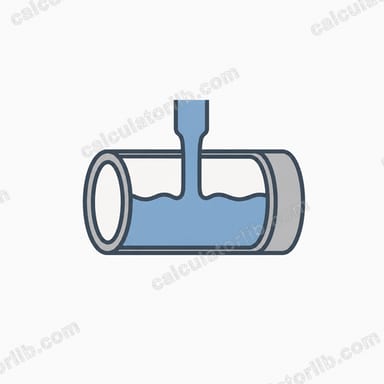
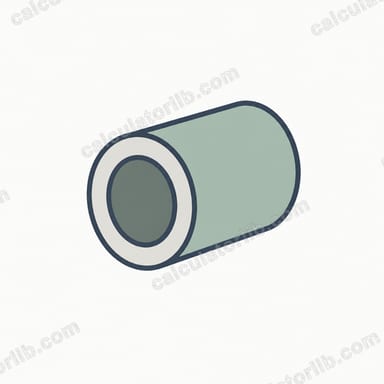
This calculator finds the volume of a round, cylindrical hole — such as a post hole, drilled borehole, fence-post hole, or auger hole — from its diameter and depth. Knowing the volume tells you how much concrete, soil, water, or backfill the hole will hold, which is useful for construction, landscaping, drilling, and DIY projects.
How to Use It
Enter the hole's diameter (the width across the opening), the depth (how far down it goes), and choose a unit of measurement. The calculator returns the volume in cubic units, plus handy conversions to liters and US gallons so you can quickly estimate material quantities.
The Formula Explained
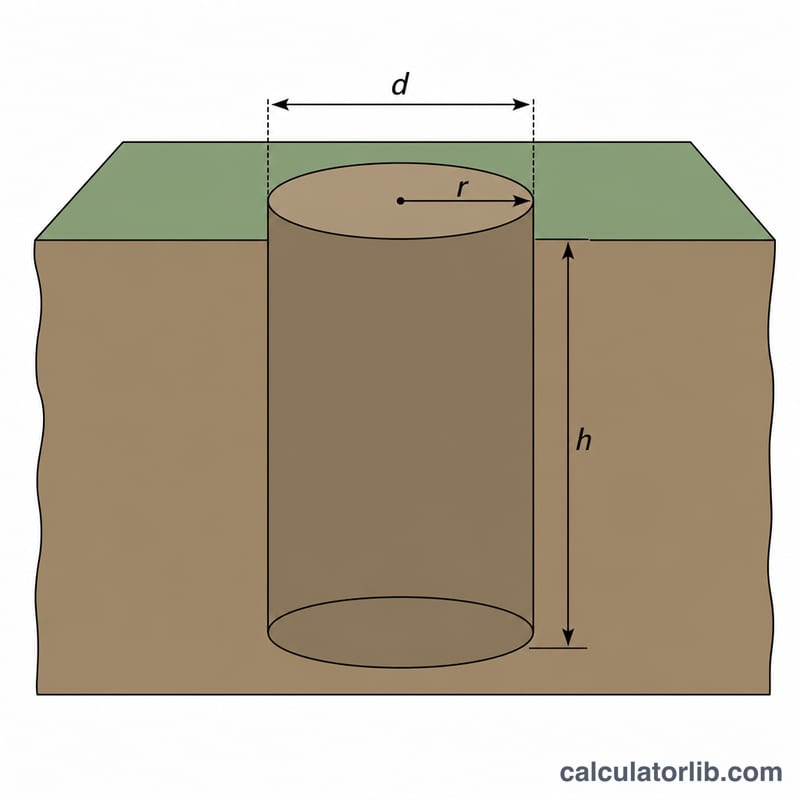
A cylindrical hole's volume equals the area of its circular cross-section multiplied by its depth:
$$V = \pi \times \left(\frac{d}{2}\right)^{2} \times h$$
Here d is the diameter, d/2 is the radius, and h is the depth. The radius is squared and multiplied by π (≈3.14159) to get the circle's area, then multiplied by the depth.
Worked Example
Suppose you dig a post hole 0.5 m in diameter and 2 m deep. The radius is 0.25 m, so the area is \(\pi \times 0.25^{2} \approx 0.19635\) m². Multiply by the 2 m depth:
$$0.19635 \times 2 \approx 0.3927 \text{ cubic meters}$$
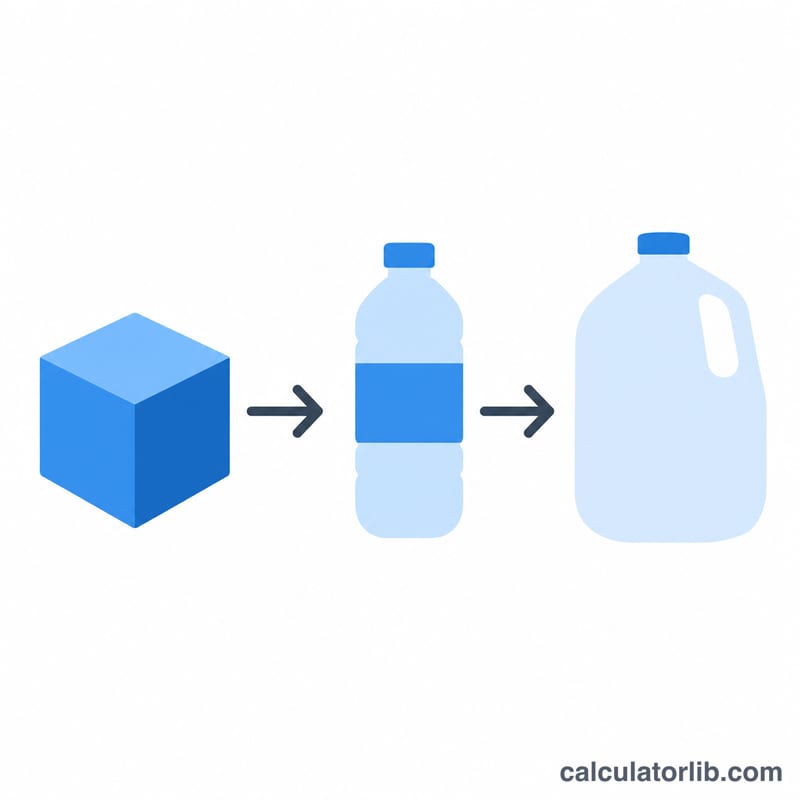
or about 392.7 liters (≈103.7 US gallons).
FAQ
Does this work for non-round holes? No — it assumes a perfectly cylindrical hole. For square or irregular holes, use a different formula.
How much concrete do I need? The cubic-unit result is the total fill volume. For a post hole, subtract the post's volume to find the concrete needed.
Why are liters and gallons shown? They make it easy to estimate water capacity or compare to bagged-material yields, regardless of the input unit.