What Is a Thinset Calculator?
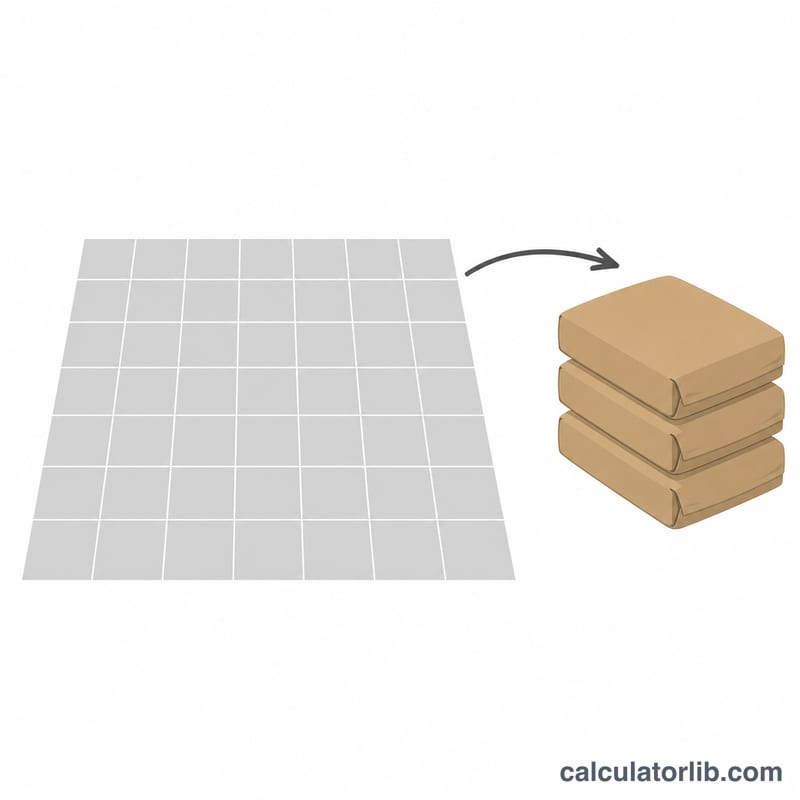
A thinset calculator estimates how many bags of thinset mortar you need to set tile over a given area. Thinset (a cement-based adhesive) is sold in roughly 50 lb bags, and how far each bag stretches depends mainly on the notched trowel you use to spread it. Larger notches lay down a thicker bed and cover less area per bag.
How to Use It
Enter the total area you plan to tile in square feet, choose the trowel notch size that matches your tile, and set a waste percentage (10% is a common allowance for cuts, mixing loss, and uneven substrates). The calculator multiplies your area by the waste factor, divides by the bag's coverage, and rounds up to the next whole bag.
The Formula Explained
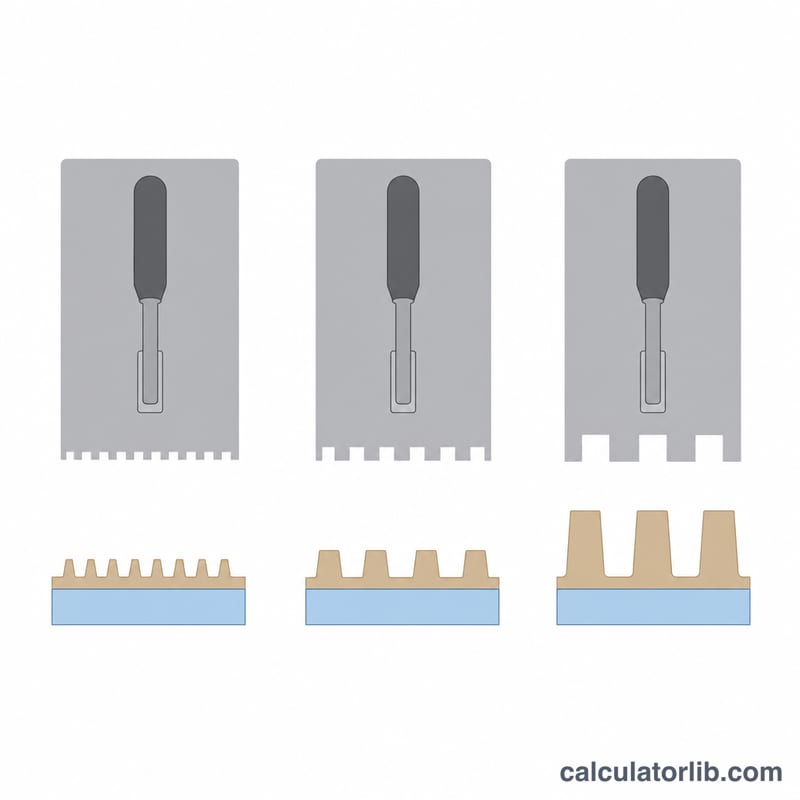
The core relationship is $$\text{Bags} = \left\lceil \frac{\text{Area (sq ft)} \times \left(1 + \frac{\text{Waste (\%)}}{100}\right)}{\text{Coverage (sq ft/bag)}} \right\rceil$$. Typical coverage values: a 1/4"×1/4" square-notch trowel covers about 95 sq ft per bag, 1/4"×3/8" about 75 sq ft, 1/2"×1/2" about 60 sq ft, and a 3/4" U-notch about 45 sq ft. Because you cannot buy part of a bag, the result is always rounded up.
Worked Example
Suppose you are tiling a 200 sq ft floor with a 1/4"×3/8" trowel (75 sq ft/bag) and a 10% waste allowance. Adjusted area = \(200 \times 1.10 = 220\) sq ft. Bags = \(220 \div 75 = 2.93\), which rounds up to 3 bags.
Trowel Size and Tile Size Coverage Table
Coverage depends on the trowel notch, the tile, the substrate flatness and how the installer holds the trowel. The figures below are typical approximations for a 50 lb bag of thinset, using US trowel sizes in inches. The calculator's coverage options (95, 75, 60 and 45 sq ft per bag) line up with these four rows.
| Trowel notch | Typical tile | Approx. coverage per 50 lb bag | Approx. bed thickness |
|---|---|---|---|
| 1/4" x 1/4" square | Mosaic and small tile, up to about 4" | about 90-95 sq ft | about 1/8" or less |
| 1/4" x 3/8" square | Tile about 6"-12" | about 70-75 sq ft | about 3/16" |
| 1/2" x 1/2" square | Large-format tile, about 12"-24" | about 50-60 sq ft | about 1/4"-5/16" |
| 3/4" U-notch (or similar deep notch) | Very large tile (24"+) or heavy natural stone | about 40-45 sq ft | about 3/8" or more |
Note: These figures are approximate. The manufacturer's data sheet for your specific thinset and the tile maker's installation guidance take precedence. Both may also require a particular notch size or minimum contact coverage.
Practical Tips for Buying and Applying Thinset
- Round up to whole bags. You can't buy a partial bag, and for large jobs an extra bag is cheap insurance against a mid-job shortage.
- Add about 15% waste for large-format tile, diagonal layouts or uneven substrates. Simple layouts on flat floors often need less.
- Back-buttering large-format tile (a thin layer of thinset on the tile back) increases usage, so plan for lower coverage per bag.
- Mix only what you can use within the open (pot) time. Thinset that has skinned over or started to set should not be re-tempered with water. Small batches reduce waste.
- Check the manufacturer's coverage rating on the bag and use modified thinset where the tile, substrate or data sheet specifies it (for example, large porcelain or natural stone).
- Prepare the substrate. A flat, clean substrate lets you use a smaller notch and less mortar, and it reduces the need for extra material to fill low spots.
Bag Count Comparison by Trowel Size
This table uses a fixed 200 sq ft area and the formula \(\text{Bags} = \lceil \text{area} \times (1 + \text{waste}/100) / \text{coverage} \rceil\). With 10% waste the adjusted area is 220 sq ft, and with 15% it is 230 sq ft.
| Coverage (sq ft per bag) | Bags at 10% waste (220 sq ft) | Bags at 15% waste (230 sq ft) |
|---|---|---|
| 95 | 220 / 95 = 2.32, so 3 | 230 / 95 = 2.42, so 3 |
| 75 | 220 / 75 = 2.93, so 3 | 230 / 75 = 3.07, so 4 |
| 60 | 220 / 60 = 3.67, so 4 | 230 / 60 = 3.83, so 4 |
| 45 | 220 / 45 = 4.89, so 5 | 230 / 45 = 5.11, so 6 |
Going from 10% to 15% waste can add a whole bag when the result sits close to a rounding boundary, as with the 75 and 45 sq ft per bag rows. A deeper trowel notch (lower coverage) raises the bag count much more than the waste allowance does.
FAQ
Does coverage really change that much with trowel size? Yes — a deeper notch can nearly double mortar usage, so always match the trowel to your tile size.
How much waste should I add? 10% is standard; use 15% for diagonal layouts, large-format tile, or uneven floors.
Are bag sizes always 50 lb? Most are, but check your product. Coverage figures here assume standard 50 lb bags spread at the recommended thickness.