

What Is the Mortar Mix Calculator?
The Mortar Mix Calculator estimates how much cement and sand you need to lay bricks, blocks or render a wall. You enter the area to cover, the mortar bed thickness and your chosen mix ratio (for example a 1:4 cement-to-sand mix), and it returns the number of 50 kg cement bags and the volume of sand. It is a universal tool based on standard volumetric construction practice.
How to Use It
Enter the wall area in square metres, the mortar thickness in millimetres (typically 10 mm for brickwork), and the cement and sand parts of your mix. Add a waste allowance (10% is common to cover spillage and over-ordering). The calculator converts thickness to metres, computes the wet mortar volume, then scales it for the dry-material requirement.
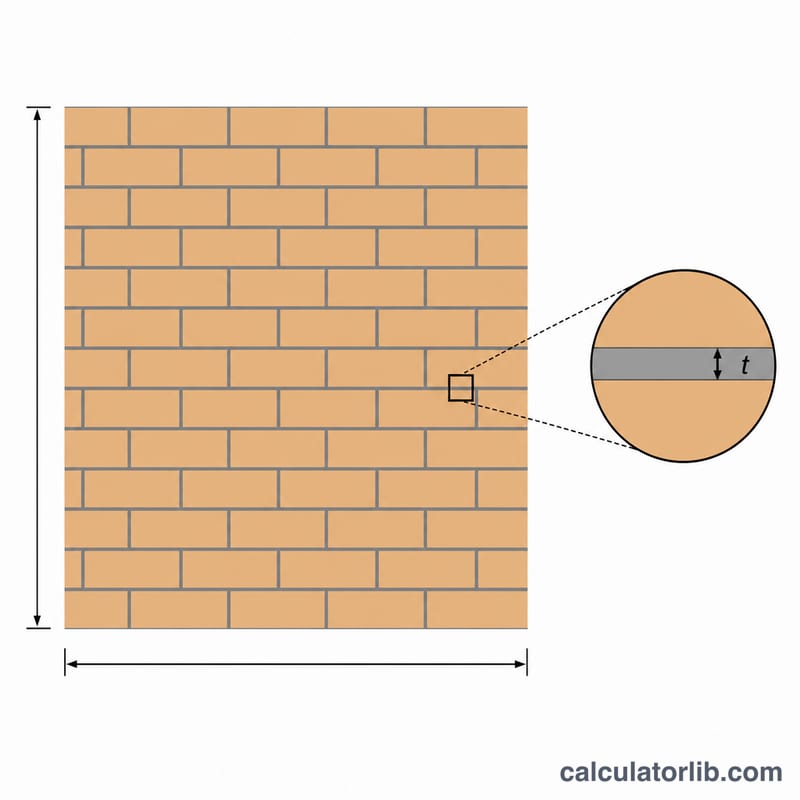
The Formula Explained
Mortar shrinks and contains voids, so the dry ingredient volume is larger than the finished wet volume. The dry volume is:
$$V_{dry} = A \times t \times 1.33 \times (1 + w)$$where \(A\) = area in m², \(t\) = thickness in metres, \(1.33\) is the standard dry-to-wet bulking factor, and \(w\) = waste fraction. Cement volume is the dry volume times \(\tfrac{c}{c+s}\), then converted to bags using a cement density of 1440 kg/m³ and a 50 kg bag:
$$\text{Bags} = \frac{V_{dry}\,\frac{c}{c+s} \times 1440}{50}$$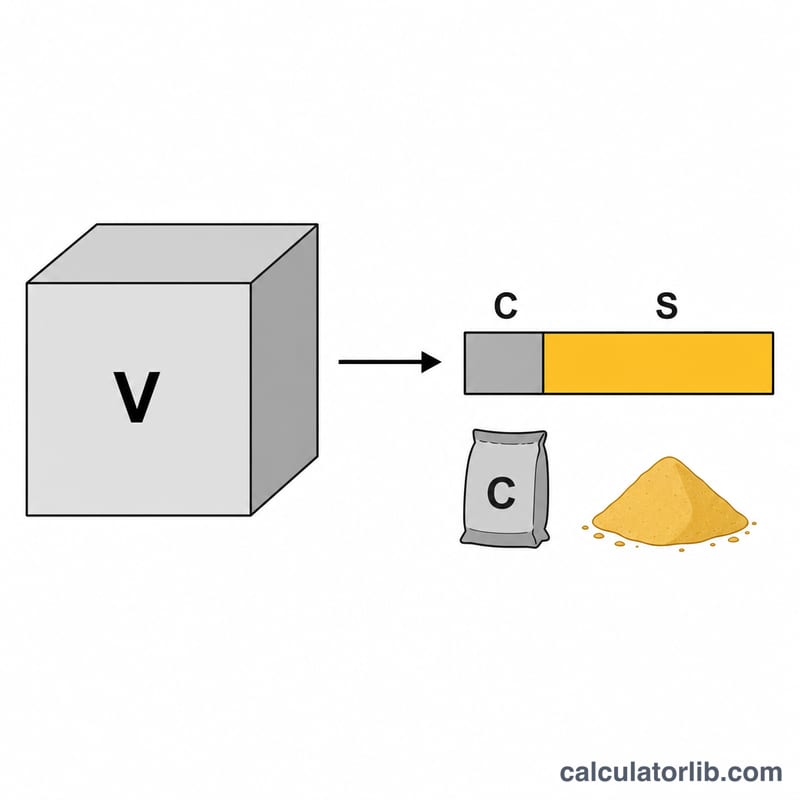
Worked Example
For 10 m² at 10 mm thickness, a 1:4 mix, and 10% waste:
$$V_{wet} = 10 \times 0.010 = 0.1\,\text{m}^3$$ $$V_{dry} = 0.1 \times 1.33 \times 1.10 = 0.1463\,\text{m}^3$$ $$V_{cement} = 0.1463 \times \tfrac{1}{5} = 0.02926\,\text{m}^3$$ $$\text{Bags} = \frac{0.02926 \times 1440}{50} \approx 0.84\,\text{bags}$$FAQ
Why is the dry volume bigger than the wet volume? Dry sand and cement bulk up and have air voids; the 1.33 factor accounts for the compaction that happens when water is added.
What mix ratio should I use? 1:4 is common for general brickwork, 1:3 for stronger work, and 1:5 or 1:6 for internal or lighter applications.
Is the cement density fixed? We assume 1440 kg/m³ for bulk cement, a widely used standard value; actual values vary slightly by product.