
What is the Mortar Calculator for Slabs?
This calculator estimates how much mortar (bedding mix) you need to lay paving slabs over a given area. It works out the total wet mortar volume from the area and bed thickness, then splits that into approximate quantities of cement and sand for a typical 1:5 bedding mix. It is a universal tool that works in any country using metric inputs.
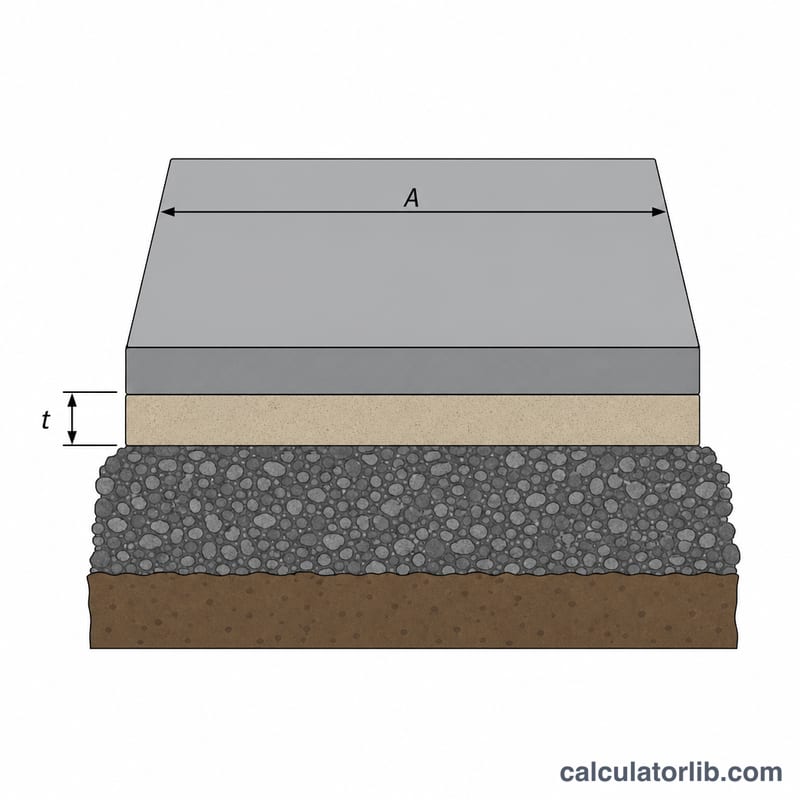
How to use it
Enter the total slab area in square metres, the mortar bed thickness in millimetres (commonly 30–50 mm for slabs), and a wastage allowance percentage (10% is a sensible default to cover spillage and uneven sub-bases). The calculator returns the mortar volume in cubic metres plus estimated cement and sand requirements.
The formula explained
The wet mortar volume is the bedding footprint:
$$V = A \times \frac{t}{1000} \times \left(1 + \frac{w}{100}\right)$$where \(A\) = area in m², \(t\) = bed thickness in mm (divided by 1000 to convert to metres), and \(w\) = wastage percentage. Mass of dry material is found from a mortar density of \(\rho \approx 2100\,\text{kg/m}^3\). For a 1:5 cement:sand mix, cement is \(\tfrac{1}{6}\) and sand \(\tfrac{5}{6}\) of the dry mass:
$$m_{cement} = \frac{1}{6}\rho V, \qquad m_{sand} = \frac{5}{6}\rho V$$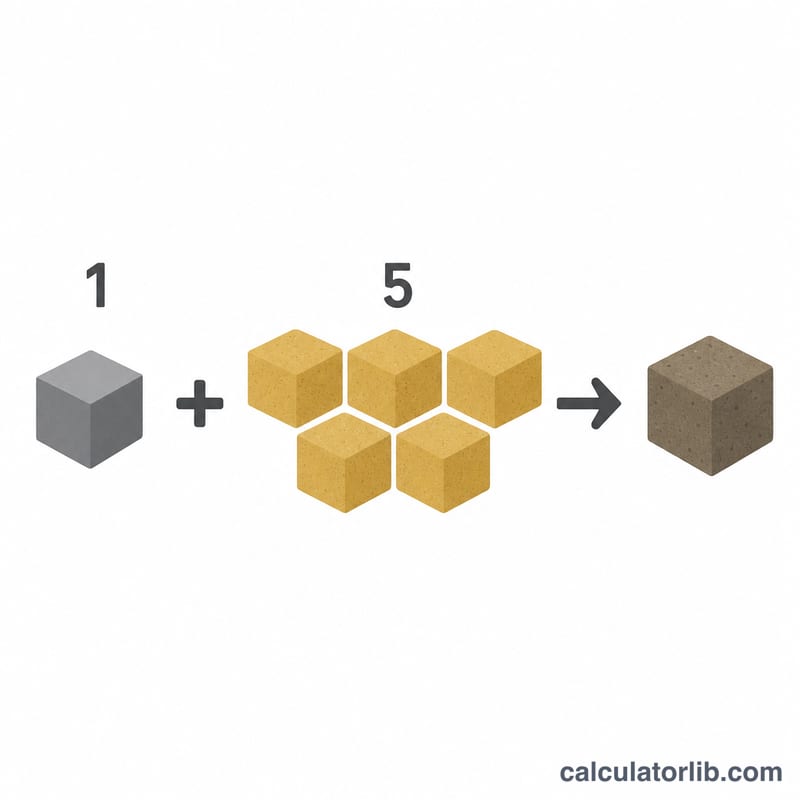
Worked example
For \(A = 20\,\text{m}^2\), \(t = 40\,\text{mm}\), and \(w = 10\%\):
$$V = 20 \times \frac{40}{1000} \times 1.10 = 0.88\,\text{m}^3$$$$m_{cement} = \tfrac{1}{6} \times 2100 \times 0.88 = 308\,\text{kg}$$$$m_{sand} = \tfrac{5}{6} \times 2100 \times 0.88 = 1540\,\text{kg}$$FAQ
How thick should a mortar bed be? For paving slabs a full mortar bed of 30–50 mm is typical. Thicker beds use more material.
What mix ratio is used? This tool assumes a standard 1:5 cement-to-sand bedding mortar. Stronger mixes (1:4) use slightly more cement.
Why add wastage? Real jobs lose material to spillage, uneven bases and offcuts, so a 10% buffer prevents running short.