
What the Tire Fitment Calculator Does
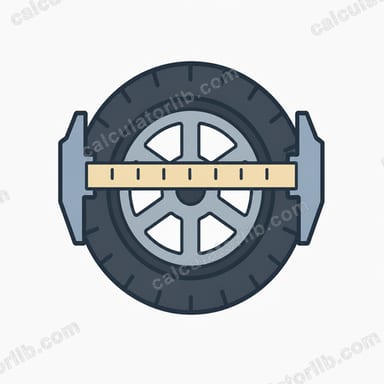
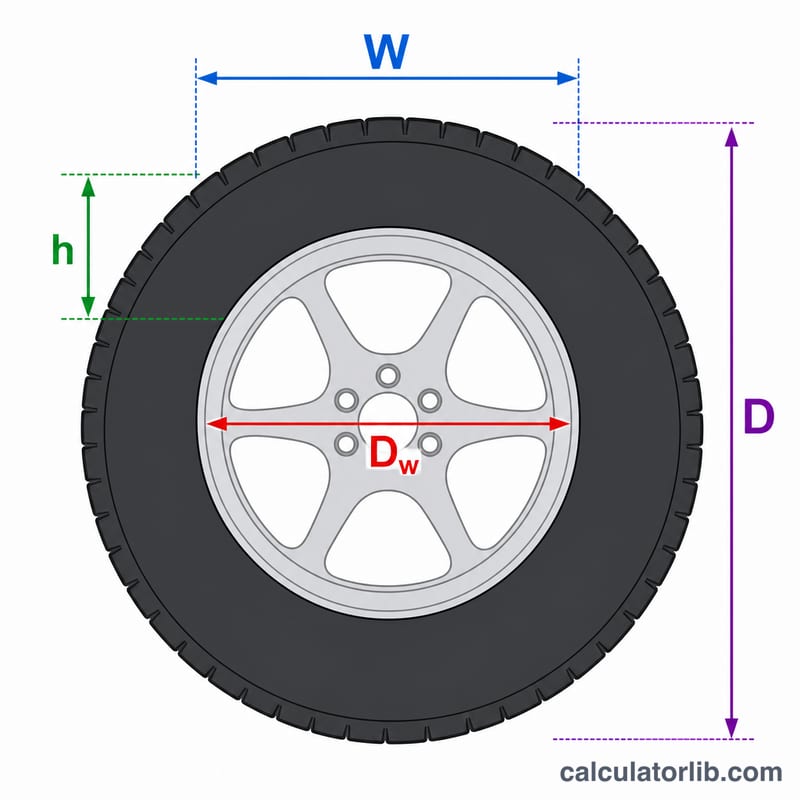
This tool converts a standard P-metric tire size (for example 225/45R17) into useful physical dimensions: overall tire diameter, sidewall height, circumference, and revolutions per mile. These figures help you compare tire sizes, check speedometer accuracy, and confirm fitment when changing wheels or plus-sizing.
How to Use It
Enter the three numbers printed on the sidewall: the section width in millimetres, the aspect ratio as a percentage, and the wheel (rim) diameter in inches. Press calculate to see the overall diameter and related values.
The Formula Explained
The sidewall height comes from the section width and aspect ratio. With \(W\) = section width (mm), \(R\) = aspect ratio (%), and \(D_w\) = wheel diameter (in):
$$d = D_w + 2\times\frac{W\times \frac{R}{100}}{25.4}$$Circumference is \(C = \pi d\). Revolutions per mile uses the tire-industry standard factor:
$$\text{revs/mile} = \frac{20168}{d}$$The constant 20168 already accounts for typical loaded-radius tire deformation, which is why it is preferred over the purely geometric \(63360/(\pi d)\).
Worked Example: 225/45R17
Sidewall = \(225\times0.45 = 101.25\) mm = \(101.25/25.4 = 3.986\) in. Overall diameter:
$$d = 17 + 2\times 3.986 = 24.97\ \text{in}$$Revolutions per mile:
$$\frac{20168}{24.97} \approx 807.34$$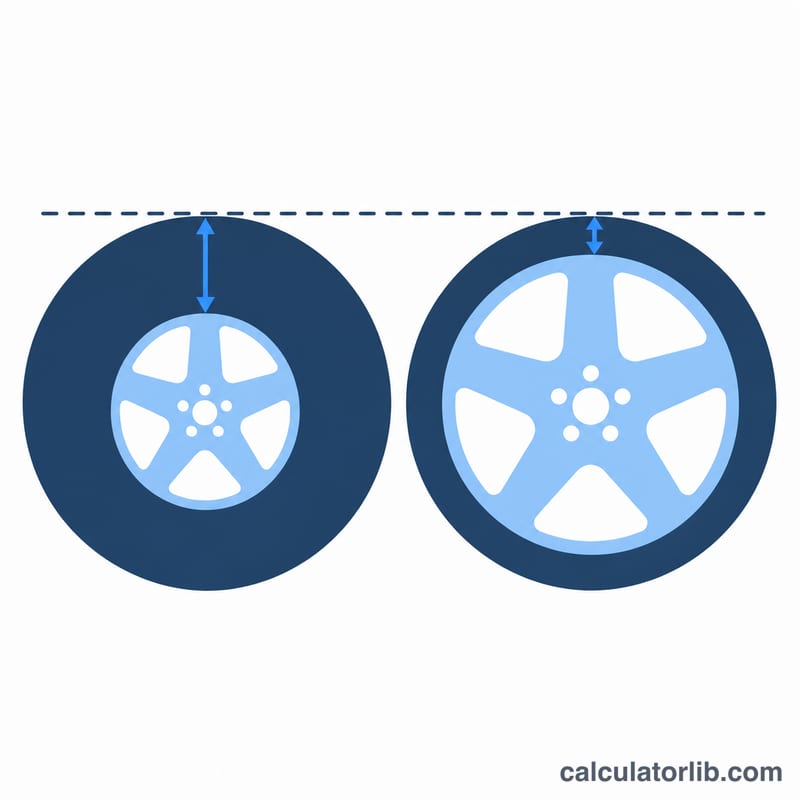
FAQ
What does 225/45R17 mean? 225 mm wide, sidewall is 45% of that width, R = radial, fits a 17-inch wheel.
Why use 20168 instead of geometry? A loaded tire flexes and rolls slightly smaller than its free diameter; the 20168 factor matches measured rolling distances.
How much diameter change is safe? Most guides keep overall diameter within about 3% of the original to limit speedometer error.