
What is the Tire Manufacture Date Calculator?
Every tire sold has a US Department of Transportation (DOT) identification number molded into its sidewall. Since the year 2000, this code ends in four digits that encode exactly when the tire was built. This calculator decodes those four digits into the manufacture week and the calendar date range so you can judge how old a tire really is, regardless of when it was sold or fitted.
How the DOT 4-digit code works
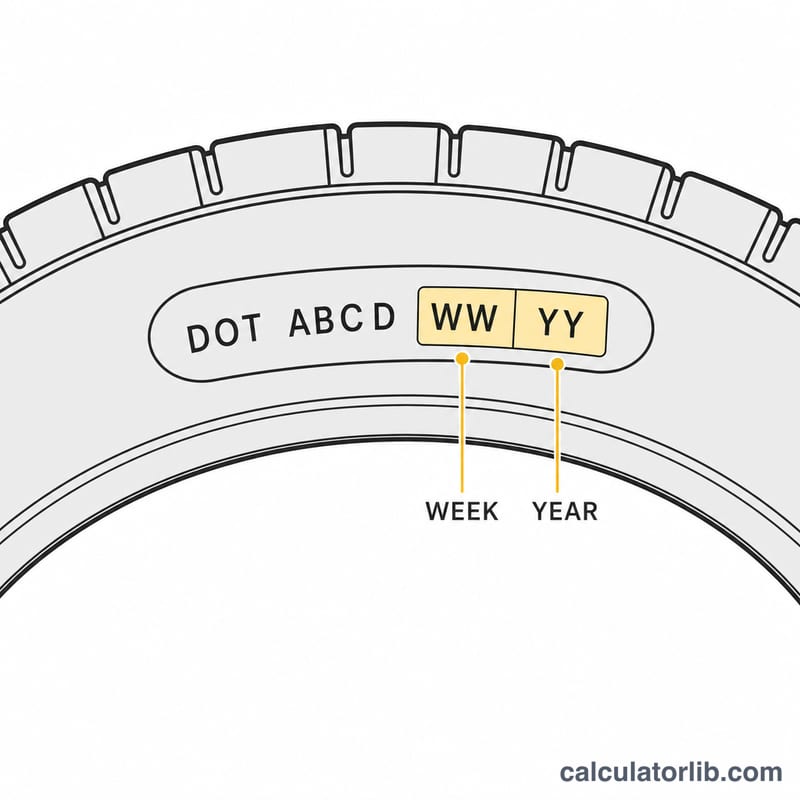
The last four digits of the DOT code are split in two. The first two digits are the week of the year (01 to 53) and the last two digits are the last two digits of the year. For example, the code "0722" means the tire was made in week 7 of 2022. The 4-digit format only applies to tires manufactured in 2000 or later; tires made before 2000 used a 3-digit code that is not supported here.
How to use it
Find the DOT code on your tire sidewall (it starts with "DOT" and ends with a group of digits). Enter just the final four digits into the field and read off the manufacture week, year and the Sunday-to-Saturday date range during which the tire was produced.
The formula explained
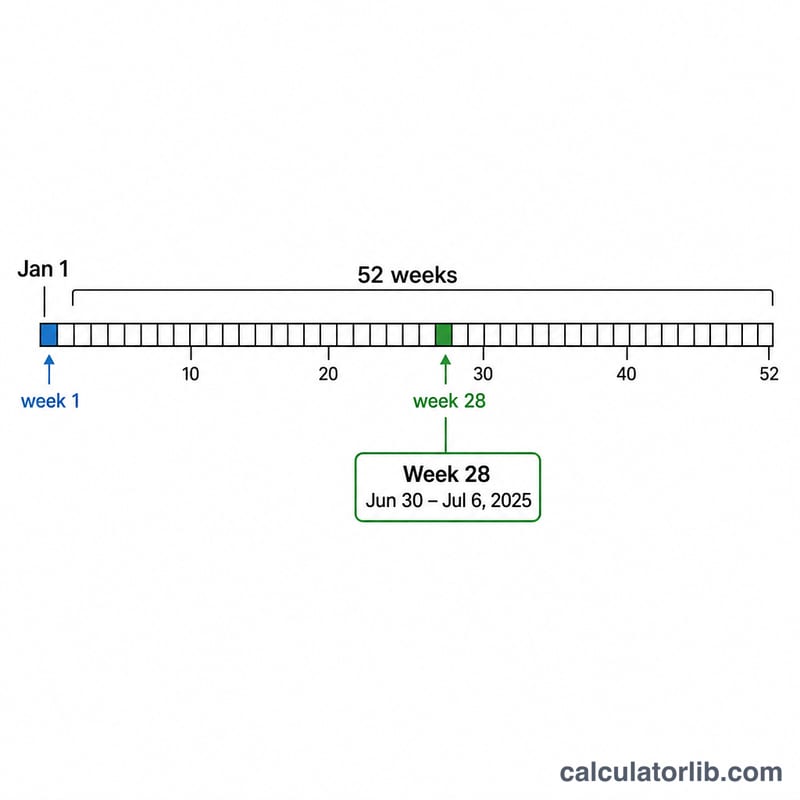
The year is simply 2000 plus the two-digit year code. To find the week, we locate January 1 of that year and step back to the Sunday on or before it, which begins week 1. Week N then starts (N minus 1) times seven days later, and ends six days after its start (the following Saturday).
$$\begin{gathered} \text{Week} = \text{DOT}_{[1,2]}, \quad \text{Year} = 2000 + \text{DOT}_{[3,4]} \\[1.5em] \text{Start} = \text{Jan 1} - d_{\text{Jan 1}} + (\text{Week}-1)\times 7,\quad \text{End} = \text{Start} + 6 \end{gathered}$$
Worked example
Take the code "0722". The first two digits give week 7; the last two give year 2022. January 1, 2022 was a Saturday, so week 1 began on the Sunday before it, December 26, 2021. Week 7 starts 42 days later on February 6, 2022 and ends February 12, 2022. So the tire was made the week of February 6-12, 2022.
$$\text{Start} = \text{Dec 26, 2021} + (7-1)\times 7 = \text{Feb 6, 2022}, \quad \text{End} = \text{Feb 6, 2022} + 6 = \text{Feb 12, 2022}$$
FAQ
How old is too old for a tire? Many manufacturers recommend replacing tires that are 6 to 10 years old regardless of tread, because rubber degrades with age. Check your vehicle and tire maker guidance.
Why is my date range slightly different from another tool? The exact week-1 convention can shift the displayed range by up to a week. This tool uses Sunday-Saturday weeks anchored to the week containing January 1.
My code has only 3 digits - why does it fail? Three-digit codes are from before 2000 and are out of scope for this calculator.