
What Is Maximum Heart Rate?
Your maximum heart rate (HRmax) is the highest number of times your heart can beat per minute during all-out physical effort. It is a key reference point for setting training intensity, pacing workouts, and defining heart-rate zones. Because directly measuring HRmax requires a maximal exercise test, most people estimate it from their age using a simple equation.
How to Use This Calculator
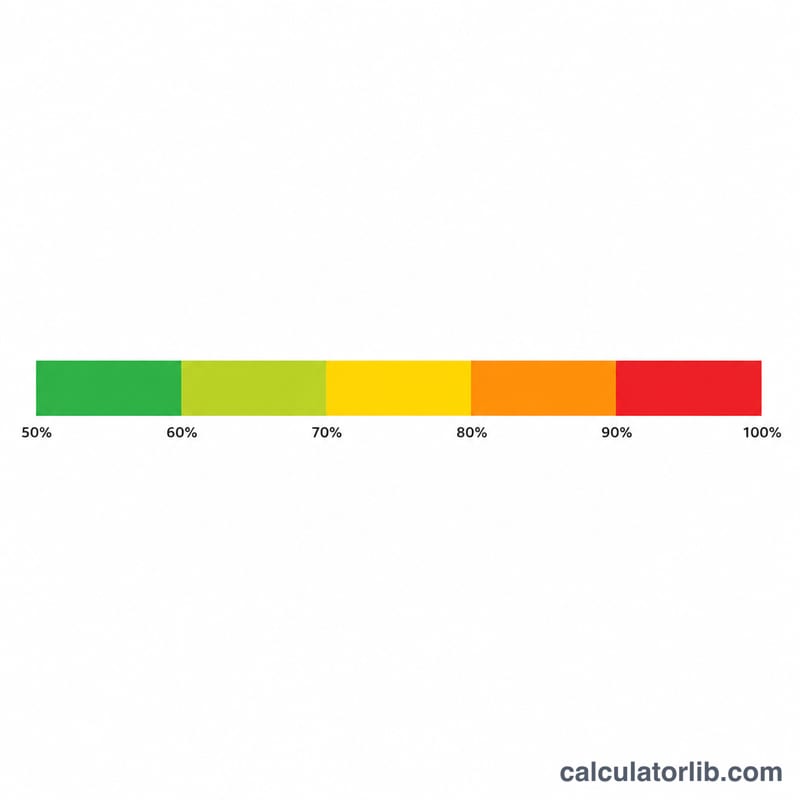
Enter your age in years and choose a formula. The Fox method \(220 - \text{age}\) is the best-known rule of thumb. The Tanaka method \(208 - 0.7 \times \text{age}\) is supported by more recent research and tends to be more accurate, especially for older adults. The calculator returns your estimated HRmax plus three common training zones based on percentages of that maximum.
The Formula Explained
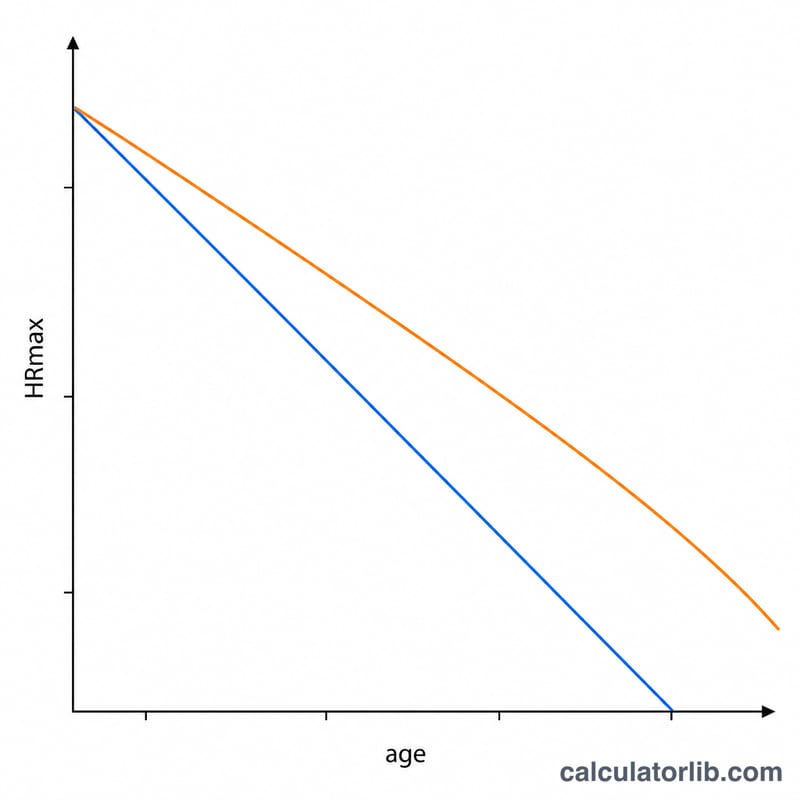
The Fox equation assumes maximum heart rate declines by roughly one beat per minute for every year of age.
$$\text{HR}_{max} = 220 - \text{Age (years)}$$The Tanaka equation uses a gentler slope of 0.7 bpm per year and a lower intercept, which fits population data better.
$$\text{HR}_{max} = 208 - 0.7 \times \text{Age (years)}$$Both are population averages — individual maximums can vary by ±10–12 bpm.
Worked Example
For a 40-year-old using the Fox formula:
$$\text{HR}_{max} = 220 - 40 = \textbf{180 bpm}$$Using Tanaka:
$$\text{HR}_{max} = 208 - 0.7 \times 40 = 208 - 28 = \textbf{180 bpm}$$The 70% aerobic zone would be \(0.70 \times 180 = 126\) bpm.
FAQ
Which formula should I use? Tanaka is generally more accurate for adults; Fox is simpler and widely taught.
How accurate is the estimate? These are averages with a standard deviation of about 10–12 bpm, so use the result as a guide rather than an exact limit.
Should I exceed my HRmax? Training near or above your estimated maximum is intense; consult a doctor before high-intensity exercise if you have health concerns.