
What Is the Tanaka Maximum Heart Rate Formula?
Your maximum heart rate (MaxHR) is the highest number of beats per minute your heart can reach during all-out effort. The Tanaka formula, published by Hirofumi Tanaka and colleagues in 2001, estimates MaxHR from age alone and is widely considered more accurate across the adult population than the older "220 − age" rule. It applies universally and is independent of sex.
How to Use This Calculator
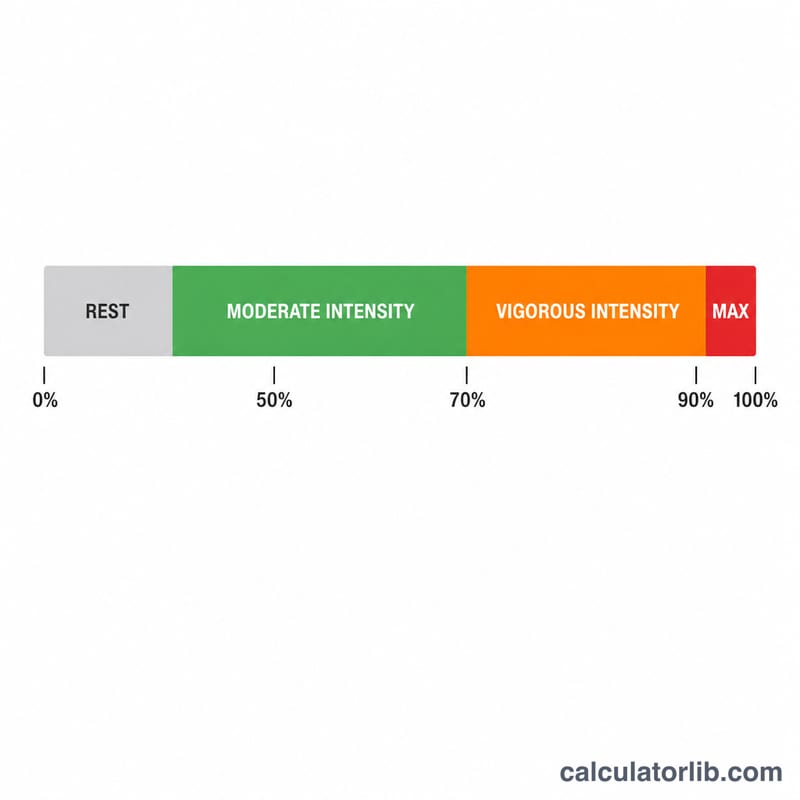
Enter your age in years and the calculator instantly returns your estimated maximum heart rate, plus two common training-intensity boundaries: 50% (the lower edge of moderate-intensity exercise) and 85% (the upper edge of vigorous-intensity exercise). Aim to keep your workout heart rate within those values for general aerobic fitness.
The Formula Explained
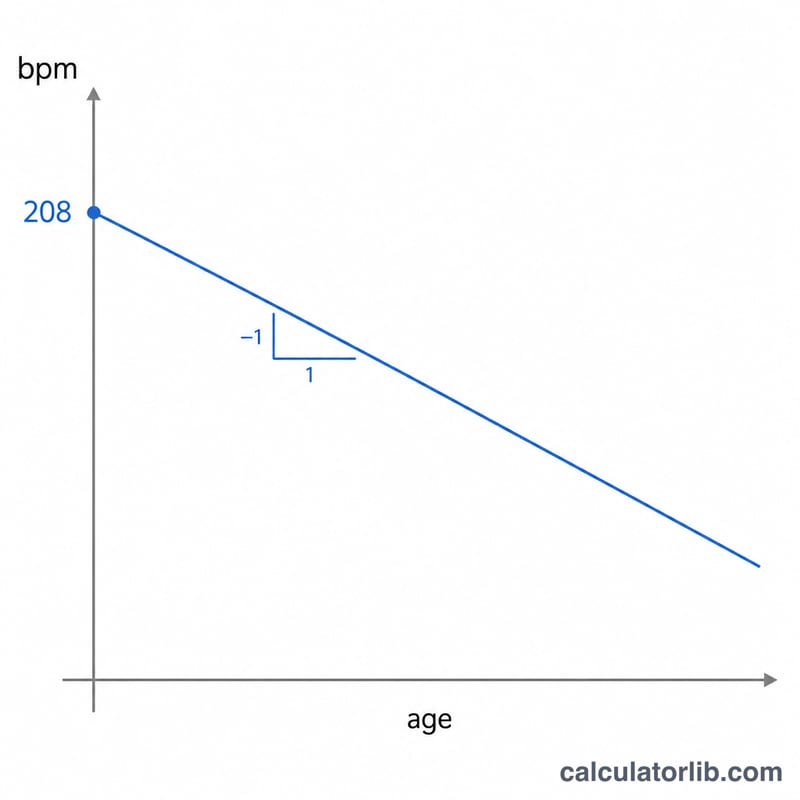
The equation is $$\text{MaxHR} = 208 - 0.7 \times \text{age}$$ The constant 208 represents the modeled maximum for a newborn, and each year of age subtracts 0.7 beats per minute. A training zone is simply your MaxHR multiplied by a target percentage.
Worked Example
For a 40-year-old: $$\text{MaxHR} = 208 - 0.7 \times 40 = 208 - 28 = \mathbf{180 \text{ bpm}}$$ The moderate zone floor is \(180 \times 0.50 = 90\) bpm, and the vigorous zone ceiling is \(180 \times 0.85 = 153\) bpm. So this person would typically train between roughly 90 and 153 bpm depending on goals.
FAQ
Is Tanaka better than 220 − age? Yes — research shows "220 − age" overestimates MaxHR in younger people and underestimates it in older people. Tanaka reduces this bias across ages.
Is this an exact value? No. Any age-based formula is a population estimate with individual variation of about ±10 bpm. A graded exercise test gives a true measured value.
Should I exercise at my maximum heart rate? No. MaxHR is a reference ceiling. Most training happens at a percentage of it; consult a physician before high-intensity exercise if you have health concerns.