Heart Rate as Percent of Max Calculator

Heart Rate as Percent of Max Calculator

Emerging AI Skill PRO

Enter Calculation

Formula

% of Max=Heart Rate (bpm)220−Age (years)×100\%\text{ of Max} = \frac{\text{Heart Rate (bpm)}}{220 - \text{Age (years)}} \times 100

Example

% of Max=120220−30×100≈63.2\%\text{ of Max} = \frac{120}{220 - 30} \times 100 \approx 63.2
Usage stats

Advertisement

Results

Heart Rate as % of Maximum
63.2%
of estimated maximum heart rate
Estimated Max HR (220 − age) 190 bpm
Current Heart Rate 120 bpm

Report an error on this page

What Is Heart Rate as Percent of Max?

Your maximum heart rate (HRmax) is the highest number of beats per minute your heart can reach during all-out effort. Expressing your current heart rate as a percentage of this maximum tells you how hard you are working — a key metric for pacing cardio, interval training, and recovery. This calculator uses the widely known age-based estimate, \(220 - \text{age}\), to approximate your maximum.

How to Use It

Enter your age in years and your current heart rate in beats per minute (from a chest strap, watch, or pulse count). The calculator returns your estimated maximum heart rate and the percentage of that maximum you are currently working at.

The Formula Explained

The calculation is simple:

$$\%\text{ of Max} = \frac{\text{Heart Rate (bpm)}}{220 - \text{Age (years)}} \times 100$$

First the estimated maximum is found by subtracting your age from 220. Then your current heart rate is divided by that maximum and multiplied by 100 to convert to a percentage.
Advertisement
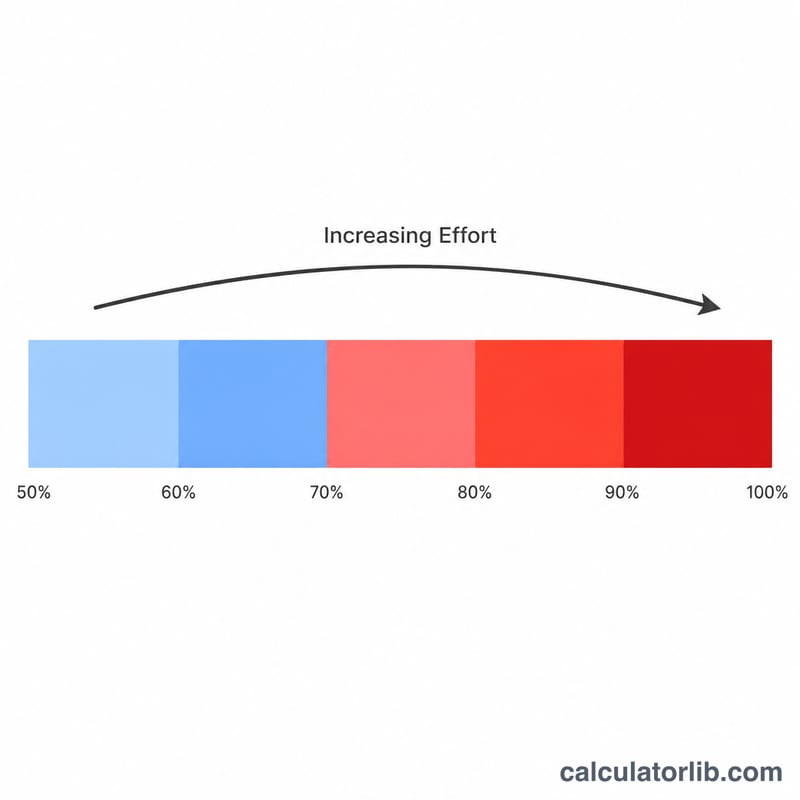
Horizontal bar showing heart rate training intensity zones from low to maximum effort
The five training intensity zones expressed as percentages of maximum heart rate.

Worked Example

Suppose you are 30 years old with a current heart rate of 150 bpm. Your estimated maximum is \(220 - 30 = 190\) bpm. Then

$$150 \div 190 \times 100 = 78.9\%$$

That places you in a vigorous aerobic training zone (70–85%).
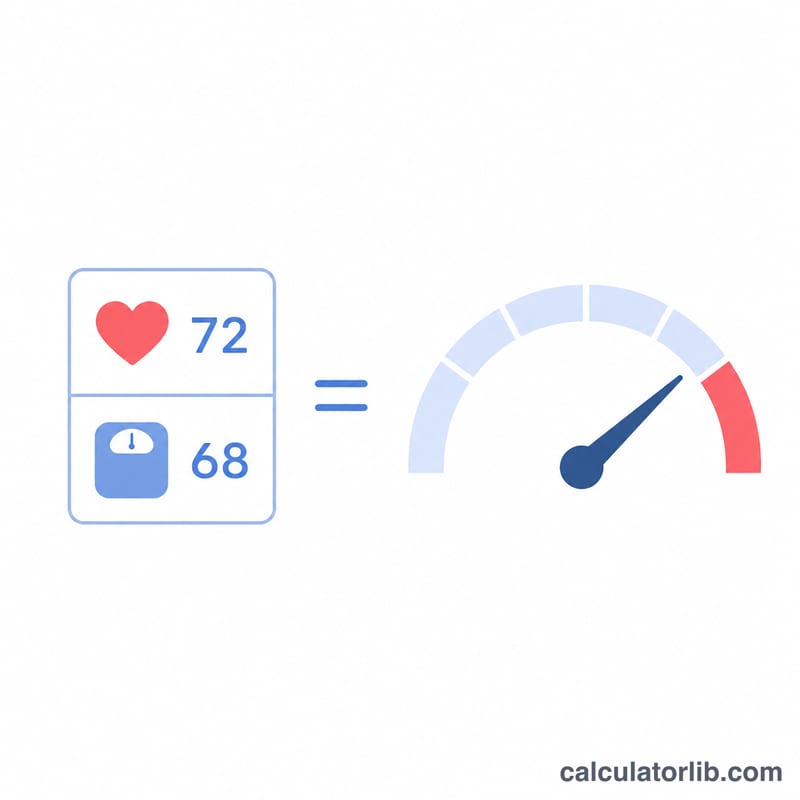
Diagram showing current heart rate divided by max heart rate giving a percentage on a gauge
The percent of max is the current heart rate divided by the estimated maximum.

FAQ

How accurate is \(220 - \text{age}\)? It is a population average and can be off by ±10–12 bpm for any individual. For precision, a measured maximum from a stress test is better.

What are the training zones? Roughly: 50–60% very light, 60–70% fat-burning/light, 70–80% aerobic, 80–90% anaerobic, 90–100% maximum effort.

Is a high percentage dangerous? Sustained effort near 100% is intense and should only be done by trained, healthy individuals. Consult a doctor before high-intensity exercise if you have any health concerns.


Sources & References

  • Table: Estimating Target Heart Rate — MSD Manual Consumer Version (Merck & Co., Inc.). HRmax = 220 - age; moderate-intensity target = about 50-60% of HRmax. · Verified 2026-11-07
  • Table: Estimating Target Heart Rate — MSD Manual Consumer Version (Merck & Co., Inc.). Vigorous-intensity target = about 70-85% of HRmax (220 - age). · Verified 2026-11-07
  • Age-predicted maximal heart rate revisited — Tanaka H, Monahan KD, Seals DR, J Am Coll Cardiol 2001;37(1):153-156, doi 10.1016/s0735-1097(00)01054-8, PMID 11153730. 220 - age is the widely used age-predicted HRmax equation; Tanaka's 208 - 0.7 x age is more accurate in healthy adults. · Verified 2026-11-07
  • Determinants of fat oxidation during exercise in healthy men and women: a cross-sectional study — Venables MC, Achten J, Jeukendrup AE, J Appl Physiol 2005;98(1):160-167, doi 10.1152/japplphysiol.00662.2003, PMID 15333616. In 300 healthy adults, maximal fat oxidation occurred on average at 48% VO2max, about 61.5% of measured maximal heart rate. · Verified 2026-11-07

Checked against these sources on . Not reviewed by a clinician. For general information only, not medical advice or a diagnosis. Talk to a doctor about any health concern.

Last updated:

Most popular in Health and Fitness

View all Health and Fitness calculators