
What Is the Blood Glucose Unit Converter?
Blood glucose (blood sugar) is reported in two different units around the world. The United States, Germany, Japan and a few other countries use milligrams per deciliter (mg/dL), while most of the rest of the world — including the UK, Canada, Australia and much of Europe — uses millimoles per liter (mmol/L). This converter lets you translate a reading from one unit into the other instantly, so lab results, glucose meters and diabetes guidelines all make sense no matter where they came from.
How to Use It
Enter your glucose reading, choose whether the number is in mg/dL or mmol/L, and the calculator returns the equivalent value in both units. The conversion factor (18.0182) reflects the molar mass of glucose, so the result is medically accurate.
The Formula Explained
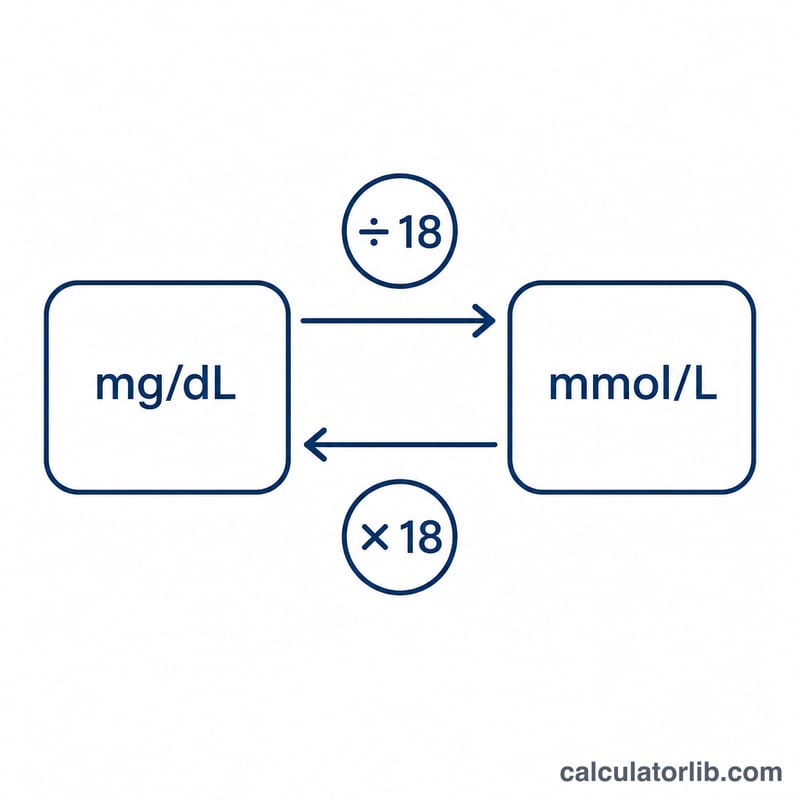
Because one millimole of glucose weighs about 180.182 milligrams and there are 10 deciliters in a liter, the relationship simplifies to a single factor:
$$\text{mmol/L} = \frac{\text{mg/dL}}{18.0182}$$ and $$\text{mg/dL} = \text{mmol/L} \times 18.0182$$. The factor is constant for glucose, which makes conversions quick and reliable.
Worked Example
Suppose your glucose meter reads 100 mg/dL. Divide by 18.0182: $$100 \div 18.0182 \approx 5.55 \text{ mmol/L}$$ a normal fasting value. Going the other way, a reading of 7 mmol/L equals \(7 \times 18.0182 \approx 126\) mg/dL.
FAQ
Is 100 mg/dL the same as 5.5 mmol/L? Yes — 100 mg/dL is approximately 5.55 mmol/L.
What is a normal fasting glucose level? Generally about 70–99 mg/dL (3.9–5.5 mmol/L), though target ranges vary by individual and condition. This tool is for unit conversion only and is not medical advice.
Why 18.0182 and not 18? 18 is a common rounded shortcut, but 18.0182 reflects glucose's precise molar mass for more accurate results.