
What Is the Blood Volume Calculator?
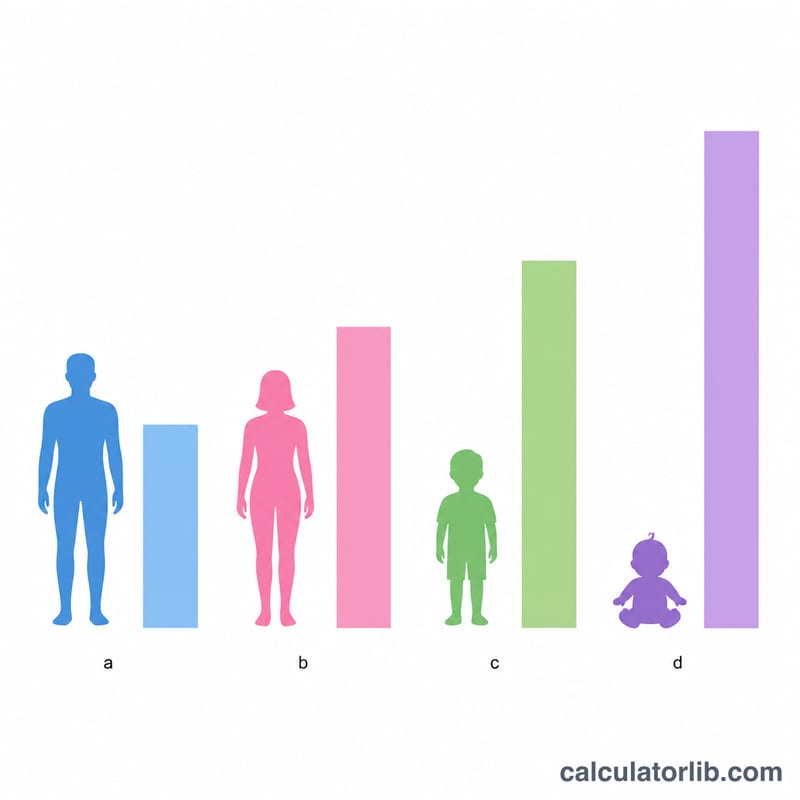
The Blood Volume Calculator estimates the total amount of blood circulating in a person's body based on their body weight and an average blood-volume factor (mL/kg). It uses widely cited average constants: roughly 70 mL/kg for adult males, 65 mL/kg for adult females, 80 mL/kg for children, and 85 mL/kg for infants. This is a general physiological estimate and not a clinical diagnostic measurement.
How to Use It
Select the gender or age group that best matches the individual, then enter the body weight in kilograms. The calculator multiplies the weight by the chosen mL/kg factor and reports the estimated blood volume in milliliters and liters.
The Formula Explained
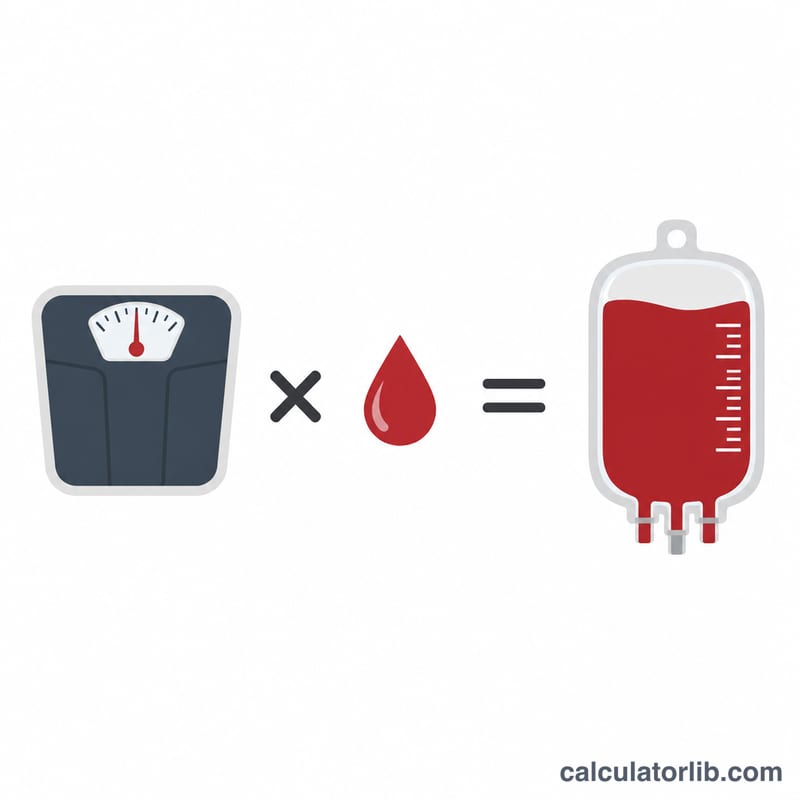
The estimate uses a simple linear relationship: $$\text{Blood Volume} = \text{Weight} \times \text{mL/kg}$$. The mL/kg factor reflects the fact that blood makes up a fairly consistent proportion of body mass, though it varies with body composition, sex, and age. Leaner, more muscular bodies tend to have proportionally more blood, while higher body-fat percentages slightly reduce the per-kilogram figure.
Worked Example
Consider an adult male weighing 70 kg. Using the 70 mL/kg factor: $$70 \times 70 = 4{,}900 \text{ mL}$$ or 4.9 liters. This matches the commonly stated figure that an average adult has about 5 liters of blood.
Interpreting Your Result
For an average adult, total blood volume comes out to roughly 5 liters — for example, a 70 kg man estimates near 4.9 L and a 70 kg woman near 4.55 L. The commonly cited typical adult range is about 4.5 to 5.5 L, which is consistent with weight-based estimates for most adults of average build.
This figure is an estimate, not a measurement. Because the calculation uses a single mL/kg factor multiplied by body weight, it does not account for individual differences in body composition. Lean tissue is more vascular than fat, so people with a higher percentage of body fat tend to have a lower blood volume per kilogram than the average factor suggests, while very muscular individuals may have somewhat more. Hydration status, sex, age, altitude acclimatization and pregnancy can all shift actual blood volume away from the estimate.
If you want a sense of how body composition might affect the estimate, you can review your lean body mass or BMI separately, since the simple weight-based formula does not incorporate them.
This tool is intended for general education and rough estimation only. It is not a clinical measurement of blood volume and should not be used to guide transfusion, fluid resuscitation, blood-loss assessment or any other medical decision. Accurate clinical determination of blood volume requires direct measurement techniques performed and interpreted by healthcare professionals. This is general information, not professional medical advice — consult a qualified clinician for any health concern.
FAQ
Is this medically accurate? It provides a reasonable population-average estimate but is not a substitute for clinical measurement. Actual blood volume varies by individual.
What factor should I use for myself? Use the option matching your sex and age group. Adults typically fall between 65 and 75 mL/kg.
How do I convert to pints? One liter is about 2.11 US pints, so multiply the liter result by 2.11 for an approximate pint value.