
What Is Stroke Volume?
Stroke volume (SV) is the amount of blood pumped out of the left ventricle of the heart with each beat, measured in milliliters per beat (mL/beat). It is a key indicator of cardiac function. A typical resting adult value is about 60–100 mL/beat. This calculator finds stroke volume two ways: from cardiac output and heart rate, or from the difference between the heart's filled and emptied volumes.
How to Use the Calculator
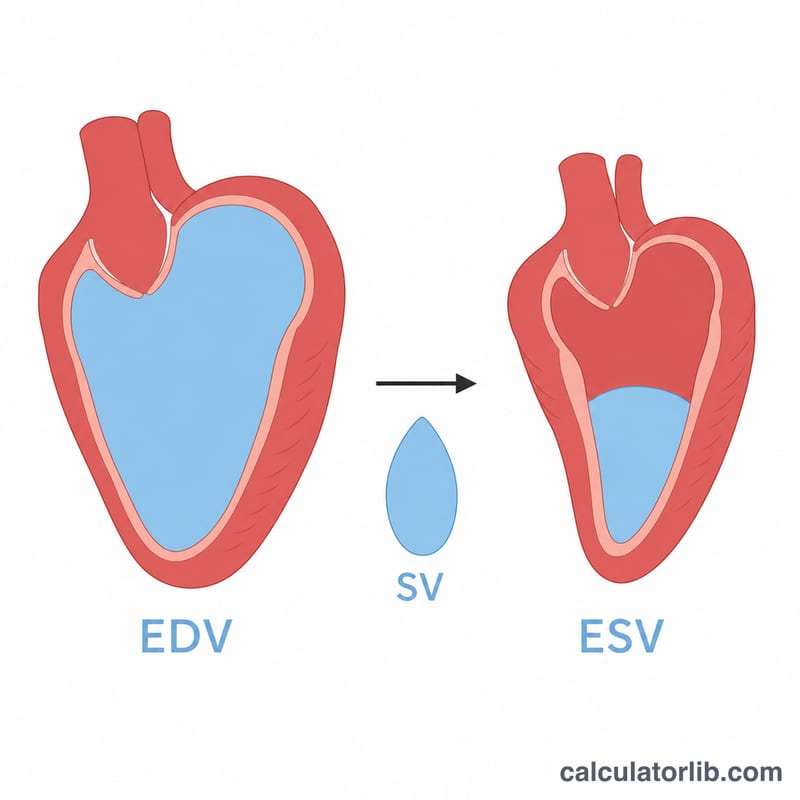
Choose a method. For the Cardiac Output method, enter cardiac output in liters per minute (L/min) and heart rate in beats per minute (bpm). For the Ventricular Volume method, enter end-diastolic volume (EDV, the volume when the ventricle is full) and end-systolic volume (ESV, the volume after contraction) in milliliters. The result appears instantly in mL per beat.
The Formula Explained
Cardiac output is the total blood pumped per minute, equal to stroke volume times heart rate. Rearranging gives \(\text{SV} = \text{CO} \div \text{HR}\). Because cardiac output is usually expressed in L/min and stroke volume in mL, we multiply CO by 1000 first.
$$\text{SV} = \frac{\text{Cardiac Output (L/min)} \times 1000}{\text{Heart Rate (bpm)}}$$Alternatively, stroke volume is simply how much the ventricle empties each beat: \(\text{SV} = \text{EDV} - \text{ESV}\).
$$\text{SV} = \text{End-Diastolic Volume (mL)} - \text{End-Systolic Volume (mL)}$$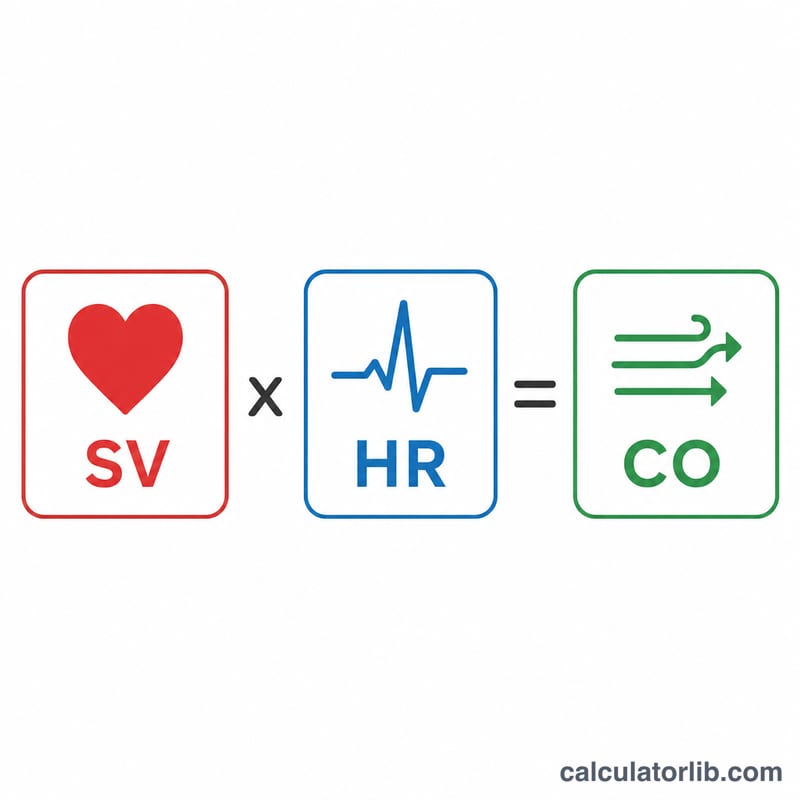
Worked Example
Suppose a patient has a cardiac output of 5 L/min and a heart rate of 70 bpm.
$$\text{SV} = \frac{5 \times 1000}{70} = \frac{5000}{70} \approx 71.4 \text{ mL/beat}$$a healthy value. Using volumes: if EDV is 120 mL and ESV is 50 mL,
$$\text{SV} = 120 - 50 = 70 \text{ mL/beat}$$FAQ
What is a normal stroke volume? Roughly 60–100 mL per beat for a resting adult, though it varies with body size and fitness.
How is stroke volume related to ejection fraction? Ejection fraction = \(\text{SV} \div \text{EDV} \times 100\%\). With SV 70 mL and EDV 120 mL, EF \(\approx 58\%\).
Does exercise change stroke volume? Yes, stroke volume rises during exercise as the heart fills and contracts more forcefully, increasing cardiac output. This tool is for educational use, not medical diagnosis.