
What Is the Breastfeeding Calorie Calculator?
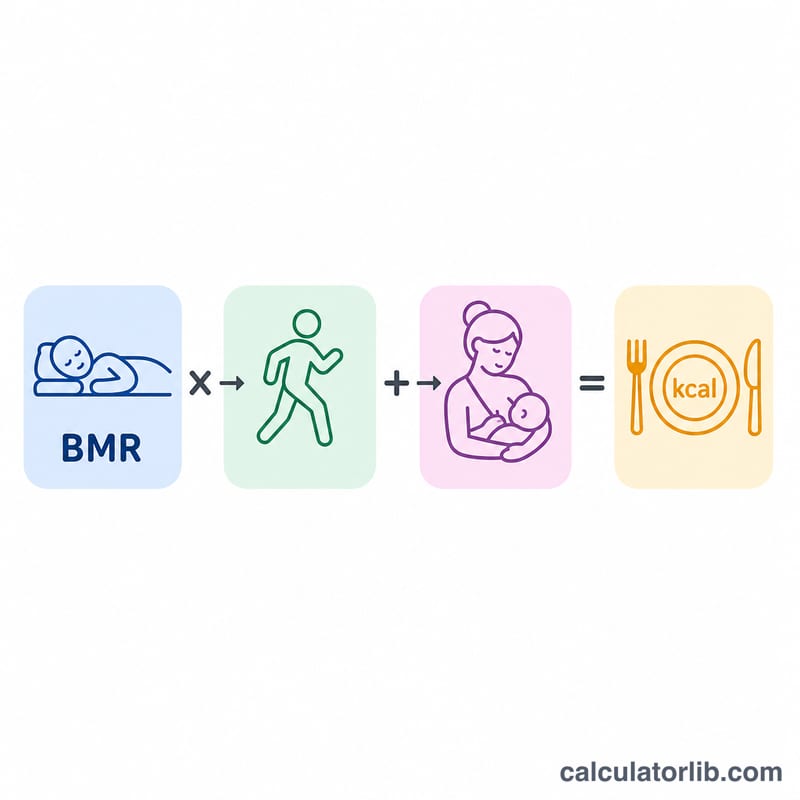
Breastfeeding burns extra energy because your body produces milk around the clock. This calculator estimates how many calories you need each day while nursing by combining your basal metabolic rate (BMR), your daily activity level, and an additional lactation allowance. It gives a practical target so you can eat enough to support both your own health and a steady milk supply.
How to Use It
Enter your weight, height, age, and gender, then choose how active you are on a typical day. Finally, select your breastfeeding type: exclusive nursing demands the most energy (around +500 kcal), while partial breastfeeding (when baby also takes solids or formula) needs less. The result shows your total daily calorie target plus a breakdown of your BMR, maintenance calories, and the lactation add.
The Formula Explained
We first calculate BMR using the Mifflin-St Jeor equation. For women: $$\text{BMR} = 10 \times \text{weight(kg)} + 6.25 \times \text{height(cm)} - 5 \times \text{age} - 161.$$ Multiplying BMR by an activity factor (1.2 sedentary to 1.9 extra active) gives maintenance calories — the amount to hold your weight steady. We then add the lactation energy cost. Health authorities estimate exclusive breastfeeding requires roughly 330–500 extra kcal per day, partly offset by pregnancy fat stores.
Worked Example
A 30-year-old woman weighing 65 kg at 165 cm who is lightly active and exclusively breastfeeding: $$\text{BMR} = (10\times65) + (6.25\times165) - (5\times30) - 161 = 650 + 1031.25 - 150 - 161 = 1370.25 \text{ kcal}.$$ Maintenance \(= 1370.25 \times 1.375 \approx 1884\) kcal. Add 500 kcal for exclusive nursing → about 2384 calories per day.
What Your Result Means
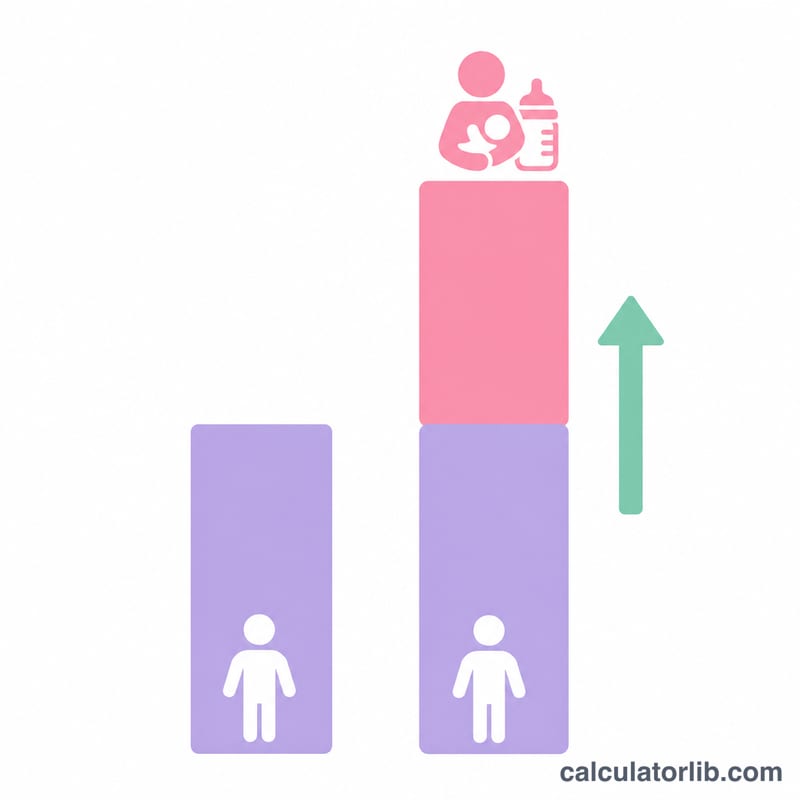
The number this calculator returns is an estimate of the calories needed to maintain your current weight while supporting a healthy milk supply. It combines your baseline metabolism, daily movement, and the extra energy of making milk.
- It is an estimate, not a prescription. Individual metabolism, exact milk volume, and how much you move all vary. Use the figure as a starting point and adjust based on hunger, energy, and how your weight and supply respond over a few weeks.
- Pregnancy fat stores offset part of the cost. Full milk production costs roughly 500 kcal/day, but the body draws on fat reserves built during pregnancy, which is why authorities recommend a net add of about 330 kcal. Choosing the 330 option supports gradual, healthy postpartum weight loss; the 500 option more fully replaces the cost.
- There is a floor. Most health authorities advise breastfeeding parents not to drop below about 1,500–1,800 kcal/day, since very low intakes can reduce milk supply and leave you short on key nutrients. If your calculated total approaches this range, lean toward the higher lactation add rather than cutting further.
- Needs shift as the baby grows. Once solids begin around 6 months and the baby nurses less, milk demand and the lactation add both fall. Re-run the calculator with a lower feeding option as you move into partial feeding or weaning so your intake tracks your actual needs.
This is general information, not professional advice. For weight, supply, or nutrition concerns, consult your doctor, a registered dietitian, or a lactation consultant for guidance tailored to you and your baby.
FAQ
How many extra calories do I need while breastfeeding? Most exclusively breastfeeding mothers need roughly 450–500 extra kcal per day, though some guidance uses 330 to account for fat stores from pregnancy.
Will eating more calories help my milk supply? Adequate nutrition and hydration support supply. Severe calorie restriction can reduce supply, so avoid aggressive dieting while nursing.
Is this medical advice? No. This is an estimate for general planning. Consult your doctor or a registered dietitian for personalized guidance, especially if managing weight or health conditions.