
What Is Fundal Height?
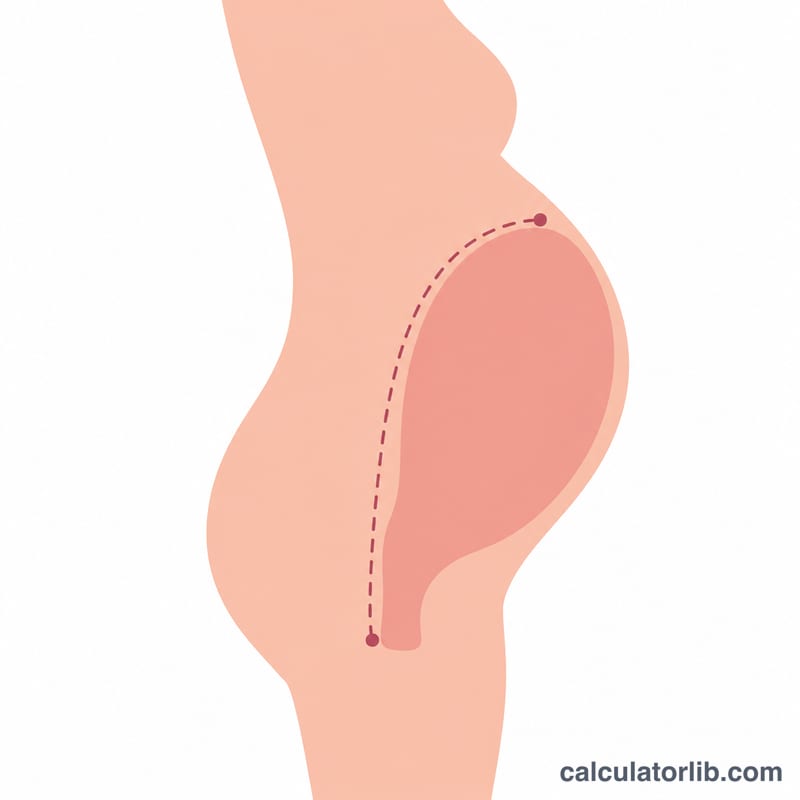
Fundal height is the distance in centimeters from the top of the pubic bone (symphysis pubis) to the top of the uterus (the fundus), measured by a clinician during pregnancy. From roughly 20 to 36 weeks of gestation, this measurement closely tracks gestational age: a pregnancy at 28 weeks typically shows a fundal height near 28 cm. This calculator gives you the expected value and the commonly accepted normal range so you can understand a measurement in context.
How to Use the Calculator
Enter the current gestational age in completed weeks (between 20 and 40). The calculator returns the expected fundal height in centimeters along with the normal low and high bounds (gestational age minus 2 cm and plus 2 cm). Compare a measured value to this range to see whether it falls within the expected window.
The Formula Explained
The widely used clinical rule of thumb is: expected fundal height (cm) ≈ gestational age (weeks). To allow for natural variation, a tolerance of about ± 2 cm is applied, so the normal range runs from (weeks − 2) to (weeks + 2):
$$\text{Fundal Height (cm)} = \text{Weeks} \pm 2$$For example, at 30 weeks the expected height is 30 cm and the normal range is 28–32 cm.

Worked Example
Suppose a woman is 32 weeks pregnant. The expected fundal height is 32 cm. The normal range is:
$$32 - 2 = 30 \text{ cm} \quad \text{to} \quad 32 + 2 = 34 \text{ cm}$$If her measured fundal height is 31 cm, it falls comfortably inside the normal range.
FAQ
Is this a diagnosis? No. This is an educational estimate only. Fundal height is a screening tool; deviations can have many causes and should always be evaluated by a healthcare provider with ultrasound and other assessments.
When is the weeks ≈ cm rule reliable? It is most reliable from about 20 to 36 weeks. Earlier and later in pregnancy the relationship is less precise.
What if my measurement is outside the range? A measurement more than 2–3 cm above or below expected may prompt your provider to check for factors such as multiple pregnancy, amniotic fluid level, fetal growth, or fibroids. Discuss any concerns with your clinician.