
What Is Mean Sac Diameter (MSD)?
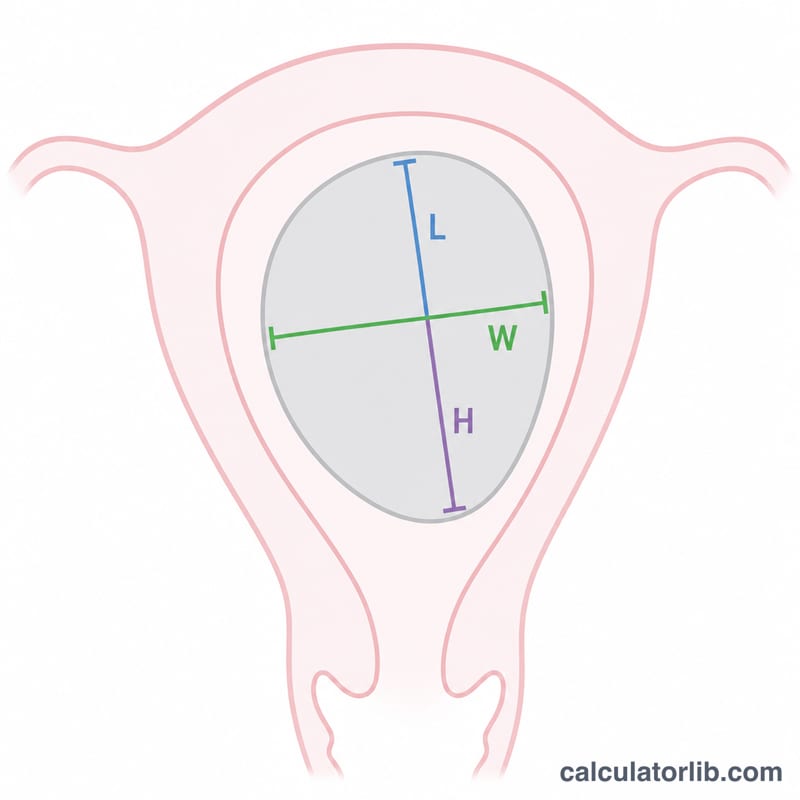
The Mean Sac Diameter (MSD) is an ultrasound measurement used in early pregnancy to assess the size of the gestational sac before an embryo or yolk sac is clearly visible. It is calculated by averaging three perpendicular dimensions of the sac — length, width, and height — measured in millimetres. This calculator also provides a rough estimate of gestational age. Note: this tool is for educational purposes only and is not a substitute for professional medical assessment.
How to Use This Calculator
Enter the three orthogonal sac measurements (length, width, and height) in millimetres taken from the ultrasound report. The calculator averages them to give the MSD, then estimates gestational age in days and weeks. Compare the result with your sonographer's report.
The Formula Explained
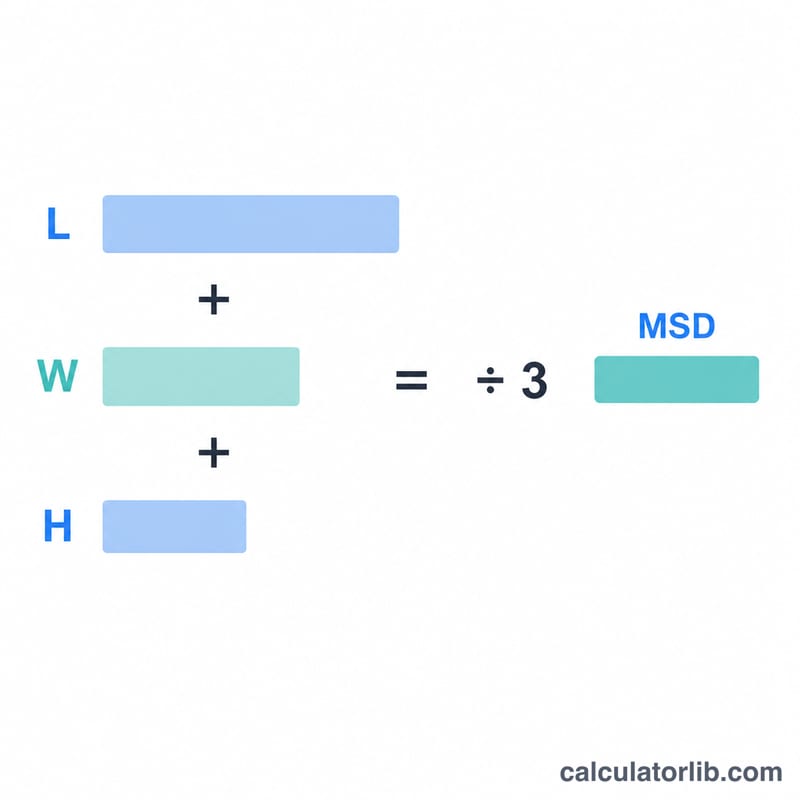
The MSD is simply the arithmetic mean of the three dimensions:
$$\text{MSD} = \frac{\text{Length} + \text{Width} + \text{Height}}{3}$$
A widely cited early approximation for gestational age (most accurate before about 6 weeks) adds 30 days to the MSD in millimetres:
$$\text{Gestational Age (days)} \approx \text{MSD (mm)} + 30$$
Dividing by 7 converts days into weeks.
Worked Example
Suppose the gestational sac measures 10 mm × 12 mm × 14 mm. The MSD is $$\text{MSD} = \frac{10 + 12 + 14}{3} = \frac{36}{3} = 12 \text{ mm}$$ The estimated gestational age is \(12 + 30 = 42\) days, or \(42 / 7 = 6\) weeks exactly.
FAQ
How accurate is the gestational age estimate? The "MSD + 30 days" rule is a quick approximation that works reasonably well in the very early weeks but becomes less reliable as pregnancy progresses; crown-rump length is preferred once the embryo is visible.
What is a normal MSD? A gestational sac is usually first seen around 2–3 mm and grows roughly 1 mm per day. Your clinician interprets the value in context.
Why average three measurements? The sac is not perfectly spherical, so averaging three perpendicular axes gives a representative single diameter.