
What Is a Reverse Due Date Calculator?
A reverse due date calculator works backward from a known or estimated due date to tell you two important dates: the approximate date of conception and the first day of the last menstrual period (LMP). This is handy when you already have a due date from an early ultrasound or your provider, and you want to understand the timeline of how the pregnancy began.
How the Calculation Works
Standard pregnancy dating uses Naegele's rule, which assumes a 40-week (280-day) pregnancy measured from the first day of the last menstrual period. Conception typically occurs about two weeks after the LMP, which is roughly 38 weeks (266 days) before the due date. So the math is simply:
$$\text{Conception Date} = \text{Due Date} - 266\ \text{days}$$$$\text{LMP} = \text{Due Date} - 280\ \text{days}$$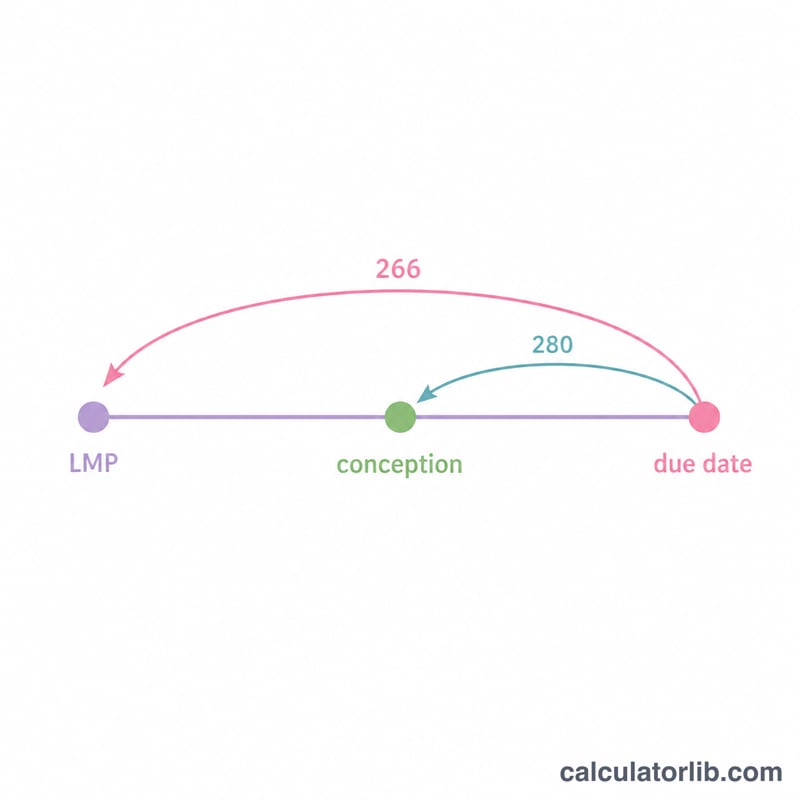
How to Use It
Select the year, month, and day of the estimated due date and the calculator instantly subtracts the appropriate number of days to give you both the conception date and the LMP. No personal data is stored.
Worked Example
Suppose the due date is October 3, 2025. Subtracting 266 days gives an estimated conception date of January 10, 2025. Subtracting 280 days gives an LMP of December 27, 2024. These dates help you map out the early weeks of pregnancy.
FAQ
Is the conception date exact? No. It is an estimate based on average cycle timing. Actual conception can vary by several days depending on ovulation and cycle length.
Why is the LMP 14 days before conception? Pregnancy is counted from the LMP for consistency, but ovulation and fertilization usually happen about two weeks later, in a typical 28-day cycle.
Should I rely on this for medical decisions? This tool is for general information and education. Always confirm dating with your healthcare provider, ideally via an early ultrasound.