
What is the Pregnancy Countdown Calculator?
The Pregnancy Countdown Calculator tells you exactly how much time is left until your estimated due date (EDD). Simply enter the due date your doctor or midwife gave you and today's date, and the tool shows the number of days remaining, the equivalent in weeks, and a friendly "weeks and days" breakdown so you always know where you stand on your journey.
How to use it
Enter your estimated due date using the year, month and day fields. Then enter today's date (it defaults to the current date). Press calculate and you'll instantly see your countdown. If the due date has already passed, the days remaining will show as a negative number, which can be handy when you're overdue and waiting.
The formula explained
The math is simple date subtraction. We compute the difference in milliseconds between the two dates and divide by the number of milliseconds in a day (86,400,000) to get whole days:
$$\text{days remaining} = \frac{\text{due date} - \text{today}}{86400000\ \text{ms/day}}$$
To express the countdown in weeks we divide by 7:
$$\text{weeks remaining} = \frac{\text{days remaining}}{7}$$

Worked example
Suppose your due date is December 25, 2025 and today is December 1, 2025. The difference is 24 days. Dividing by 7 gives roughly 3.43 weeks, or 3 weeks and 3 days remaining until baby is due.
$$\frac{24}{7} \approx 3.43\ \text{weeks}$$
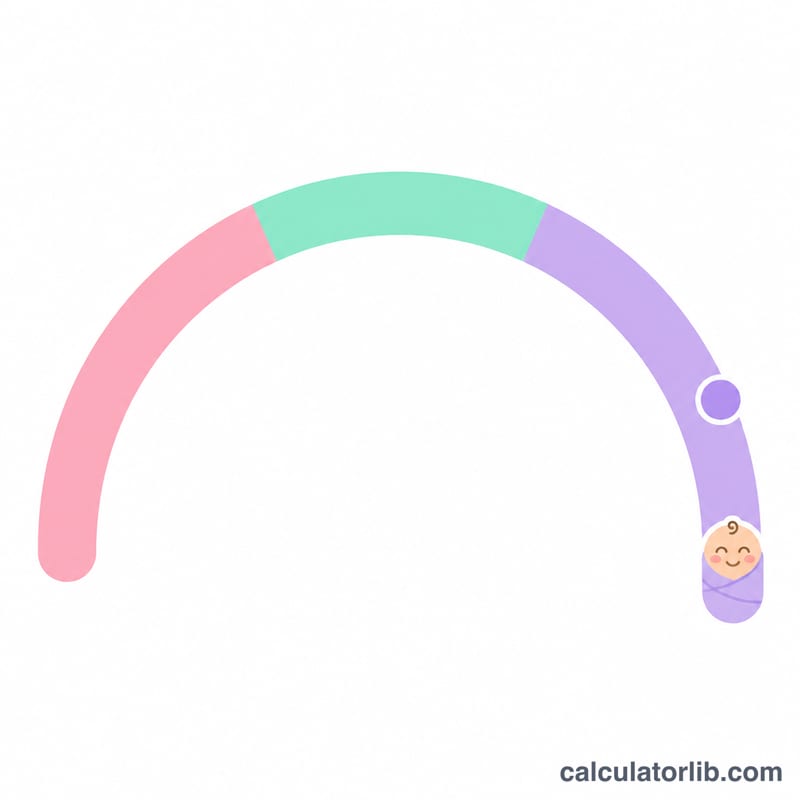
Pregnancy Milestones by Week and Trimester
Pregnancy is dated from the first day of the last menstrual period (or an equivalent ultrasound-adjusted date) and is counted as 280 days, or 40 weeks. For a completed gestational week \(W\), the days remaining until a 40-week due date are \(280 - 7W\). Trimester boundaries vary slightly by source; the table uses ACOG-style conventions (first trimester through 13w6d, second 14w0d–27w6d, third from 28w0d).
| Gestational age | Trimester | Days remaining to 40w0d |
|---|---|---|
| 12w0d | First | 196 |
| 13w0d | First (last full week) | 189 |
| 14w0d | Second begins | 182 |
| 20w0d | Second (about midpoint) | 140 |
| 28w0d | Third begins | 84 |
| 37w0d | Third (early term begins) | 21 |
| 39w0d | Third (full term begins) | 7 |
| 40w0d | Third (estimated due date) | 0 |
Example: at 20 weeks, \(280 - 7 \times 20 = 140\) days remain.
Term Classifications (ACOG Definitions)
| Classification | Gestational age range |
|---|---|
| Early term | 37w0d – 38w6d |
| Full term | 39w0d – 40w6d |
| Late term | 41w0d – 41w6d |
| Post-term | 42w0d and beyond |
These definitions come from the American College of Obstetricians and Gynecologists (ACOG, United States); other countries' guidelines may use slightly different terms or cut-offs.
Interpreting Your Countdown Result
The calculator subtracts today's date from your due date and divides the difference in milliseconds by 86,400,000 (milliseconds per day). The result is the number of calendar days until the due date. Because a full pregnancy is 280 days, you can compare it to that total: for example, 140 days remaining means you are roughly halfway (about 20 weeks), and 280 minus your days remaining gives your approximate gestational age in days.
Worked example: with a due date of October 15, 2025 and today being September 24, 2025, there are 6 days left in September plus 15 days in October, so \(6 + 15 = \)21 days, which is exactly 3 weeks.
Under 21 days remaining
A result of 21 days or fewer means you are at about 37 weeks or later. Under ACOG definitions, 37w0d–38w6d is early term and 39w0d–40w6d is full term, so this window covers the transition into the term range. It is a general marker only; it does not predict when labor will begin.
A negative result (past the due date)
A negative number means the due date has passed. Each day past 40w0d is counted from the estimated due date: ACOG classifies 41w0d–41w6d as late term and 42w0d and beyond as post-term. Only about 4% of babies are born on their estimated due date, so many births occur before or after it, and passing the date is common.
Keep in mind
- The countdown is an estimate. The due date itself depends on the dating method (last menstrual period or ultrasound) and can be revised.
- Your healthcare provider's guidance determines monitoring, timing and care decisions, not this calculator.
- This is general information, not medical advice. Contact your provider with any concerns about your pregnancy.
FAQ
Is the due date exact? No. A due date is an estimate — only about 4% of babies arrive on the exact day. Most are born within two weeks before or after.
How is the due date calculated? Doctors usually estimate it as 280 days (40 weeks) from the first day of your last menstrual period, or via an early ultrasound.
What if the result is negative? A negative number means the due date has already passed, so you are overdue by that many days.