
What is the Square Area Calculator?
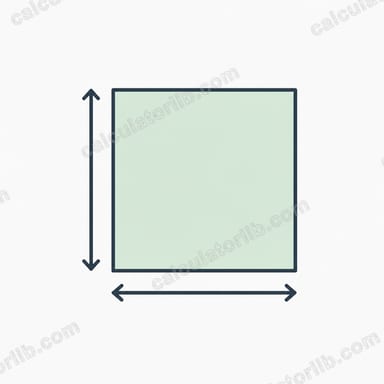
This calculator finds the area of a square using the simple formula \(A = s^{2}\), where s is the length of one side. Because all four sides of a square are equal, you only need a single measurement. Along with the area, the tool also returns the perimeter and the diagonal for convenience.
How to use it
Enter the side length of your square in any unit (cm, m, inches, feet — the result is in those same units squared). Click calculate and you instantly get the area in square units, the perimeter (the distance around the square), and the diagonal (the straight line corner to corner).
The formula explained
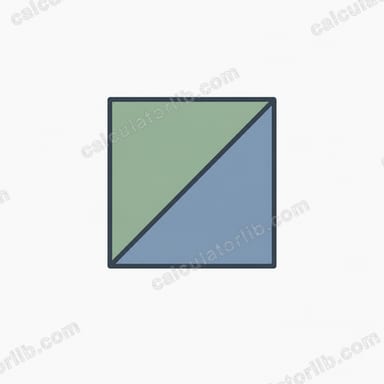
A square is a special rectangle whose length and width are identical. The area of any rectangle is length × width, so for a square it becomes \(s \times s = s^{2}\). The perimeter adds up all four equal sides:
$$P = 4s$$The diagonal forms a right triangle with two sides, so by the Pythagorean theorem
$$d = \sqrt{s^{2} + s^{2}} = s\sqrt{2}$$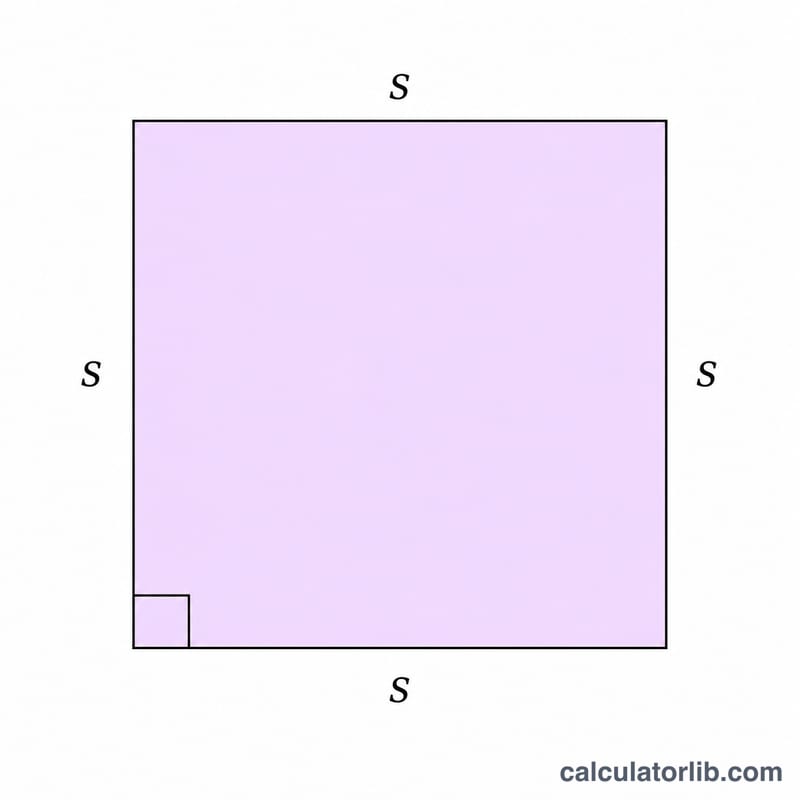
Worked example
Suppose a square tile has a side of 5 cm. The area is
$$A = 5^{2} = 25 \text{ cm}^{2}$$The perimeter is
$$P = 4 \times 5 = 20 \text{ cm}$$and the diagonal is
$$d = 5\sqrt{2} \approx 7.07 \text{ cm}$$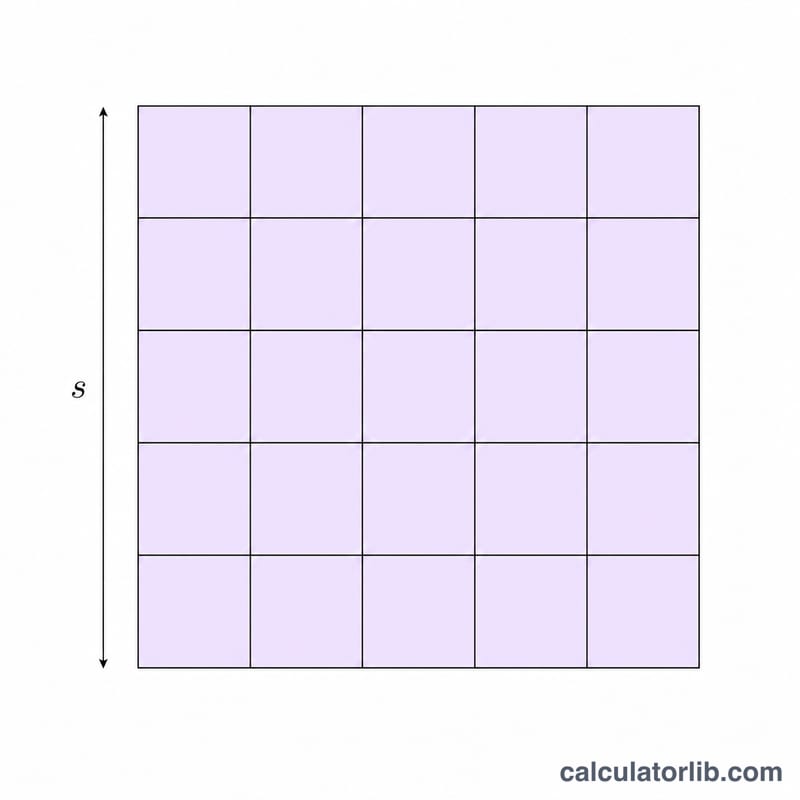
FAQ
What units does the result use? Whatever unit you enter the side in — the area comes out as that unit squared (e.g. metres → square metres).
Can I find the side from the area? Yes — take the square root of the area: \(s = \sqrt{A}\). For an area of 25, the side is \(\sqrt{25} = 5\).
Is a square's area the same as a rectangle's? Yes, a square is a rectangle with equal sides, so the area formula length × width simplifies to \(s^{2}\).