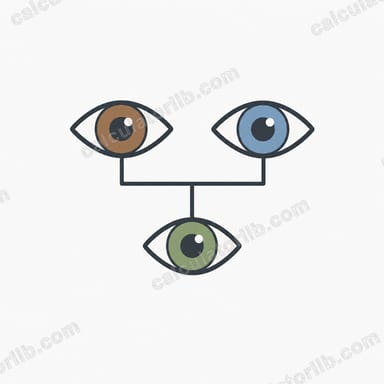

What this calculator does
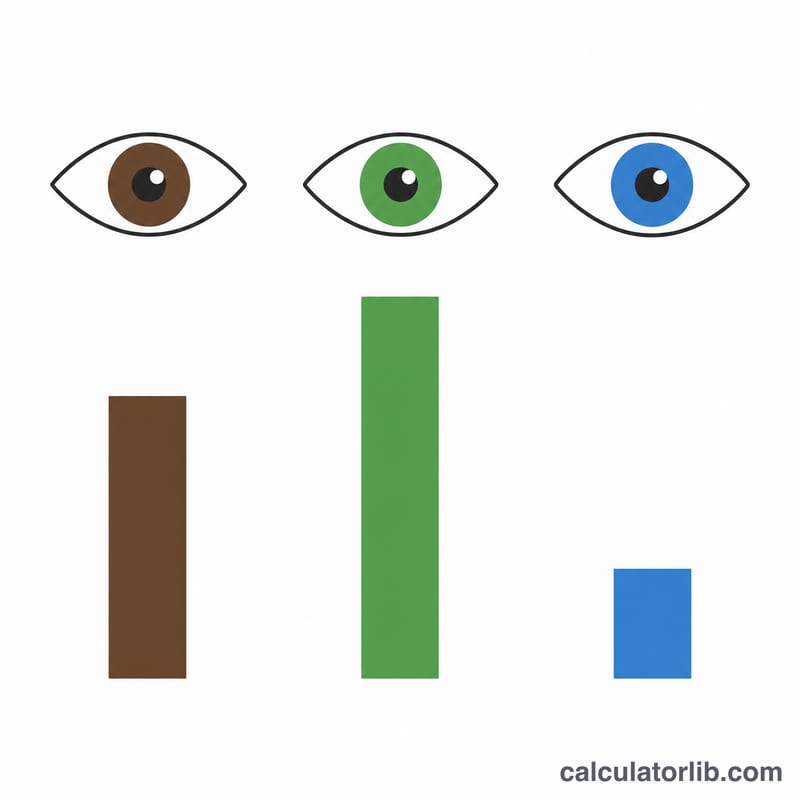
The Baby Eye Color Predictor estimates the probability that your child will have brown, green/hazel, or blue eyes based on the eye colors of both parents. It uses a simplified Mendelian genetics model in which brown is dominant, green is intermediate, and blue is recessive. Real eye color is influenced by many genes (notably OCA2 and HERC2), so treat these numbers as a fun, educational estimate rather than a medical or genetic guarantee.
How to use it
Select the mother's eye color and the father's eye color from the drop-downs, then read the probability for each outcome. The result highlights the brown-eye chance and lists green and blue probabilities in the table below.
The model explained
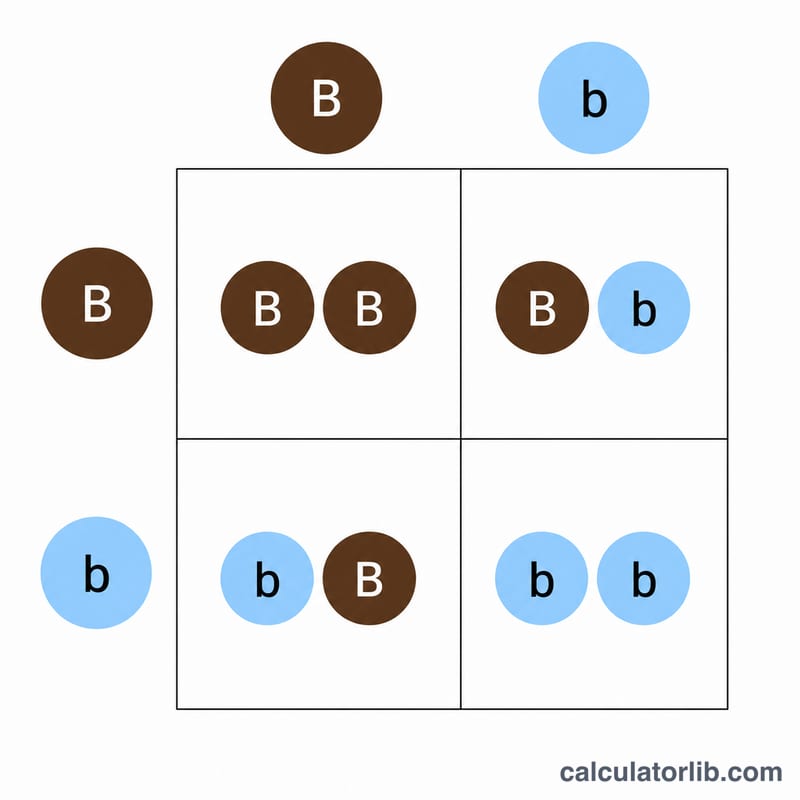
Each parent passes one allele. We approximate the chance a parent passes a brown (B), green (G), or blue (b) allele from their visible eye color. Brown-eyed parents are assumed to be carriers (one B plus a hidden G or b), green-eyed parents carry G plus G or b, and blue-eyed parents are bb. A child shows brown if it receives at least one B allele, green if it has no B but at least one G, and blue only when it inherits bb with no green.
Worked example
If both parents are blue-eyed, each can only pass a blue (b) allele. The child is bb, so brown = 0%, green = 0%, and blue = 100%. If both parents are brown-eyed, each passes B with 50% probability, giving
$$P(\text{brown}) = 1 - 0.5 \times 0.5 = 75\%$$Key Terms Explained
- Allele
- One of the alternative versions of a gene found at the same position on a chromosome. A child inherits one allele from each parent for a given trait.
- Dominant
- An allele whose effect appears in the individual even when only one copy is present. Brown (B) is treated as dominant in this simplified model.
- Recessive
- An allele whose effect only appears when two copies are present. Blue (b) behaves recessively, so blue eyes typically require a blue-contributing allele from both parents.
- Carrier
- An individual who has one copy of a recessive allele but does not show its trait — for example, a brown-eyed parent who carries a hidden blue allele and can still pass it to a child.
- Punnett square
- A grid used to combine the possible alleles from each parent and read off the proportions of offspring genotypes and phenotypes.
- Mendelian inheritance
- The classical pattern in which traits are passed on through discrete dominant and recessive alleles, following the rules described by Gregor Mendel. This calculator uses a Mendelian approximation.
- Polygenic
- A trait controlled by many genes acting together rather than a single gene. Real human eye color is polygenic, which is why simple models give only approximate probabilities.
- B / G / b notation
- Shorthand for the allele contributions used here: B = brown contribution, G = green contribution, b = blue contribution. Each parent's eye color sets the relative chance \([p_B, p_G, p_b]\) of passing each type.
FAQ
Can two blue-eyed parents have a brown-eyed child? In this simple model, no. In reality it is rare but possible because multiple genes are involved.
Is this scientifically exact? No. It is a teaching approximation; actual inheritance is polygenic.
Why do brown-eyed parents still have blue-eyed children? Because a brown-eyed parent can carry a hidden recessive blue allele and pass it on.