
What the Due Date Calculator does
This Due Date Calculator estimates when your baby is likely to arrive based on the first day of your last menstrual period (LMP) and the length of your menstrual cycle. It uses the internationally recognised Naegele's rule, adjusted for cycles that are longer or shorter than the standard 28 days, so the result is tailored to you rather than a one-size-fits-all figure.
The inputs you provide
- Last Period (Last Menstrual Period): the first day of your most recent period. This is the anchor date for the whole calculation.
- Average Cycle Length (Cycles): the typical number of days from the start of one period to the start of the next. The default is 28 days; enter 30 if your cycles run long, 26 if they run short.
The formula explained
The calculator works out your estimated due date like this:
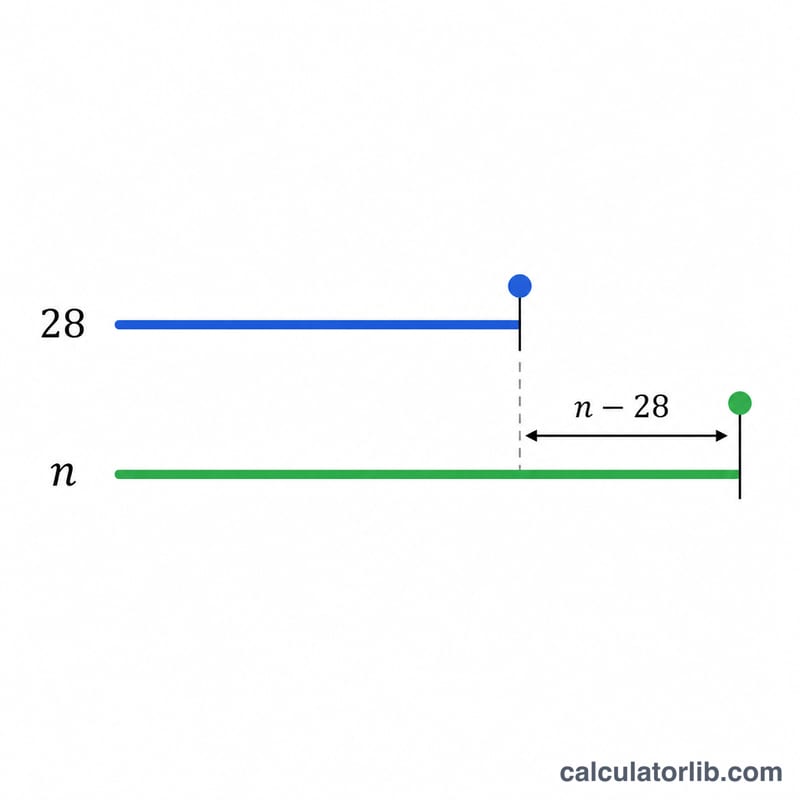
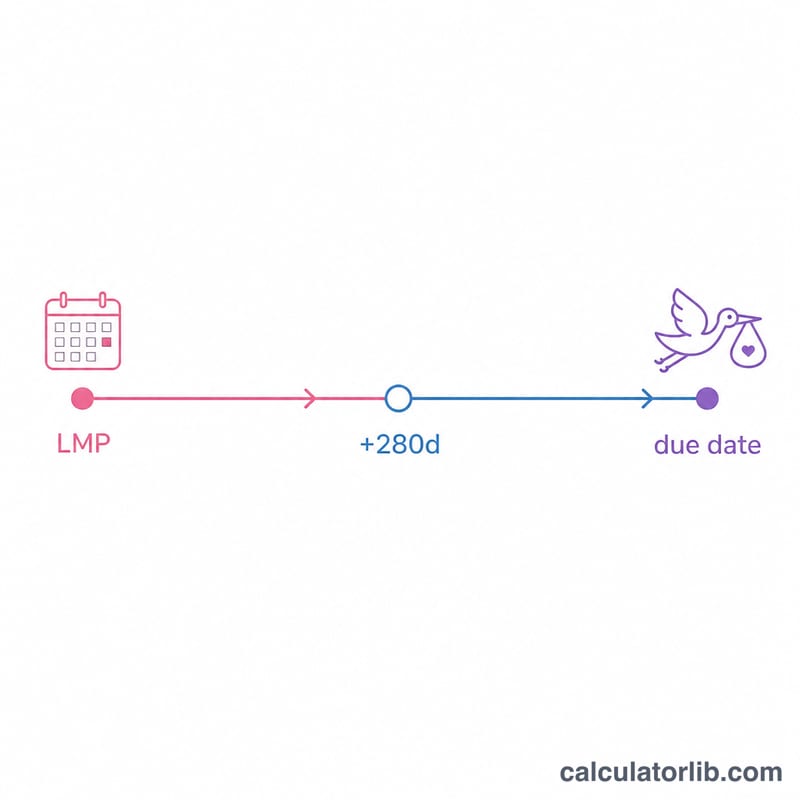
$$\text{Due Date} = \text{Last Menstrual Period} + 280\ \text{days} + \left(\text{Cycle Length} - 28\right)\ \text{days}$$
The 280 days represents the standard 40 weeks of pregnancy measured from your last period. The (Cycle Length − 28) term shifts the date to account for when you likely ovulated: a longer cycle means later ovulation and a later due date, while a shorter cycle moves it earlier. The tool also maps out a 42-week, week-by-week pregnancy calendar so you can see which week you are currently in.
Worked example
Suppose your last period began on 1 January and your average cycle is 30 days. The calculator adds 280 days to 1 January, reaching about 8 October. It then adds \((30 - 28) = 2\) extra days, giving an estimated due date of 10 October. If your cycle were the standard 28 days, your due date would simply be 8 October.
Frequently asked questions
How accurate is the estimated due date? Only about 1 in 20 babies arrive on their exact due date. The result is a best estimate; most births happen within two weeks either side.
Why adjust for cycle length? The standard formula assumes ovulation on day 14 of a 28-day cycle. Adjusting keeps the estimate realistic for people who ovulate earlier or later.
Should I rely on this instead of a scan? No. This is a planning tool. An early ultrasound dating scan is more precise, so always confirm your due date with your midwife or doctor.