
What the Work Hours Calculator Does
This calculator estimates how many hours you actually spend working in a single year, then shows what slice of your total available time that represents. Instead of guessing, you enter four simple values about your schedule and get an instant breakdown of working days, working hours, and the share of the year spent on the job versus everything else.
The Inputs You Provide
- Hours Worked Per Day – your typical daily working hours (e.g. 8).
- Days Worked Per Week – how many days a week you work (e.g. 5).
- Vacation Days Per Year – paid or unpaid days you take off for holidays/leave.
- Holidays Per Year – public or company holidays you don't work.
The Formula Explained
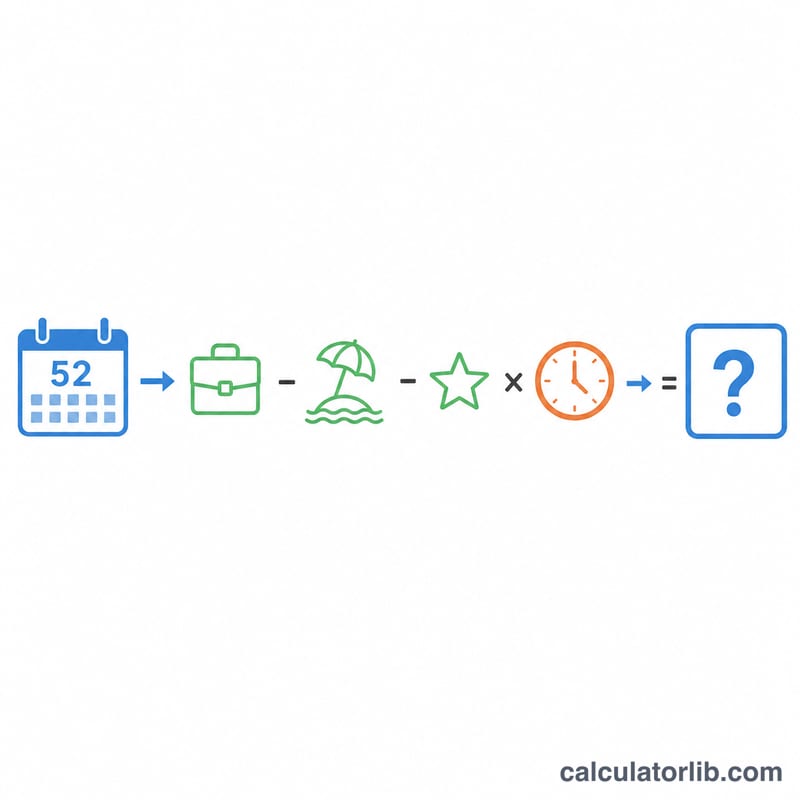
The calculator assumes a 52-week year and works through these steps:
$$\text{Work Hours} = \left(52 \times \text{Days/Week} - \text{Vacation Days} - \text{Holidays}\right) \times \text{Hours/Day}$$- Work days in year = \(52 \text{ weeks} \times \text{days worked per week}\)
- Total days off = \(\text{vacation days} + \text{holidays}\)
- Actual work days = \(\text{work days in year} - \text{total days off}\)
- Total work hours = \(\text{actual work days} \times \text{hours per day}\)
- Work hours percentage = \((\text{total work hours} \div 8{,}760) \times 100\), where 8,760 is the total hours in a 365-day year (\(365 \times 24\))
The off-hours figure is simply 8,760 minus your total work hours, and the percentages are turned into a conic-gradient chart so you can see the work-versus-rest split at a glance.
Worked Example
Suppose you work 8 hours per day, 5 days per week, with 15 vacation days and 10 holidays:
- Work days in year = \(52 \times 5 = 260\)
- Total days off = \(15 + 10 = 25\)
- Actual work days = \(260 - 25 = 235\)
- Total work hours = \(235 \times 8 =\) 1,880 hours
- Work hours percentage = \((1{,}880 \div 8{,}760) \times 100 \approx\) 21.5%
So roughly 21.5% of the calendar year is spent working, leaving about 6,880 hours (78.5%) for sleep, leisure and everything else.
Frequently Asked Questions
Does this count overtime or unpaid breaks? No. It uses the hours-per-day figure you enter, so to include overtime simply raise that number, and to exclude unpaid lunch breaks lower it accordingly.
Why does it use 52 weeks but 365 days? Work days are based on 52 weeks for a clean weekly schedule, while the percentage compares your hours against the full 8,760 hours in a 365-day calendar year.
Is this country-specific? No. It works for any country—just enter the vacation and holiday days that match your own region and employment terms.