What Is the Pregnancy Due Date Calculator?
This calculator estimates when your baby is likely to arrive and how far along you are today. It is based on the first day of your last menstrual period (LMP) and Naegele's rule, the standard method clinicians use to set an estimated due date (EDD). While every pregnancy is unique and only about 4 percent of babies are born on their exact due date, the EDD is a useful reference point for scheduling scans, tests, and appointments.
How to Use It
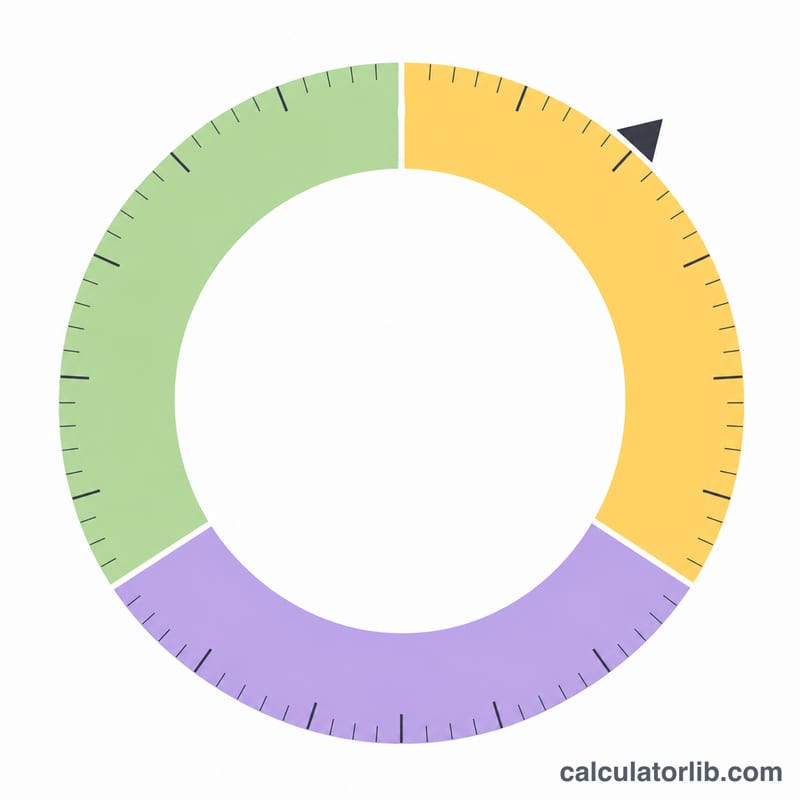
Enter the first day of your last menstrual period. Optionally enter an as-of date to check your gestational age on a specific day; if you leave it blank, today is used. The tool returns your estimated due date plus your current gestational age in completed weeks and extra days.
The Formula Explained
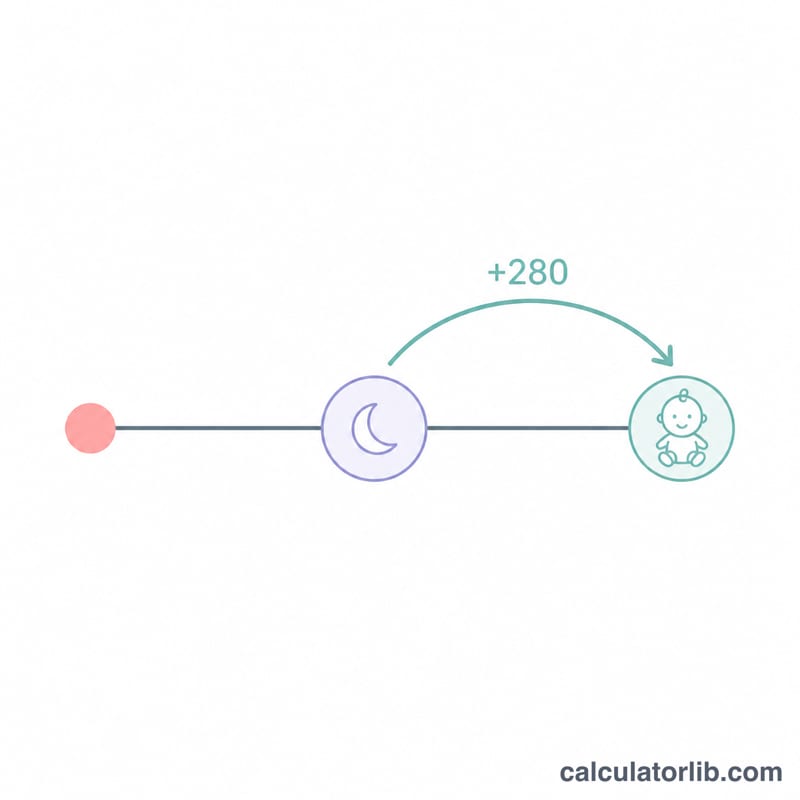
Naegele's rule adds 280 days (40 weeks) to the LMP. Gestational age is simply the elapsed time since the LMP, split into full weeks and remaining days where \(W\) = completed weeks and \(D\) = extra days.
$$\text{EDD} = \text{LMP} + 280\,\text{days}$$
$$W = \left\lfloor \frac{\text{days since LMP}}{7} \right\rfloor, \quad D = (\text{days since LMP}) \bmod 7$$
Worked Example
Suppose your LMP was 1 January 2024. Adding 280 days lands on 7 October 2024:
$$\text{EDD} = \text{2024-01-01} + 280\,\text{days} = \text{2024-10-07}$$
If today is 1 April 2024, that is 91 days after the LMP, so your gestational age is:
$$\text{GA} = 91\,\text{days} = 13\text{w}\ 0\text{d}$$
Trimester & Gestational Age Reference
Gestational age is expressed in completed weeks plus days (for example, 24w3d = 24 completed weeks and 3 days), counted from the first day of the last menstrual period (LMP). The trimester boundaries below follow standard clinical convention, and the term-definition rows follow the definitions published by the American College of Obstetricians and Gynecologists (ACOG, United States), which are also widely used internationally. A full-term pregnancy is conventionally counted as about 40 weeks (280 days) from the LMP.
| Period | Gestational age range | Notes |
|---|---|---|
| First trimester | Weeks 0–13 (through 13w6d) | From the first day of the LMP |
| Second trimester | Weeks 14–27 (through 27w6d) | Begins at 14w0d |
| Third trimester | Weeks 28–40+ (from 28w0d) | Continues through delivery |
| Term category (ACOG) | Gestational age |
|---|---|
| Preterm | Before 37w0d (<37 weeks) |
| Early term | 37w0d – 38w6d |
| Full term | 39w0d – 40w6d |
| Late term | 41w0d – 41w6d |
| Post-term | 42w0d and later (≥42 weeks) |
Interpreting Your Result
The estimated due date (EDD) is calculated with Naegele's rule, which adds 280 days to the first day of your last menstrual period:
$$\text{EDD} = \text{LMP} + 280\ \text{days}$$
Treat the EDD as a single reference point, not a deadline. Only about 4% of births occur exactly on the estimated date; most spontaneous deliveries happen within roughly two weeks before or after it. This is why the EDD is best understood as the center of a normal range rather than an exact prediction.
Gestational age is counted from the LMP, not from conception. Because ovulation and conception typically occur about two weeks after the first day of the LMP, gestational age is roughly two weeks greater than the actual time since conception (fetal or conceptional age). Reported values such as \(24\text{w}3\text{d}\) mean 24 completed weeks plus 3 days of gestation.
To place your current gestational age in context, compare it with the reference table above: the weeks value determines your trimester (weeks 0–13 first, 14–27 second, 28 onward third), and, near the end of pregnancy, the same weeks-plus-days value determines the term category (for example, 37w0d–38w6d is early term and 39w0d–40w6d is full term under the ACOG definitions).
Because the LMP date can be uncertain and cycle length varies, an early ultrasound (typically in the first trimester) is often used to confirm or adjust the EDD; the ultrasound-based date may differ from the LMP-based estimate, and clinicians commonly use the ultrasound date when the difference exceeds accepted thresholds.
This tool provides general information for planning and education only. It is not medical advice, and it does not replace assessment by a qualified healthcare professional. For questions about your specific pregnancy, dating, or timing of care, consult your provider.
FAQ
Is the due date exact? No. It is an estimate; babies commonly arrive within two weeks before or after the EDD.
What if my cycle is not 28 days? Naegele's rule assumes a regular 28-day cycle. Longer or shorter cycles can shift the true due date, and an early ultrasound often gives a more accurate date.
Can I use a conception date instead? This tool uses the LMP. Since ovulation is roughly two weeks after the LMP, a conception-based estimate adds about 266 days instead of 280.