What is the Lux to Candela Calculator?
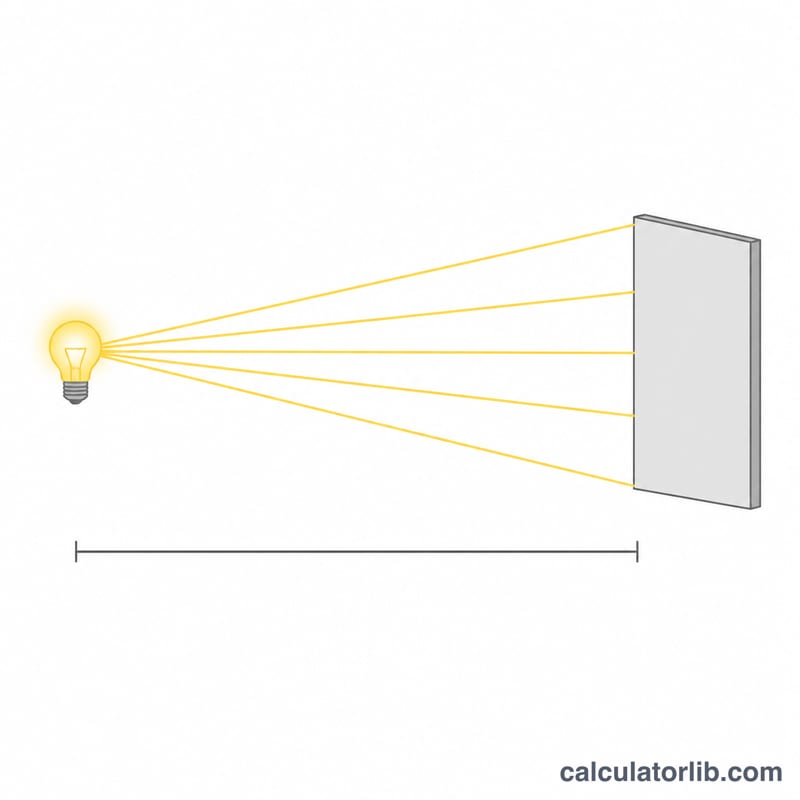
This calculator converts an illuminance reading in lux into luminous intensity expressed in candela (cd). Illuminance describes how much light lands on a surface, while luminous intensity describes how much light a source emits in a particular direction. Because illuminance falls off with distance, you need the distance from the source to relate the two quantities.
The formula explained
The conversion is based on the inverse-square law of light. The core relationship is:
$$I_{cd} = E_{v} \times d^{2}$$where \(I_{cd}\) = luminous intensity in candela, \(E_{v}\) = illuminance in lux, and \(d\) = distance from the light source in meters. Since one lux equals one lumen per square meter and one candela equals one lumen per steradian, multiplying illuminance by the squared distance recovers the source intensity.
How to use it
Enter the measured illuminance in lux (for example, from a light meter) and the distance in meters between the source and the point where you measured. The calculator returns the luminous intensity in candela. Use consistent units: distance must be in meters for the result to be correct.
Worked example
Suppose a lamp produces an illuminance of \(100\) lux measured at a distance of \(2\) meters. The luminous intensity is:
$$I_{cd} = 100 \times 2^{2} = 100 \times 4 = 400\,\text{cd}$$So the source has a luminous intensity of \(400\) candela in that direction.
Distance Unit Conversions
The formula \(I = E_v \times d^2\) requires the distance \(d\) in meters, because the lux is defined as one lumen per square meter and the candela is derived from that SI base. If you measured the distance in feet, inches, or another unit, convert it to meters first using the exact factors below (the SI definitions of the inch and foot are exact).
| Unit | Symbol | Equivalent in meters |
|---|---|---|
| Foot | ft | 0.3048 m |
| Inch | in | 0.0254 m |
| Yard | yd | 0.9144 m |
| Centimeter | cm | 0.01 m |
| Millimeter | mm | 0.001 m |
These conversions are worldwide SI definitions, not country-specific. Once the distance is in meters, square it and multiply by the illuminance.
Worked example. Suppose a light meter reads 500 lux at a distance of 5 ft from the source. First convert the distance: \(5 \text{ ft} \times 0.3048 = 1.524 \text{ m}\). Then apply the formula with the full substitution:
$$I = E_v \times d^2 = 500 \times (1.524)^2 = 500 \times 2.322576 = 1161.288 \text{ cd}$$
So the luminous intensity is about 1,161.288 candela.
Typical Illuminance (Lux) Levels
Illuminance measures how much light falls on a surface, expressed in lux (lumens per square meter). The values below are approximate, widely published ranges to help you sanity-check a light-meter reading before converting to candela. Real conditions vary with weather, time of day, and lamp type, so treat these as orders of magnitude rather than exact figures.
| Situation | Approximate illuminance |
|---|---|
| Full moonlight (clear night) | ~0.1–1 lux |
| Living room / general home lighting | ~50 lux |
| Office / classroom (general task lighting) | ~300–500 lux |
| Detailed or drawing work | ~750–1,000 lux |
| Overcast daylight | ~1,000–10,000 lux |
| Full daylight (not direct sun) | ~10,000–25,000 lux |
| Direct sunlight | ~32,000–100,000 lux |
Note: recommended workplace lighting levels (for example the office and task figures above) are set by regional standards such as EN 12464-1 in Europe or IES guidance in the United States, and the exact required value depends on the specific task and jurisdiction. Use the range as a general reference, not a legal requirement for your location.
FAQ
Does distance have to be in meters? Yes. The standard relationship between lux and candela uses meters, so convert feet or centimeters to meters first.
Why does intensity grow with the square of distance? Illuminance obeys the inverse-square law \(E_{v} = \tfrac{I_{cd}}{d^{2}}\); rearranging it multiplies illuminance by \(d^{2}\) to solve for intensity.
Is this exact for all lights? It is accurate for a point source measured along the direction of interest. Large or diffuse sources measured very close by may deviate.