What this calculator does
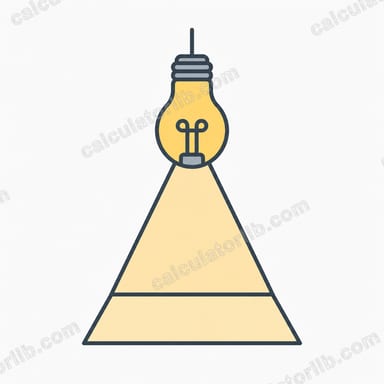
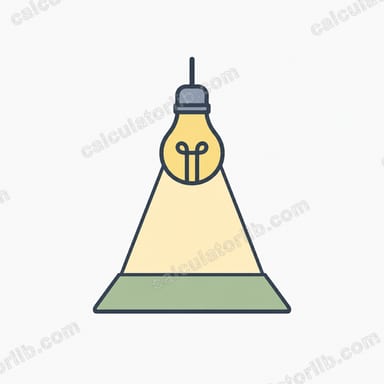
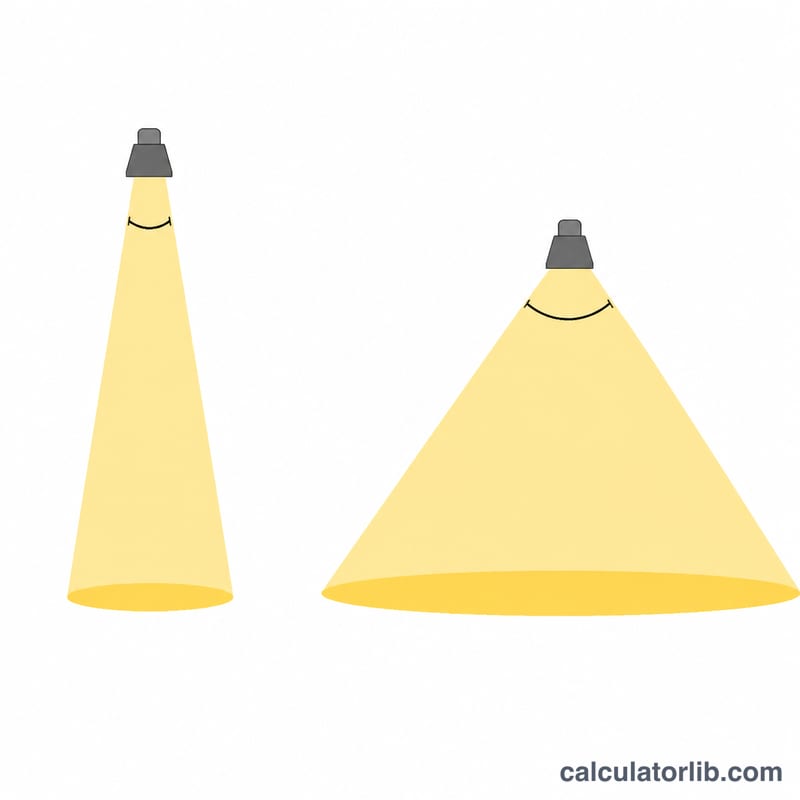
This tool converts luminous flux (measured in lumens, lm) into luminous intensity (measured in millicandela, mcd) for a light source that emits into a symmetric cone. Lumens describe the total light output in all directions of the beam, while candela and millicandela describe how concentrated that light is within the beam. The narrower the beam, the higher the intensity for the same flux.
The formula explained
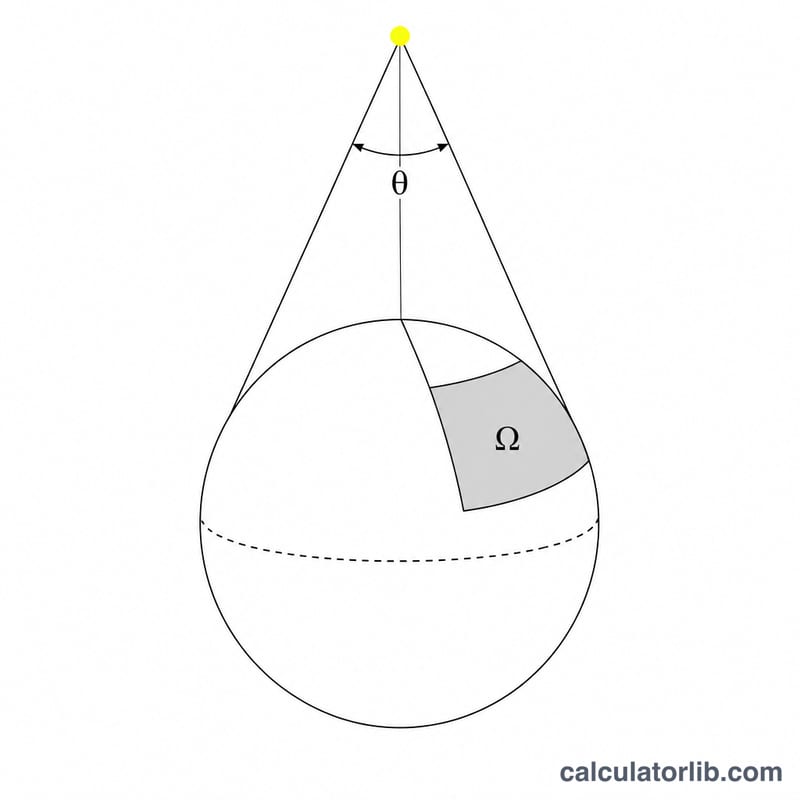
The conversion depends on the beam solid angle \(\Omega\), which is set by the apex beam angle \(\theta\):
$$I_{\text{mcd}} = \frac{1000\,\Phi_V}{2\pi\left(1-\cos\frac{\theta}{2}\right)}$$Here \(\Phi_V\) = luminous flux in lumens, \(\theta\) = full apex angle of the cone in degrees, and the factor \(1000\) converts candela to millicandela. The denominator \(\Omega = 2\pi\left(1-\cos\frac{\theta}{2}\right)\) is the solid angle in steradians.
How to use it
Enter the total luminous flux of the beam in lumens and the apex beam angle in degrees, then read the intensity in millicandela. Use the datasheet full-beam angle (for example the angle at which output falls to 50%).
Worked example
Take \(\Phi_V = 100\ \text{lm}\) and \(\theta = 30^{\circ}\). First the solid angle:
$$\Omega = 2\pi\left(1-\cos 15^{\circ}\right) = 2\pi(1-0.965926) \approx 0.214094\ \text{sr}$$$$I = \frac{1000 \times 100}{0.214094} \approx 467{,}084\ \text{mcd}$$So a 100 lm source in a 30 degree beam produces roughly 467,084 mcd.
Beam Angle to Solid Angle Reference
The conversion from luminous flux (lumens) to luminous intensity (millicandela) depends entirely on the solid angle \(\Omega\) of the beam, measured in steradians (sr). For a symmetric cone with apex (full) beam angle \(\theta\), the solid angle is:
$$\Omega = 2\pi\left(1 - \cos\frac{ {\theta}}{2}\right)$$
This is a purely geometric relationship from SI photometry and is not tied to any national standard. The table below lists common apex angles with the half-angle \(\theta/2\), its cosine, and the resulting solid angle so you can substitute directly into the formula. Values are rounded to six decimals.
| Apex angle \(\theta\) | Half-angle \(\theta/2\) | \(\cos(\theta/2)\) | Solid angle \(\Omega\) (sr) |
|---|---|---|---|
| 5° | 2.5° | 0.999048 | 0.005980 |
| 10° | 5° | 0.996195 | 0.023909 |
| 15° | 7.5° | 0.991445 | 0.053754 |
| 24° | 12° | 0.978148 | 0.137300 |
| 30° | 15° | 0.965926 | 0.214094 |
| 45° | 22.5° | 0.923880 | 0.478280 |
| 60° | 30° | 0.866025 | 0.841788 |
| 90° | 45° | 0.707107 | 1.840302 |
| 120° | 60° | 0.500000 | 3.141593 |
Once \(\Omega\) is known, the intensity in millicandela follows from \(I_V = \dfrac{1000\,\Phi_V}{\Omega}\). A narrower beam yields a smaller \(\Omega\), concentrating the same flux into a higher intensity.
FAQ
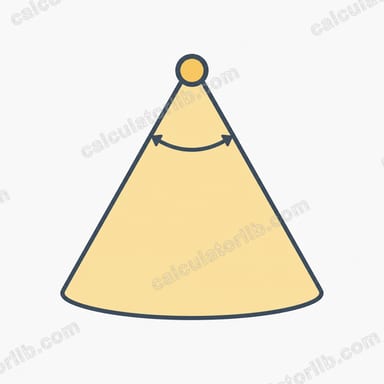
What is the apex beam angle? It is the full cone angle of the beam, tip to edge to edge, so the half angle is \(\theta/2\).
How do candela and millicandela relate? \(1\ \text{cd} = 1000\ \text{mcd}\).
Why does a narrower beam give more mcd? The same flux is packed into a smaller solid angle, raising intensity.